
Septic tank full after pumping? Learn whether liquid refill is normal, 7 real causes of rapid refilling, and exactly when to call a pro. Includes refill timeline table.
Quick Answer
A septic tank full after pumping is sometimes normal — liquid effluent refills to operating level within 1–2 weeks. But if solids are high, drains stay slow, or the tank fills within 24–48 hours with clear water, you likely have a drain field failure, groundwater infiltration, or a structural problem that pumping alone won't fix.
💡 Key Takeaways
- Liquid refill after pumping is normal. A 1,000-gallon tank returns to its operating effluent level within 1–2 weeks for a typical 4-person household.
- A tank that fills with clear water within 24–48 hours signals groundwater infiltration through tank cracks — a structural problem.
- Slow drains after pumping almost always point to drain field failure or a clogged outlet pipe, not the tank itself.
- Pumping the tank a second time rarely fixes the underlying problem. You need a diagnosis first.
- Drain field repair runs $2,000–$10,000. Full replacement can hit $20,000+. Early diagnosis saves money.
You just paid $300–$600 to have your tank pumped. The pumper left, you ran the dishwasher, and now your drains are sluggish again. Or maybe your neighbor told you the tank looked full when he peeked at it a week later. Either way, you're wondering what exactly you got for your money.
Here's the honest answer: sometimes nothing is wrong. Liquid refill is expected. But sometimes that "full" tank is telling you something expensive is starting to fail. Knowing the difference matters a lot — both for your wallet and for avoiding a sewage backup in your yard (or worse, your basement).
This guide walks you through exactly how to tell the difference.
Yes and no — and the distinction depends on what type of "full" you're looking at. A tank that has returned to its normal liquid operating level is completely expected. A tank packed with solids within weeks of pumping is not.
Not all full tanks are equal. A septic tank can be "full" in three very different ways:
1. Full of liquid effluent (normal). This is the standard operating condition. Your tank is designed to hold liquid waste at a level just at or slightly below the outlet pipe — typically 8–12 inches from the top of the tank. This is healthy.
2. Full of solids (sludge and scum). The sludge layer sits at the bottom; the scum layer floats at the top. When the sludge layer exceeds one-third of the tank's total depth, the tank needs pumping. If you just had it pumped and solids are already building fast, something is wrong — either the pump-out was incomplete or the system is under extreme stress.
3. Full of groundwater (problem). If your tank fills to the brim with relatively clear water within 24–48 hours of pumping, that's not household wastewater. That's groundwater seeping in through cracks in the tank walls or joints. This is a structural issue.
Right after a professional pump-out, your tank should have 50–100 gallons of residual liquid sitting in it. A bone-dry tank is actually unusual and slightly concerning — it can cause the concrete to dry out and crack. From that point, normal household water use refills it steadily.
The liquid level will rise to the outlet pipe's invert (the operating level) within one to two weeks for most households. At that point, effluent flows out to the drain field as it should, and the level stays roughly constant.
The EPA estimates average household water use at 70–100 gallons per person per day. For a family of four, that's 280–400 gallons of wastewater entering the system daily. Here's how that translates to refill timelines by tank size:
| Tank Size | Household Size | Daily Wastewater Input | Days to Reach Operating Level |
|---|---|---|---|
| 750 gallons | 1–2 people | 140–200 gal/day | 3–5 days |
| 1,000 gallons | 3–4 people | 210–400 gal/day | 5–10 days |
| 1,250 gallons | 4–5 people | 280–500 gal/day | 7–12 days |
| 1,500 gallons | 5–6 people | 350–600 gal/day | 8–14 days |
Sources: EPA Office of Water; typical tank sizing per state health department guidelines.
✅ Pro Tip: If your tank is back to its liquid operating level within this window and your drains are running fine, congratulations — your system is working exactly as designed.
If the timeline above doesn't explain your situation, one of these seven causes likely does.
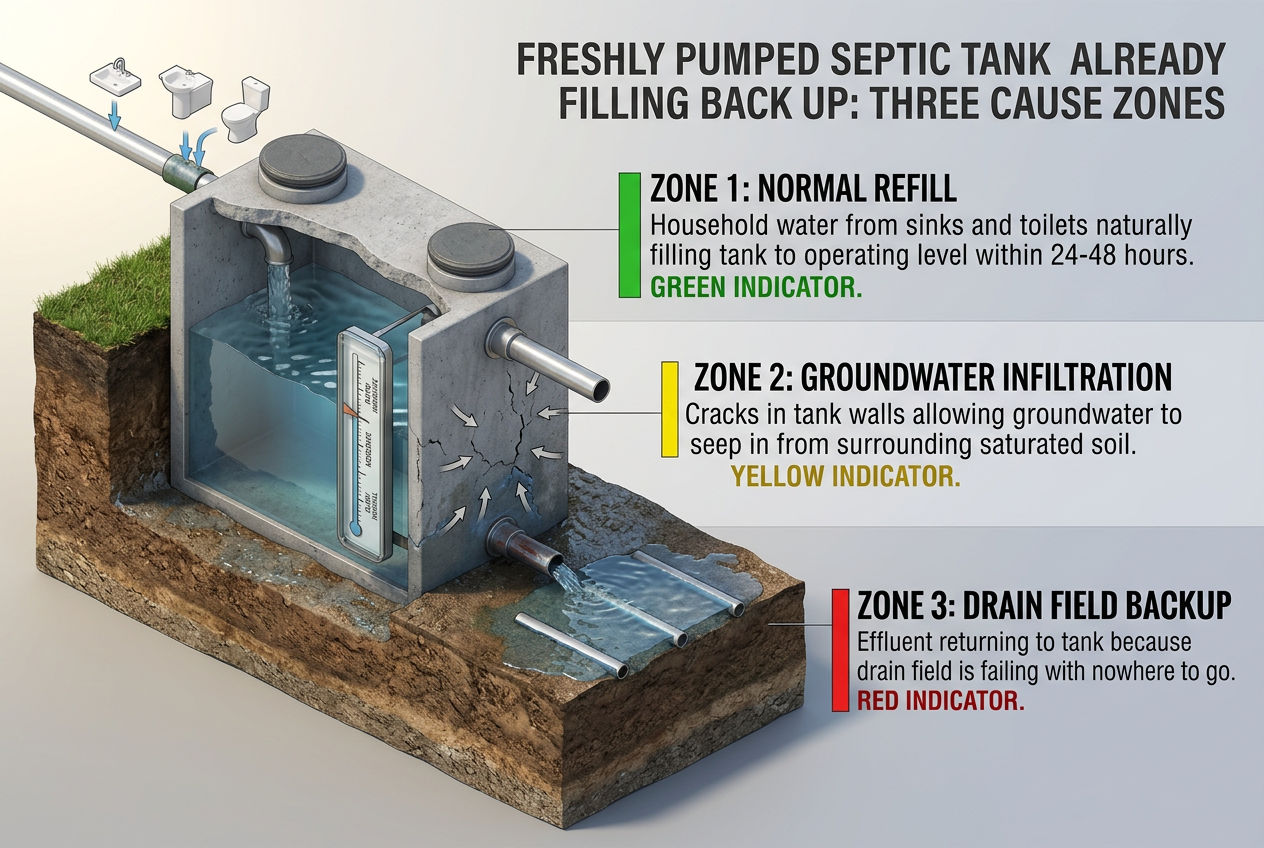
Worth saying again plainly: a tank that has returned to its liquid operating level is not "full" in the problematic sense. If you checked the tank within a week of pumping and saw liquid near the top, that may simply be your system doing its job. Before assuming the worst, confirm how much time has passed and whether any symptoms — slow drains, odors, wet spots — are actually present.
This is the most common real cause of a septic system that seems perpetually full after pumping. When the drain field fails, effluent has nowhere to go. It backs up into the tank, which then reads as "full" even though you just had it pumped.
Signs your drain field is struggling:
Drain field failure happens when the soil can no longer absorb effluent. The main culprits are biomat buildup (a black, slimy layer of organic matter that clogs soil pores), hydraulic overloading, and soil compaction. In clay-heavy Midwest soils — Ohio, Indiana, Michigan — percolation rates can drop to 0.1 inches per minute or slower, and biomat accelerates the problem significantly.
⚠️ Warning: Repairing a drain field runs $2,000–$10,000 depending on the scope. Full replacement lands between $5,000 and $20,000+. A septic inspection costing $100–$300 can tell you which scenario you're facing before you commit to anything.
If your tank fills with relatively clear water within 24–48 hours of pumping, groundwater is getting in. This happens through cracked concrete tank walls, deteriorated joint seals, or damaged inlet/outlet risers.
This is especially common in the Northeast — Massachusetts, Pennsylvania, New York — where freeze-thaw cycles crack older concrete tanks. It also spikes every spring in the upper Midwest when snowmelt raises the water table. A 1,000-gallon tank with a 2-inch crack in a saturated soil environment can refill with groundwater in under a day.
📊 Quick Fact: The fix here isn't pumping. It's sealing or replacing the tank. For more on how heavy rain and high water tables affect septic systems, that's worth reading before your next spring pump-out.
Your tank has inlet and outlet baffles — typically T-shaped fittings made of concrete, PVC, or fiberglass (like the Polylok PL-122 effluent baffle). The inlet baffle directs incoming wastewater downward, preventing it from disturbing the scum layer. The outlet baffle keeps solids from flowing into the drain field.
When the outlet baffle is broken or missing, solids escape into the drain field and clog the soil — which then causes the tank to back up and appear full.
✅ Pro Tip: A competent pumper should check baffle condition during every service call. If yours didn't, that's a red flag. Baffle replacement costs $150–$500 and is far cheaper than replacing a drain field. See our full breakdown of septic tank baffle repair if you suspect this is your issue.
Between your tank and the drain field sits a distribution box (D-box), which splits effluent evenly across the drain field's lateral lines. If the outlet pipe from the tank is clogged, or the D-box is collapsed or flooded, effluent backs up into the tank.
A D-box inspection is simple and inexpensive — a septic professional can locate it, dig it up, and assess it in an hour or two. If one lateral is clogged but others are fine, the D-box is often the culprit, not the entire drain field. That's important because fixing a D-box costs hundreds of dollars, not tens of thousands.
Picture this: you have your tank pumped in late June, then host a Fourth of July party with 30 guests. Six extra people showering, multiple toilet flushes per hour, and the dishwasher running constantly. That's potentially 2,000–3,000 extra gallons in 48 hours. Even a healthy system struggles with that kind of hydraulic overload.
The same thing happens when a homeowner unknowingly has a running toilet — a single flapper leak can waste 200 gallons per day. That's the equivalent of two extra people living in your house. Check for slow drains connected to water overuse before assuming your system has a structural problem.
Not every pump-out is thorough. A rushed technician might remove the liquid but leave substantial sludge at the bottom of the tank. If the sludge layer exceeds one-third of tank depth immediately after "pumping," the job wasn't done right.
Professional pumpers should use a sludge judge — a clear acrylic tube that lets them measure sludge depth before and after service. The National Association of Wastewater Technicians (NAWT) recommends pumping when sludge or scum layers occupy more than one-third of the tank's working capacity.
⚠️ Warning: If your pumper didn't inspect the tank after completing the job, or didn't mention sludge levels, ask for documentation or consider scheduling a re-inspection with a different company.
You don't need special equipment to narrow down the cause. Work through these checks in order.
Use this simple flow to identify what's actually happening before calling anyone.
If you have a septic tank riser installed, you can open the lid and observe the liquid level directly. Bring a flashlight and a long stick.
What to look for:
Find your drain field — if you're not sure where it is, check your property's as-built diagram or read our guide on how to find your drain field. Then walk it slowly.
Look for:
📊 Quick Fact: A wet spot in your yard near the septic system is one of the clearest signs of drain field failure. Don't ignore it.
Before concluding your system is broken, account for recent water use. Did you have guests? Run multiple loads of laundry in one day? Have a running toilet for weeks without noticing?
Check your water meter over a 2-hour period when no water is running. If the meter moves, you have a leak — and that leak is overloading your septic system.
Probably not — at least not yet. If drain field failure is the cause, pumping again just buys you a few days of relief before effluent backs up again. You're essentially emptying a bathtub with a clogged drain. The water comes back.
The exception: if your tank is completely backed up and sewage is surfacing in your yard or backing up into the house, emergency pumping can relieve the immediate pressure while you arrange a proper repair. For that situation, emergency septic service is worth the premium cost.
Call a licensed septic inspector — not just a pumping company — if:
A septic system inspection ($100–$300) gives you a documented assessment of your tank, baffles, D-box, and drain field. That report tells you exactly what service you need and in what order. Without it, you're guessing — and guessing wrong about drain field repairs gets expensive fast.
Compare top-rated companies in your area. Get free, no-obligation quotes from verified providers.
Was this article helpful?
Connect with licensed, verified septic companies in your area.
Get estimates from licensed, verified companies in your area. No obligation.
⚡ Average response time: under 2 hours