
Quick Answer
No, not every house has a septic tank. Roughly 1 in 5 U.S. homes — about 21 million properties — rely on private septic systems for wastewater disposal. The rest connect to a municipal sewer system. Whether your home has a septic tank depends on its location, lot size, and when it was built. Does every house have a septic tank? The short answer is no — but the longer answer depends on factors most buyers never think to check.
Key Takeaways
- About 21% of U.S. homes use a private septic system — roughly 21 million properties, per EPA estimates.
- The alternative is a municipal sewer connection, where wastewater travels to a public treatment plant.
- Rural homes, properties on large lots, and houses built before sewer infrastructure arrived are most likely to have septic.
- You can confirm your system type by checking your water bill, property records, or calling your county health department.
- Septic systems require regular maintenance — pumping every 3–5 years — and the homeowner, not the city, is responsible.
What Percentage of U.S. Homes Have Septic Systems?
About 21% of U.S. homes use a private on-site wastewater treatment system — commonly called a septic system. According to the EPA, that works out to roughly 21–25 million individual systems nationwide. Nearly 33% of all new residential construction in some recent years has relied on septic rather than public sewer, according to National Association of Home Builders data.

That figure shifts dramatically by region:
| State / Region | Approx. Septic Usage Rate | Key Driver |
|---|---|---|
| Maine | ~56% | Rural density, older development |
| Vermont | ~55% | Limited municipal infrastructure |
| New Hampshire | ~43% | Rural topography |
| North Carolina | ~38% | Suburban sprawl, rapid growth |
| New York City | <2% | Dense urban sewer grid |
| San Francisco, CA | <3% | Consolidated municipal system |
| Chicago, IL | <5% | Regional sewer authority |
Source: U.S. Census Bureau American Community Survey; EPA Decentralized Wastewater Program
New England dominates septic usage because the region developed before centralized sewer infrastructure existed. The Southeast — particularly North Carolina and South Carolina — sees high septic rates because suburban development has outpaced sewer expansion for decades. Dense urban cores like New York City and Chicago are almost entirely on municipal sewer.
Does Every House Have a Septic Tank, or Do Some Connect to Sewer?
Not every house has a septic tank — and the split between septic and sewer isn't random. Location is the primary driver. Municipal sewer systems are built where population density makes the infrastructure investment worthwhile. A city block with 50 homes per acre justifies a sewer main. A rural road with one home per 10 acres does not.
Here's a worked example. Take a 3-bedroom house built in 1968 on a 1.2-acre lot outside Raleigh, North Carolina. In 1968, no sewer line ran past that property. The builder installed a 1,000-gallon concrete septic tank and a 300-linear-foot drain field — standard practice for the era. By 1995, the city annexed the surrounding area and extended a sewer main to within 400 feet of the property line. The homeowner was notified but never required to connect under North Carolina General Statute § 130A-317, which allows counties to mandate connection under certain conditions but doesn't automatically force it. The house still runs on its original septic system today — inside city limits, fully legal, but entirely off the municipal sewer grid.
That scenario repeats across thousands of properties in fast-growing metros. So no, not every house has a septic tank — but don't assume a suburban address means sewer.
Do Houses in Cities Have Septic Tanks?
Most houses inside city limits connect to a municipal sewer system. But "mostly" isn't "always," and that gap is where a lot of homeowners get surprised.
Cities annex land over time. A neighborhood that sits within city limits today might have been rural farmland 40 years ago — and the houses built back then went in on septic because no sewer line existed. Some of those properties were never connected to the sewer grid even after one became available nearby. The home is technically "in town" but still running its wastewater through a 1,500-gallon concrete tank buried in the backyard.
This happens more frequently than buyers anticipate in fast-growing metros across the Southeast, parts of Texas, and the Mid-Atlantic. If you're buying a home in a suburban or semi-urban area, don't assume sewer just because you're not deep in the country.
If you want to understand what a full septic system looks like and how it operates, this overview of what a septic system is covers every component in plain language.
How Do I Know If My House Has a Septic Tank or Is on Sewer?
There are five reliable ways to find out:
1. Check your water bill. If you pay a sewer fee on your utility bill — separate from water — you're almost certainly on municipal sewer. No sewer line item on the bill? That's a strong indicator of septic.
2. Look up your property records. Your county health department keeps records of permitted septic systems. Call them directly or search their online portal. Most counties have digitized permits going back decades. The permit record will show tank size, installation date, and drain field location. When you call, ask specifically: "Do you have a septic system permit on file for this address, and can you tell me the tank capacity and drain field location?"
3. Pull the original building permit. When a home is built, the builder files for either a sewer tap permit or a septic system permit. Your county building department holds these records.
4. Check the yard — physically. A conventional septic system has a tank buried 4–10 feet underground and a drain field extending away from it. Look for a cleanout pipe near the house foundation, or a riser lid (often a green or black plastic dome) in the yard. If you see either, you've got septic.
5. Ask the previous owner or listing agent. In most states, sellers are required to disclose the type of wastewater system. If that disclosure is missing, ask directly. Sellers who didn't disclose septic problems can face legal liability in many states.
Honest limitation: These five steps will identify a septic system in the vast majority of cases, but older systems installed before permitting requirements existed may not appear in county records at all. If your home was built before 1960 and you find no permit on file, that doesn't mean there's no tank — it may mean the system predates the recordkeeping. In that case, a licensed inspector with a probe rod or ground-penetrating radar is the only reliable confirmation.
How to Tell If You Have a Septic Tank: Signs in the Yard and House
Knowing how to tell if you have a septic tank doesn't always require a county records search. Your own property leaves physical clues.
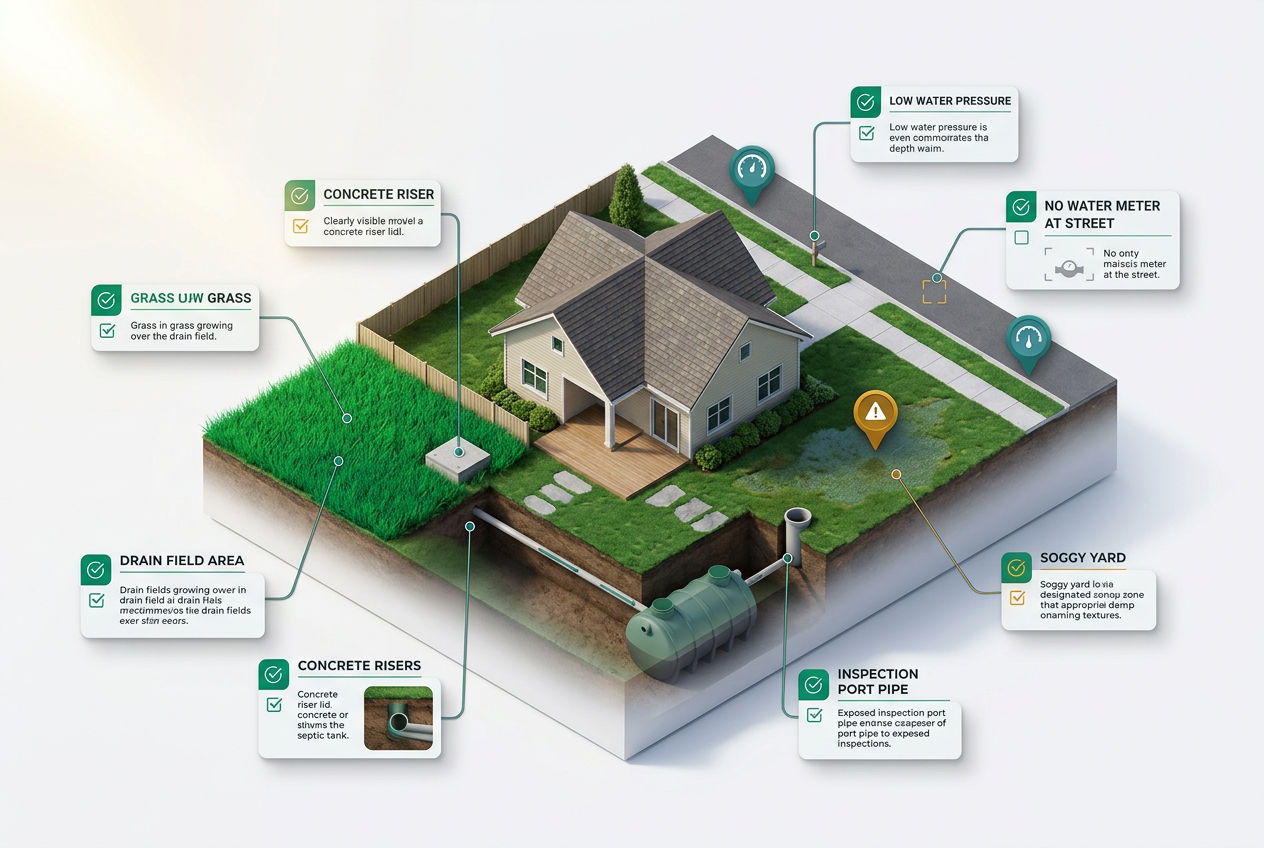
Above-ground indicators:
- A green plastic access riser or cast-iron lid anywhere in the yard, typically 6–24 inches in diameter
- An unusually lush, green patch of grass that stays green even in dry weather — effluent feeds the drain field, and the grass above it shows it
- A cleanout pipe (a white or black PVC pipe capped at grade) within 5–10 feet of the foundation
- Soft or spongy ground in a rectangular or linear area away from the house — this is often the drain field footprint
Inside the house:
- No sewer charges on your water bill
- Gurgling sounds from multiple drains simultaneously (can indicate a system under stress)
- Slow drains throughout the house, not just in one fixture
If you notice the lush-grass pattern and a riser lid in the same general area of your yard, you've almost certainly found your septic system. The next step is locating the tank access point and scheduling a professional inspection.
Septic System vs. Sewer: What's the Actual Difference?
Both systems remove wastewater from your home. The difference is where that wastewater goes and who's responsible when something breaks.
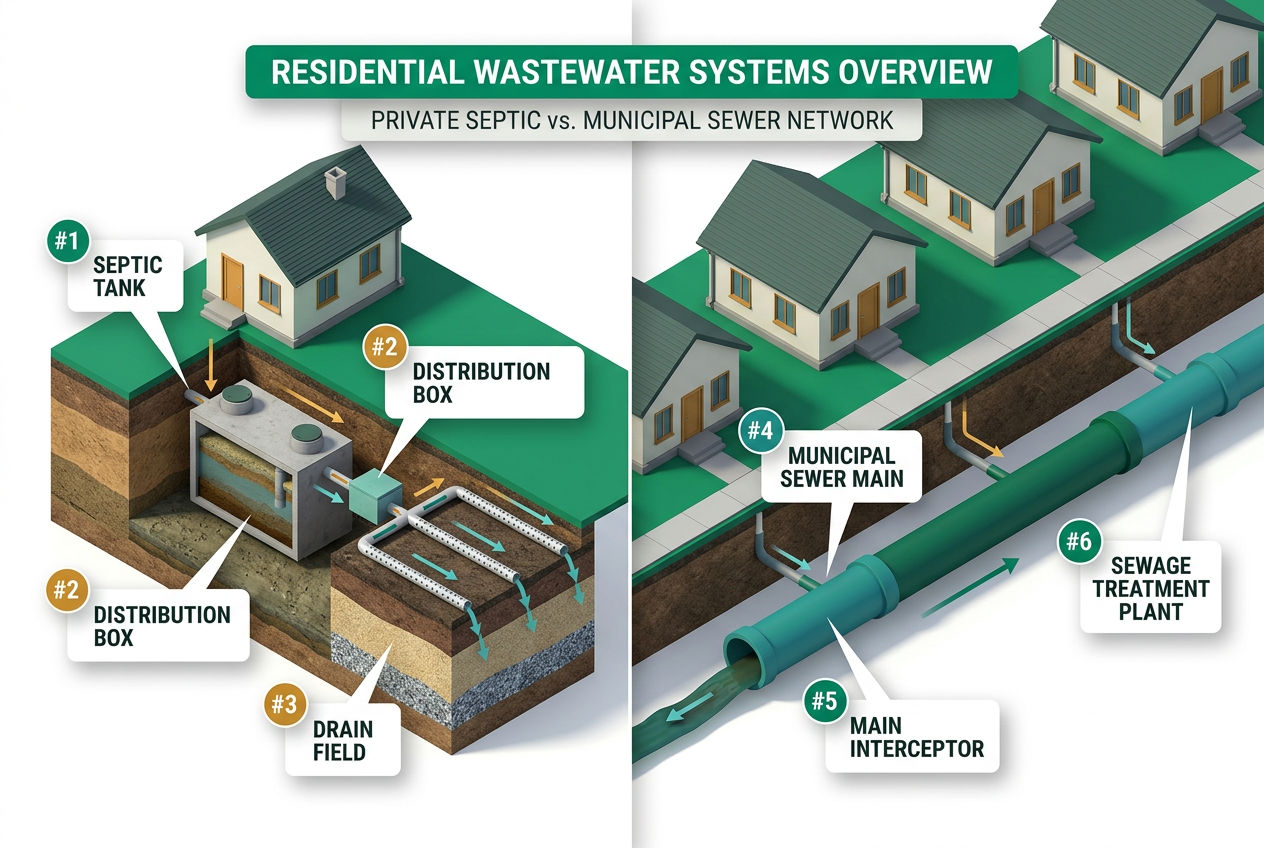
A municipal sewer system uses underground pipes to carry wastewater from your home to a centralized treatment plant operated by your city or utility district. You pay a monthly fee. The infrastructure is the city's responsibility. If a main line breaks, that's their problem, not yours.
A private septic system treats wastewater on your own property. Waste flows from your home into a buried tank — typically 750 to 1,500 gallons for a residential property — where solids settle and anaerobic bacteria break them down. The clarified liquid (called effluent) then flows out to a drain field, also called a leach field, where it percolates through soil and gets naturally filtered before rejoining groundwater.
The core difference from a homeowner's perspective: with septic, you're the utility company. The system is yours. Maintenance is yours. Repair costs are yours. A failed drain field on a municipal sewer connection is the city's expense. A failed drain field on a private septic system comes out of your pocket — and drain field replacement runs $5,000–$20,000 depending on system type and soil conditions.
Why Do Some Homes Have Septic and Others Don't?
It comes down to three factors: location, lot size, and timing.
Location. Municipal sewer lines have a finite reach. The farther a property sits from an existing main line, the more it costs the city (or the developer) to extend service. Rural areas simply never got sewer infrastructure built.
Lot size. A conventional septic system requires enough land to install a drain field. Most county health departments require a minimum of 0.5 to 1 acre, though that threshold varies. Soil type matters too — a sandy loam passes a percolation (perc) test easily, while dense clay or a high water table can make a conventional system impossible without engineering workarounds like a mound system or a sand filter.
Timing. Plenty of homes in suburban areas were built on septic in the 1960s and 1970s, before sewer lines arrived. Some were eventually connected. Many weren't — either because the connection fee was steep, or the owner never bothered. Converting from septic to sewer typically costs $3,000–$10,000 or more, depending on how far the tap is from the existing main and what local connection fees look like.
What Are the Different Types of Septic Systems?
Not every septic system is a basic concrete box. Depending on your soil, lot size, and local regulations, a home might have one of several system types:
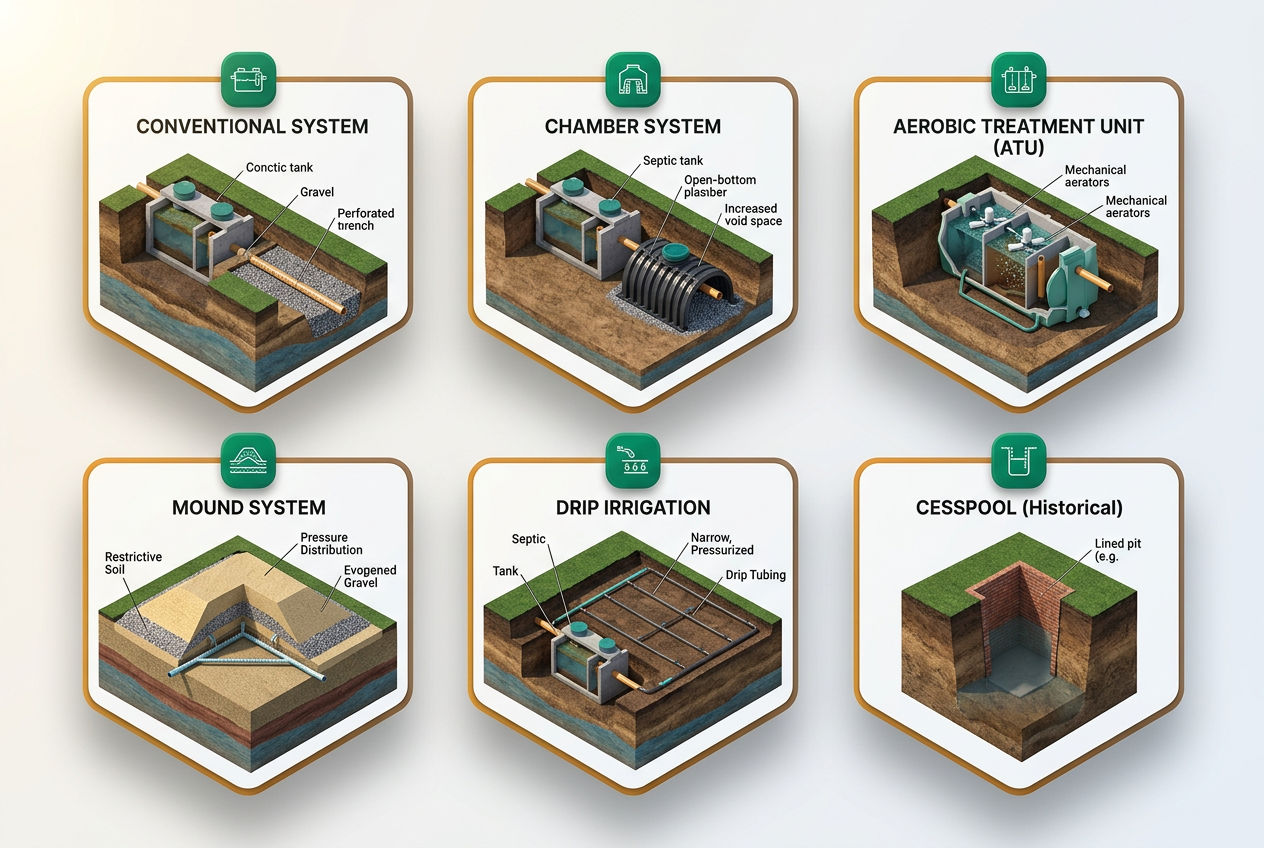
- Conventional gravity system: The most common design. A 1,000–1,500 gallon tank feeds effluent by gravity to a leach field.
- Pressure distribution system: Uses a pump and float switch to dose effluent evenly across the drain field.
- Aerobic treatment unit (ATU): Injects air to accelerate bacterial breakdown. Common in Texas and the Southeast.
- Mound system: Built above grade when soil depth or a high water table prevents a conventional in-ground field.
- Chamber system: Uses Infiltrator Water Technologies plastic chambers instead of gravel-and-pipe laterals. Popular in new construction.
For a complete breakdown of system designs, see our guide to types of septic systems.
What Happens If You Don't Know You Have a Septic Tank?
You end up with an expensive surprise — often at the worst possible time.
Here's a scenario that plays out every spring during home-buying season. Someone closes on a house in October, assuming it's on sewer — because it's in a suburban neighborhood, because the listing didn't mention septic, because nobody asked. Then by March, the drains slow down. A wet patch appears over what turns out to be a failing drain field.
A licensed inspector pulls the tank lid and finds the 1,000-gallon concrete tank hasn't been pumped in 12 years. Sludge is three-quarters of the way up. The effluent filter — a Polylok PL-122 — is completely clogged. The buyer is looking at a pump-out ($350–$500), a new filter ($80–$150 installed), and potentially a drain field repair depending on how long the overloaded effluent has been reaching the field.
None of that is catastrophic if you catch it before closing. All of it is avoidable with a proper septic inspection for home buyers before you sign.
Who Is Responsible for Septic Tank Maintenance?
The homeowner. Full stop.
Unlike a municipal sewer connection — where the city operates the treatment infrastructure and you pay a monthly fee — a private septic system is entirely the homeowner's responsibility. The tank, the drain field, the pump (if there is one), the effluent filter, the access risers: all of it falls on you.
That responsibility includes:
- Pumping the tank every 3–5 years. For a 1,000-gallon tank serving a household of four, plan on every 3 years. Add a garbage disposal and that timeline shrinks — garbage disposals and septic systems are a known strain combination, and pumping every 2 years is more realistic.
- Inspecting the system at each pump-out. A licensed pumper should check baffles, inspect the effluent filter, and note sludge depth.
- Protecting the drain field from compaction, root intrusion, and overloading.
The average septic pump-out runs $300–$600 nationally, with regional variation — a 1,000-gallon tank in Central Florida typically costs $275–$375 to pump, while the same job in rural Montana or northern Minnesota runs $400–$600 due to travel distance and local market conditions.
Minnesota's Pollution Control Agency (MPCA) is one example of a state agency that requires licensed pumpers to file a disposal manifest confirming where septage is taken — a regulatory requirement that gives homeowners a paper trail for their service history.
For a full maintenance schedule and cost breakdown, see our septic tank maintenance guide.
Can a House Be Converted from Septic to Sewer?
Yes, but it's not automatic and it's not cheap.
To connect to a municipal sewer, three things have to be true: a public sewer main must run close enough to your property, your local government must allow (or require) the connection, and you have to pay for it. The total cost typically runs $3,000–$20,000 depending on the distance from your property line to the nearest main, local connection fees, permit costs, and whether your existing plumbing needs to be rerouted.
Some municipalities require connection within a set timeframe once a sewer main is extended to your street — this is especially common if your septic system has failed or is approaching a mandated upgrade. Others make connection optional indefinitely. Check with your county health department or utility district for the rules in your area.
Once connected, your old septic tank must typically be pumped, inspected, and either decommissioned (filled with sand or concrete) or left in place with the inlet and outlet pipes capped, depending on local ordinance. Decommissioning typically adds $500–$2,000 to the project cost.
For a detailed breakdown of drain field replacement cost versus conversion costs, compare both options before assuming one is cheaper.
Sources & Methodology
- U.S. Environmental Protection Agency — Septic Systems Overview (epa.gov/septic): Source for the 21 million systems figure and national septic system usage rates.
- U.S. Census Bureau — American Community Survey (census.gov): Source for state-level septic usage percentages in the regional table.
- National Association of Home Builders — Housing Economics Data (nahb.org): Source for the statistic that approximately 33% of new residential construction in recent years has used septic systems.
- Minnesota Pollution Control Agency — Individual Sewage Treatment Systems (pca.state.mn.us): Source for the disposal manifest requirement referenced in the maintenance section.
- North Carolina General Statute § 130A-317: Referenced in the worked example regarding conditions under which counties may mandate sewer connection.
Frequently Asked Questions
Does my house have a septic tank if it's in a suburb?
Not necessarily, but it's more common than most buyers expect. Suburban homes built before sewer infrastructure reached their area — typically anything constructed before the mid-1980s in fast-growing metros — often went in on septic and were never converted. A house sitting inside city limits, in an established subdivision, with neighbors on both sides can still be running on a private septic system. The fastest way to check: look at your monthly water bill for a separate sewer charge. If you only see a water charge with no sewer line item, there's a strong probability your home is on septic. Follow that up with a call to your county health department to pull any permitted septic records on file for your address. Don't assume urban or suburban location equals municipal sewer — confirm it through the actual records before you buy or before you schedule any major plumbing work.
How to tell if you have a septic tank without calling anyone?
Walk your yard and look for three physical clues. First, find a green or black plastic access riser — a round lid, usually 6 to 24 inches in diameter — sitting at or just above grade anywhere in the yard. Second, look for a rectangular patch of unusually green grass that stays lush even during dry spells; that's effluent feeding the drain field from below. Third, check for a cleanout pipe (capped PVC or ABS pipe) within about 10 feet of your foundation. If you spot any one of these, you almost certainly have a septic system. You can also check inside the house: pull your water bill and look for a line item labeled "sewer" or "wastewater." No such charge means no municipal sewer connection. These visual and billing checks give you a high-confidence answer in under 15 minutes without making a single phone call.
Does my home have a septic tank or sewer — how do I check the records?
Your county health department maintains permits for every legally installed septic system in the jurisdiction. Call them directly and ask: "Do you have a septic system permit on file for [your address]? If so, can you tell me the tank size, installation year, and drain field location?" Most counties have digitized these records and can answer within minutes. If the health department shows no permit, also check the county building department for the original construction permit — it will specify either a sewer tap or a septic installation. A third option is your state's online GIS or property data portal; some states (including North Carolina and Florida) have publicly searchable septic permit databases. If your home predates 1960, be aware that permitting requirements weren't uniformly enforced — the absence of a permit record doesn't confirm the absence of a tank.
What is the difference between a septic tank and a sewer system for homeowners?
The functional difference is straightforward: a septic system treats your wastewater on your own property, while a municipal sewer system sends it to a centralized treatment plant. But the practical difference — the one that affects your wallet — is ownership. With municipal sewer, you pay a monthly fee and the city handles all infrastructure repair and replacement. With a private septic system, you own the tank, the drain field, and every component in between. A failed sewer main on the city's side costs you nothing. A failed drain field on a private system costs $5,000 to $20,000 out of pocket, depending on system type and soil conditions. Routine maintenance — pumping every 3 to 5 years at $300 to $600 per service — is also entirely your responsibility. Understanding this distinction before buying a property with septic is the single most important thing a buyer can do to avoid an expensive post-closing surprise.
Does every rural house have a septic tank?
Most do, but not all. The vast majority of rural homes — particularly those built more than a quarter mile from the nearest municipal boundary — rely on private septic systems because extending sewer infrastructure that far is economically impractical. However, some rural communities have invested in small-scale community sewer systems or shared septic systems that serve clusters of homes. These are more common in rural subdivisions platted after 1990, where a developer installed a community drainfield rather than individual systems. Additionally, some rural homes in areas with problematic soil conditions (very shallow bedrock, high water tables, or extremely dense clay) have been denied conventional septic permits entirely and are served by alternative community systems. So while septic is the default assumption for a rural property, the only way to confirm is to pull the county health department permit records or request a property disclosure from the seller.
Who is responsible for a septic tank — the homeowner or the city?
The homeowner is fully responsible for a private septic system — the city has no role whatsoever. This is the most important distinction between septic and sewer ownership. Your tank, your drain field, your pump, your effluent filter, your maintenance schedule, your repair bills. When a municipal sewer main backs up or breaks, your city's public works department dispatches a crew at no cost to you. When your septic tank fills beyond capacity or your drain field saturates and fails, you hire a licensed contractor and pay the full cost yourself. Routine pumping runs $300 to $600 every 3 to 5 years. An effluent filter replacement — such as the Polylok PL-122, a common residential model — adds $80 to $150. A full drain field replacement can run $5,000 to $20,000. Homeowner's insurance typically does not cover septic system failure from normal wear. Some states offer septic repair loan programs, but the debt and the decision remain with the property owner.
Find a licensed septic professional near you through the SepticTankHub inspector directory to get a pre-purchase inspection or schedule routine maintenance.
Free download
Not ready for the Handbook? Start with the free Fridge Card.
The Do / Don’t card the whole family can see, plus the Survival Kit: emergency flowchart, warning-sign decoder and pump-schedule card. One printable PDF.
Was this article helpful?
Frequently Asked Questions
Recommended Resources
📖 Related Articles
- What Is a Septic System? How It Works (Visual Guide)
- What Is a Drain Field? (And How Does It Work?)
- Seller Didn't Disclose Septic Problems: Your Legal Options
- Mound Septic System: $10K–$25K Cost & How It Works (2026)
- Types of Septic Systems: Complete Comparison Guide
- Signs Your Drain Field Is Failing (And What to Do)
- Septic Inspection for Home Buyers: Complete Checklist
- Can You Use a Garbage Disposal with a Septic System?
- The Complete Septic Tank Maintenance Guide
💰 Cost Guides
🔧 Services
Find Septic Professionals Near You
Compare licensed, verified septic companies by area — top county markets and cities below, or browse all 50 states.
County markets
Popular cities
