
Wet spot in your yard over the septic tank or drain field? Learn what causes soggy ground, how serious it is, and when to call a professional.
Quick Answer
A wet spot in your yard over your septic system is telling you something is wrong underground — and the longer you ignore it, the more expensive the fix becomes. It could be a drain field failing under biomat buildup, a tank that's been overfull for months, or a cracked distribution box leaking effluent into the soil. Whatever you're seeing, soggy ground above a septic system is one of the clearest signs your septic system is failing — and it rarely resolves on its own.
💡 Key Takeaways
- A wet spot or mushy ground over your septic tank or drain field is a sign of system trouble, not just surface drainage.
- The most common causes are drain field failure (biomat clogging), a full or overflowing tank, a cracked distribution box, or a seasonally high water table.
- Wet spots that linger more than 72 hours after rain — or that appear in dry weather — almost always point to a real system problem.
- Repairs range from $500 for a distribution box fix to $20,000+ for a full drain field replacement.
- Call a licensed septic professional if you smell sewage, see standing water, or notice the wet spot growing.
A wet spot in your yard over your septic system means effluent is surfacing because the soil can no longer absorb it. This happens when your drain field clogs with biomat, your tank overflows solids into the leach field, your distribution box cracks and floods one lateral, or a seasonally high water table pushes water back up from below.
The diagnostic test is simple: mark the edge of the wet area and watch it for 72 hours. If it shrinks as the rest of your yard dries after rain, you may have temporary surface saturation. If it holds steady — or grows during dry weather — you have a failing system that needs a licensed septic contractor on-site, not a wait-and-see approach.
A persistent wet spot in your yard over a septic system is one of the most reliable indicators of system failure. If the ground above your drain field or tank is soggy, spongy, or holding water days after the last rain, your system is likely surfacing partially treated effluent — a condition called effluent surfacing — because the soil can no longer absorb it properly.
Not every wet patch signals a crisis. A brief puddle directly after a heavy rainstorm may simply be surface runoff.
Does the soggy spot clear up within 24–72 hours when surrounding soil dries out?
⚠️ Warning: The EPA's SepticSmart guidelines are clear — visible sewage surfacing is a public health hazard that requires immediate repair.
Here are the six main reasons you might find a soggy spot in your yard over your drain field or septic tank:
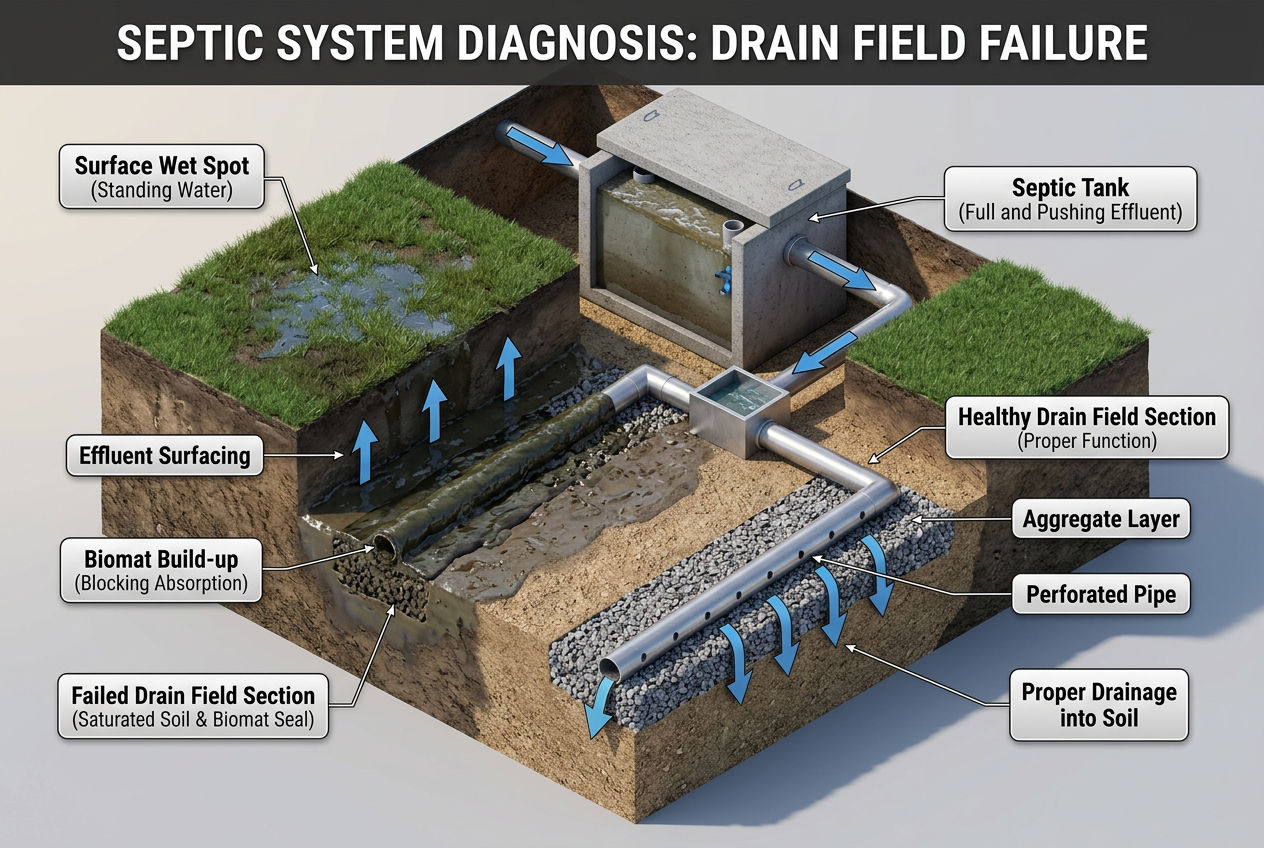
The most common cause of a failing drain field. A biomat is a dense layer of bacterial slime and organic matter that builds up along leach field trench walls over years of use. Once it's thick enough, effluent can't percolate into the soil and backs up to the surface.
A 1,000-gallon tank serving a four-person household fills with solids faster than most people realize. The EPA recommends pumping every 3–5 years, but plenty of homeowners go 8–10 years between services. When sludge and scum layers crowd out the liquid zone, solids push into the drain field and accelerate clogging. Learn how often your tank actually needs pumping.
The distribution box diverts effluent evenly across multiple leach field laterals. When a D-box cracks, shifts, or clogs with solids, one lateral gets flooded while others stay dry. The overloaded lateral saturates and surfaces. A D-box repair or replacement typically costs $500–$1,500 — far cheaper than a full field replacement.
When the seasonal water table rises within 2–4 feet of your drain field trenches, there's simply nowhere for effluent to go. This is common in:
The soil is already saturated from below. High water table septic problems often require engineered solutions like mound systems.
A household generates roughly 60–70 gallons of wastewater per person per day. Run three loads of laundry, fill a soaking tub, run the dishwasher, and have guests staying over — you can easily send 800+ gallons into a system designed for 400. That hydraulic overload can push partially treated effluent to the surface before the soil can handle it.
A cracked concrete tank lid, a failed riser seal, or a broken inlet/outlet baffle can let effluent leak directly into surrounding soil at the tank location. Septic tanks are typically buried 4 inches to 4 feet below grade. A wet spot directly above the tank — not over the field — often points to this kind of structural failure.
Soft, spongy ground directly above your septic tank usually means one of two things: the tank itself is leaking, or water is infiltrating the tank from outside and causing it to overflow.
Common structural failures include:
You might also notice the ground has shifted — yard sinking over a septic tank can indicate the tank lid or walls have partially collapsed, which is a structural emergency.
⚠️ Warning: Don't walk on ground that's visibly sinking — a collapsing tank lid is a fall hazard.
If the mushy spot is over the tank itself rather than the field, have a septic contractor open and inspect the tank immediately. They'll check the inlet and outlet baffles, look for wall cracks, and assess the lid integrity.
Standing water over a drain field is serious, but the urgency depends on a few factors. Treat it as an emergency requiring same-day service if:
If none of those apply and you had heavy rain within the past 48 hours, wait and watch. Mark the edge of the wet area with small flags or stakes. If the boundary shrinks as the rest of the yard dries, you may be dealing with a temporary saturation event rather than system failure.
📊 Quick Fact: A wet spot that holds steady — or grows — during dry weather in July is a strong indicator of drain field failure. Summer wet spots are actually more alarming than spring ones, precisely because dry conditions should favor drainage.
Call a licensed contractor for a full septic inspection.
Yes — and this is one of the most commonly misunderstood scenarios. Heavy rain can cause a temporary wet spot over a drain field for two different reasons, and only one of them means your system is failing.
| Scenario | What's Happening | System Status | Timeline |
|---|---|---|---|
| Reason 1: Surface Saturation | Soil around drain field saturated from above-ground rainfall, just like rest of yard | Usually NOT a failure | Clears in 24–72 hours |
| Reason 2: Hydraulic Overload | Stormwater infiltrating tank through loose risers/cracked lids, flooding system with clean water that displaces effluent | System problem (I&I issue) | Persists or worsens |
Surface saturation (not a failure): The wet spot clears up within 24–72 hours as the soil drains. No odor present.
Hydraulic overload from inflow and infiltration (I&I): The wet spot that results isn't rainwater — it's displaced effluent. This happens when stormwater floods your septic tank through loose-fitting risers, a cracked lid, or leaky inspection ports, pushing hundreds or thousands of extra gallons into a drain field that can't handle the load.
✅ Pro Tip: Check your riser lids and access covers after major rain events. If they're loose, cracked, or submerged during storms, water is getting in. A flooded septic system caused by storm infiltration is a preventable maintenance failure.
For more detail on how storms affect your system, see our guide on heavy rain and septic systems.
Knowing these numbers upfront helps you make a clear-eyed decision before a contractor arrives.
| Problem | Typical Repair | Cost Range |
|---|---|---|
| Tank needs pumping | Pump-out by licensed hauler | $300–$600 |
| Cracked or failed D-box | D-box replacement | $500–$1,500 |
| Inlet/outlet baffle failure | Baffle repair or replacement | $150–$500 |
| Partial drain field repair | Lateral replacement or rejuvenation | $2,000–$10,000 |
| Full drain field replacement | New leach field installation | $5,000–$20,000+ |
| Full system replacement | New tank + field | $15,000–$35,000+ |
Source: National cost averages compiled from NAWT contractor surveys and state health department data. Costs vary significantly by region — see our detailed drain field replacement cost guide for state-by-state breakdowns.
Geography is a major cost driver:
The right fix depends entirely on the cause. A contractor who diagnoses before they prescribe will give you a far better outcome than one who quotes a full field replacement before they've even located your distribution box.
A camera inspection of your lines, a tank pump-out with interior inspection, and a D-box check will identify whether you're dealing with:
💡 Key Takeaway: That inspection typically costs $200–$500 and can save you from unnecessary repairs.
If your tank is overfull, overdue for pumping, or has a failed baffle or cracked wall, address those problems before touching the drain field. Install an effluent filter — the Polylok PL-122 is a widely used option that fits most standard 4-inch outlet tees — to prevent solids from reaching the field going forward.
If biomat is the diagnosis, ask your contractor about field rejuvenation using:
These options don't work in every case — peer-reviewed research on bacterial additives is mixed at best — but when biomat is caught early, aeration can extend field life by several years. A saturated drain field repair is worth attempting before full replacement.
A failed field with collapsed trenches, a drain field in impermeable clay, or one that's been underwater for an extended period typically can't be revived. Your options:
Get multiple quotes — contractor pricing on field replacement varies by 30–40% in most markets.
✅ Pro Tip: Stop running water into the system. Do laundry at a laundromat for a few days. Don't use a garbage disposal. Every gallon you keep out of an already-saturated field gives the soil a small chance to recover before your contractor arrives.
Where you live matters when interpreting a wet spot over your septic system.
Minnesota frost lines run 42–60 inches deep, but drain fields are typically only buried 12–36 inches. This means spring thaw creates a brief period where frozen soil below the field can't accept effluent while snowmelt is simultaneously saturating everything from above.
The state requires all septic contractors to hold a Registered Septic Tank Contractor (RSTC) license through the Florida Department of Health — if your contractor can't show you that credential, stop the conversation.
Florida's shallow water tables in coastal counties mean that mound systems are often the only code-compliant option, and wet spots over conventional drain fields in these zones can be a permitting issue, not just a mechanical one.
Oregon and Washington soils are often clay-heavy, with rainfall patterns that saturate ground from October through April.
Expansive clay soils shrink and crack in summer drought, then swell in wet seasons. This soil movement can physically shift distribution boxes and crack concrete tanks over time. Wet spots in these regions sometimes trace back to a D-box that's moved an inch — just enough to flood one lateral and leave others dry.
Effluent surfacing above a drain field carries real health risks that go beyond a soggy lawn. Septic effluent contains coliform bacteria, nitrates, and in some cases pathogens including Giardia and Cryptosporidium.
⚠️ Warning: According to EPA SepticSmart guidelines, surface sewage constitutes a public health hazard that must be addressed — not just monitored.
Compare top-rated companies in your area. Get free, no-obligation quotes from verified providers.
Was this article helpful?
Connect with licensed, verified septic companies in your area.
Get estimates from licensed, verified companies in your area. No obligation.
⚡ Average response time: under 2 hours