
Septic vs sewer — which is better for your home? Compare installation costs, monthly bills, maintenance, property value impact, and conversion costs in this data-driven guide.
Quick Answer
Septic systems and municipal sewer connections handle the same job — moving wastewater away from your home — but they work differently, cost differently, and suit different situations. Whether you're buying a home, building new, or eyeing a sewer line that just appeared at the end of your road, the choice matters more than most people realize.
About 21 million U.S. households — roughly 20% of homes — rely on septic systems, according to the EPA. The rest connect to municipal sewer. Neither system is inherently better. But one of them is almost certainly better for your specific situation.
💡 Key Takeaways
- Septic systems cost $3,500–$15,000 to install; sewer hookup runs $3,000–$15,000+ depending on distance to the main.
- Monthly sewer bills average $50–$100; annual septic maintenance runs $200–$600 with proper care.
- Converting from septic to sewer costs $5,000–$30,000+ total — including the hookup fee, lateral installation, and tank decommissioning.
- Sewer-connected homes often appraise 5–10% higher in suburban markets, though the gap narrows in rural areas.
- The right choice depends on location, lot size, soil type, local regulations, and how long you plan to stay.
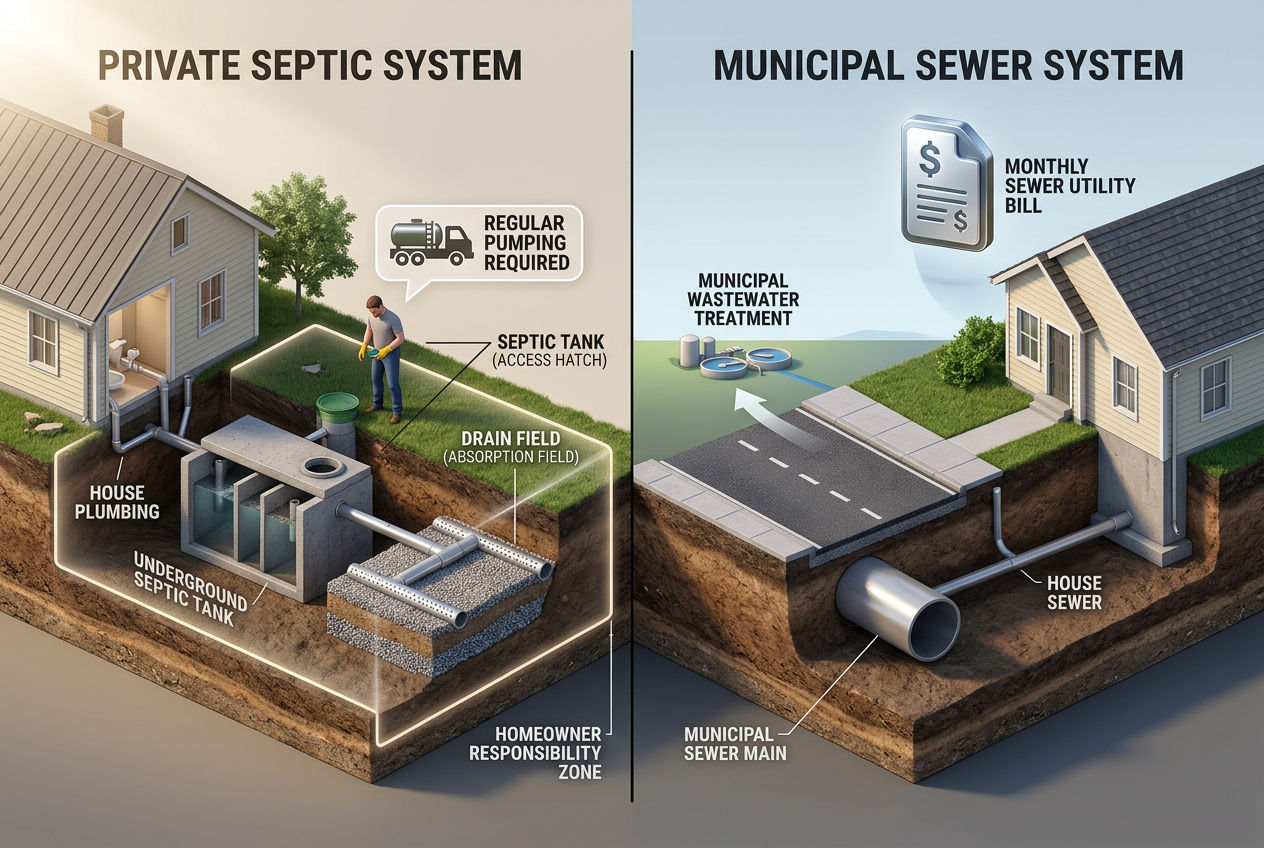
Before getting into costs and trade-offs, here's the core distinction: a septic system treats your household wastewater on your property. A sewer system sends it to a municipal treatment plant through underground pipes. One puts the responsibility — and cost — on you. The other spreads it across ratepayers.
| Factor | Septic System | Municipal Sewer |
|---|---|---|
| Upfront cost | $3,500–$35,000 | $3,000–$15,000+ hookup |
| Monthly cost | ~$0–$50 avg. | $50–$100/month |
| Maintenance | Owner's responsibility | City handles main lines |
| Lifespan | 20–40 years (tank 40+) | 50–100 years (lateral) |
| Property value | Standard in rural areas | +5–10% in suburbs |
| Environmental risk | Low if maintained; higher if neglected | Low (centralized treatment) |
| Availability | Anywhere with suitable soil | Urban/suburban areas only |
Sources: EPA SepticSmart Program; NACWA utility rate surveys; National Association of Realtors appraisal data.
A conventional septic system has two main components: a buried tank and a drain field (also called a leach field).
Wastewater flows from your house into a 1,000–1,500-gallon concrete or fiberglass tank, where:
The effluent flows into perforated lateral pipes buried in gravel trenches. Soil microbes finish the treatment naturally.
📊 Quick Fact: The whole system relies on gravity, biology, and correctly sized components — no pumps, chemicals, or electricity required in conventional systems.
A percolation test (perc test) determines whether your soil absorbs water fast enough to support a drain field:
For a deeper look at how these components fit together, see our guide on what a septic system is and how it works.
When you connect to city sewer, wastewater leaves your home through a sewer lateral — a pipe you own and maintain, typically running from your foundation to the municipal main under the street. From there, it's the city's problem.
Wastewater travels to a regional treatment plant, gets processed through primary and secondary (sometimes tertiary) treatment stages, and is discharged as treated effluent.
⚠️ Warning: The homeowner's lateral typically runs 50–150 linear feet. At $50–$250 per linear foot to install or replace, that math adds up fast. The lateral is your responsibility from the house to the property line (sometimes to the main itself, depending on your municipality). The city handles everything past that point.
Septic systems get a bad reputation largely because poorly maintained ones fail spectacularly. A properly maintained system is reliable, low-cost, and environmentally sound. Here's the honest breakdown.
Once installed, you're not paying $600–$1,200 per year in sewer fees indefinitely. Your ongoing costs are:
Our septic pumping cost guide breaks down what to expect by region and tank size.
If the city raises sewer rates — and they do, regularly — that's not your problem. You're also not subject to mandatory connection orders if a sewer line extends to your street.
✅ Pro Tip: A system installed in 1990 with regular pumping and no grease abuse can still be performing fine in 2026.
In areas where septic is the norm — rural Vermont, the Carolinas, much of New England — a septic system doesn't hurt your sale. Buyers expect it.
See our drain field replacement cost guide if you're already in that situation.
You're the operator. That means:
📊 Quick Fact: The EPA estimates 10–20% of septic systems are malfunctioning at any given time — almost always due to neglect.
Not every lot can support a conventional system:
Some lots simply can't accommodate the drain field square footage a household requires.
Picture this scenario: You're selling your suburban home and the buyer's lender requires a septic inspection before closing. The inspector flags wet spots near the drain field. Suddenly you're negotiating a $12,000 repair credit or delaying closing by three weeks. It happens.
You call the plumber if your sewer lateral backs up. Otherwise, your wastewater obligations end at your property line. No pumping schedules, no perc tests, no drain field to protect.
A failing septic system can contaminate your yard, your well (if you have one), and your neighbor's groundwater. A sewer lateral backup is unpleasant; it's rarely an environmental emergency.
Sewer works on a 3,000-square-foot urban lot just as well as a 5-acre rural parcel. You don't need to reserve 30–40% of your yard for a drain field and its required setbacks.
📊 Quick Fact: In suburban areas, sewer-connected homes tend to appraise 5–10% higher, according to NAR appraisal surveys. Buyers in those markets assume sewer is standard and view septic as a liability — fairly or not.
At $50–$100/month, sewer service costs $600–$1,200 per year.
When a municipality extends sewer lines into a previously unserved area, it often levies a sewer assessment against every property in the district — regardless of whether you connect:
If your sewer lateral — the pipe running from your foundation to the main — cracks, roots infiltrate it, or it bellies (sags), that's your repair bill:
This is where the comparison gets interesting. Looking at installation cost alone distorts the picture. The real question is total cost of ownership over 20–30 years.
A conventional septic system with a 1,000-gallon concrete tank and a properly sized drain field runs $8,000–$12,000 installed in most markets.
Annual maintenance breakdown:
30-year total: $15,500–$19,500 (assuming no major drain field repair)
Upfront costs:
Ongoing costs:
30-year total: $35,000–$43,000
💡 Key Takeaway: Septic wins on lifetime cost — often by a substantial margin — assuming the system is properly maintained and avoids major drain field failure. The calculus shifts if you need an engineered system ($20,000–$35,000 installed) or if your drain field fails prematurely.
For full installation cost details, see our septic installation cost guide.
Converting from septic to sewer — also called connecting to city sewer — typically costs $5,000–$30,000 total. Here's what drives that number:
| Cost Component | Typical Range | Notes |
|---|---|---|
| Municipal hookup/tap fee | $1,000–$5,000+ | Set by local authority |
| Sewer lateral installation | $50–$250/linear foot | × your distance to the main |
| Septic tank decommissioning | $500–$2,500 | Pumping, crushing/filling, permit |
| Sewer assessment (if applicable) | $1,000–$10,000 | Levied whether you connect or not |
| Plumbing modifications | $500–$2,000 | Re-route interior plumbing to new lateral |
Midwest suburb, 80 feet from main: $10,000–$15,000 all-in
Property 200 feet from main with assessment: $25,000–$30,000 easily
Yes. Many municipalities require property owners to abandon their septic systems and connect to sewer within a set timeframe (often 1–3 years) once a sewer line becomes available within a specified distance — typically 100–300 feet of the property.
⚠️ Warning: Check your local code before assuming connection is optional.
The honest answer: it depends on where you are.
Appraisers and buyers treat septic as a detractor:
The calculus reverses:
⚠️ Warning: A septic inspection finding a saturated drain field or a cracked tank can kill a deal or cost you $10,000–$20,000 in negotiated repairs. Keeping your system maintained isn't just good sense — it protects your resale position.
Our guide for homebuyers on septic inspections covers exactly what buyers and sellers should expect during due diligence.
Both systems, when functioning properly, handle wastewater effectively. The environmental difference shows up at failure and scale.
Advantages:
Risks:
📊 Quick Fact: The EPA estimates 10–20% of systems are malfunctioning at any given time. Failing systems can introduce excess nitrogen, phosphorus, and pathogens into groundwater and nearby surface water.
High-impact areas where failing systems are documented contributors to water quality issues:
Advantages:
Trade-offs:
💡 Key Takeaway: Neither is categorically greener. A maintained septic system in clay-free soil with adequate setbacks from water bodies performs well environmentally. A neglected one does not.
Neither system wins universally. Here's how to think through your situation:
High water table areas (coastal South, Pacific Northwest) where septic performance is compromised — an engineered system or connection may be the smarter play.
Small lots — under half an acre with setback requirements may not leave room for a compliant drain field. Our guide on septic systems for small lots covers the options.
Planning a significant addition — more bedrooms mean more wastewater, and your current system may be undersized.
✅ Pro Tip: For new construction decisions specifically, our new construction septic system guide walks through the full planning process from perc test to final inspection.
Regulations, costs, and norms vary dramatically by state and county. A few examples worth knowing:
Title 5 regulations require a full septic inspection at time of sale. Failing systems must be upgraded before transfer.
High water tables in coastal counties (Pinellas, Sarasota, Brevard) make conventional septic systems problematic.
Some of the highest per-capita septic usage in the country. Septic is standard and expected.
Septic regulation is largely delegated to county-level Authorized Agents. Requirements vary significantly between:
⚠️ Warning: Always verify with your county's On-Site Sewage Facility (OSSF) program before planning installation.
Compare top-rated companies in your area. Get free, no-obligation quotes from verified providers.
Was this article helpful?
Connect with licensed, verified septic companies in your area.
Get estimates from licensed, verified companies in your area. No obligation.
⚡ Average response time: under 2 hours