
Learn exact septic system setback requirements — how far your tank and drain field must be from your house, well, and property line. State-by-state distances included.
Quick Answer
Septic system setback requirements define the minimum distances between your tank, drain field, and key structures — your house, well, property line, and nearby water. Most states require at least 10 feet between the tank and your foundation and 100 feet between the drain field and a private drinking water well. Your county health department sets the binding rules.
💡 Key Takeaways
- No federal septic setback standard exists. Your state — and often your county — sets the rules.
- Most states require a septic tank at least 10 ft from the house foundation and 50–100 ft from a private well.
- Drain fields have stricter setbacks than tanks in nearly every jurisdiction.
- Violating setback requirements can trigger fines, forced relocation ($5,000–$30,000+), and problems selling your property.
- Always confirm distances with your local health department before breaking ground.
Roughly 21 million U.S. households — about one in five — rely on a septic system, according to the EPA. Most of those homeowners have no idea how close their tank or drain field is to their well or their neighbor's property line. That ignorance gets expensive fast.
Picture this: you're selling your home, the buyer's inspector pulls the as-built drawing, and your drain field is sitting 60 feet from a private well that code requires to be 100 feet away. The sale is now contingent on a $15,000 system relocation. This isn't a rare scenario.
Before you install a new system, replace an old one, or buy rural property, you need to understand exactly what septic system permit requirements demand — starting with setback distances.
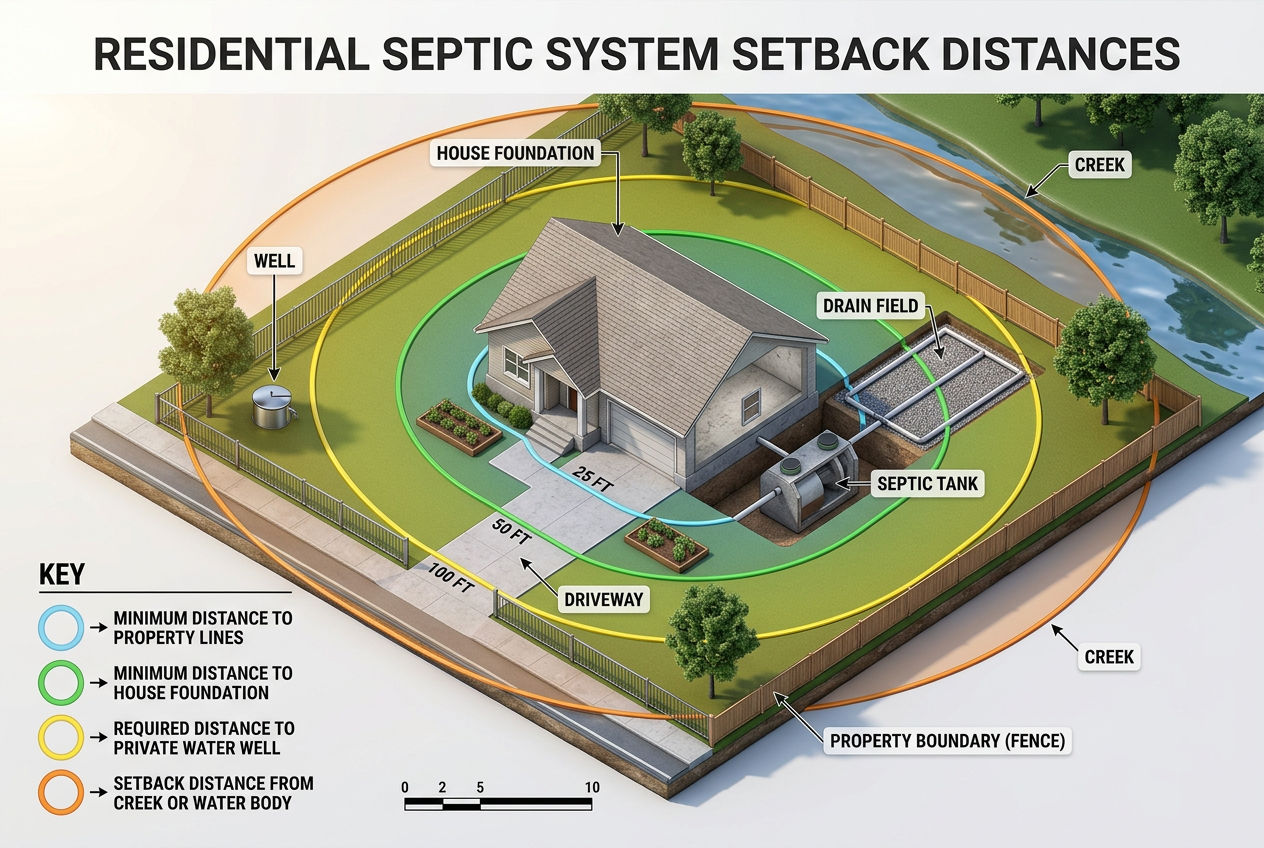
Most states require a minimum of 5–10 feet between the septic tank and the house foundation, with 10 feet being the most common standard across the country. The drain field, or leach field, usually needs to be 10–20 feet away from the foundation — farther, because that's where treated effluent disperses into the soil.
The reason isn't just odor. It's structural. Here's what inadequate clearance can cause:
⚠️ Warning: New York's Appendix 75-A requires 20 feet from structure to the absorption field. Georgia's DHR rules require 10 feet from the tank to any building. These aren't suggestions — they're conditions of your permit.
The numbers below represent the most commonly enforced ranges across U.S. states. They are a starting point, not a substitute for your local code. Always verify with your county health department.
| Structure or Feature | Septic Tank | Drain Field / Leach Field |
|---|---|---|
| House / building foundation | 5–10 ft (most: 10 ft) | 10–20 ft |
| Private drinking water well | 50–100 ft (most: 50 ft) | 100 ft |
| Public water supply well | 100–200 ft | 100–200 ft |
| Property line | 5–10 ft | 5–10 ft |
| Stream, creek, or river | 25–50 ft | 50–100 ft |
| Lake, pond, or reservoir | 50–200 ft | 50–200 ft |
| Driveway or parking area | 5–10 ft | 10 ft |
| Swimming pool | 15–25 ft | 15–25 ft |
| Trees / large root systems | 10–25 ft | 10–30 ft |
| Water supply lines (pressurized) | 10–25 ft | 25 ft |
| Embankments / cuts | varies | 10–25 ft |
Sources: EPA Onsite Wastewater Treatment Systems Manual; state administrative codes cited below. Ranges reflect variation across jurisdictions — your state may fall outside these ranges.
📊 Quick Fact: Drain field setbacks are consistently 2–10x greater than tank setbacks because that's where treated effluent disperses into soil — and where contamination risk is highest.
The septic tank to well distance requirement is typically 50 feet for the tank and 100 feet for the drain field — but this is one of the most variable numbers in all of septic regulation.
The EPA's Onsite Wastewater Treatment Systems Manual recommends a minimum of 50–100 feet between any septic component and a private well, specifically to reduce the risk of pathogen and nitrate migration through soil.
⚠️ Warning: The EPA estimates that improperly sited or maintained septic systems contribute to more than 168,000 viral illnesses and 34,000 bacterial illnesses annually in the United States.
That 100-foot figure is a horizontal distance measured at grade. It does not account for:
A 100-foot setback in dense clay soil behaves very differently than 100 feet in coarse sandy loam. That's why states with sandy coastal soils — like Florida and North Carolina — often require the same or greater distances even though water moves faster through their geology.
For a deeper look at how well and septic placement interact during new construction, see our guide on well and septic cost.
Most jurisdictions require 5–10 feet between the septic tank and the property line, with the same range applying to the drain field. Some counties add buffer requirements that push this to 15–25 feet.
This matters most on small lots. A half-acre parcel with setback requirements on all four sides may leave very little usable footprint for a drain field — especially once you account for:
For a practical look at how installers solve this problem, read our guide on septic systems on small lots.
✅ Pro Tip: If your neighbor ever installs a septic system close to your property line, those setback rules protect your groundwater too. Both systems need separation not just from structures, but from each other.
This is where most articles fail you. They give you national averages and call it a day. Here are specific standards from 10 heavily searched states, with regulatory references:
Texas Commission on Environmental Quality (TCEQ) rules require:
Texas delegates enforcement heavily to county-level Authorized Agents, so Bexar County and Travis County can — and do — apply stricter standards.
Department of Health Rule 64E-6 requires:
Florida also enforces strict setbacks from coastal wetlands and tidal waters that vary by zone.
Regulations vary significantly by county. The California State Water Board sets baseline guidance, but counties like Los Angeles, San Diego, and Sonoma each administer their own Environmental Health programs.
Always contact the county Environmental Health Department directly.
15A NCAC 18A .1950 and related rules require:
NC's rules are enforced through county Environmental Health offices, and the state has particularly strict rules near coastal plain soils with seasonal high water tables.
Under DHR's Manual for On-Site Sewage Management Systems:
Georgia uses soil morphology evaluations that directly influence where setbacks can be met.
Ohio Administrative Code 3701-29 sets:
Ohio county health departments have significant local authority to apply stricter rules.
Title 25, Chapter 73 (individual sewage disposal rules) requires:
The state's mountainous terrain and variable soils make site-specific evaluations especially important.
Appendix 75-A of the Public Health Law requires:
Individual counties like Suffolk and Westchester maintain additional overlay rules.
12VAC5-613 (Sewage Handling and Disposal Regulations) sets:
Virginia's Onsite Sewage regulations are among the most detailed in the Southeast, with specific rules for alternative systems.
Michigan's Part 117 (Onsite Wastewater Treatment) regulations set baseline standards, but county health departments have substantial local authority.
The drain field carries the heavier setback burden in almost every state. Here's why: the tank mostly holds and partially treats solids. The drain field — sometimes called an absorption field, soil absorption system, or leach field — is where treated liquid effluent disperses into the soil. Pathogens can travel through saturated or sandy soil. Groundwater contamination distance rules exist because of what happens when a leach field is too close to a water source.
| Feature | Standard Setback | Why It Matters |
|---|---|---|
| Foundation | 10–20 ft | Maintenance access; prevents hydrostatic pressure against basement walls |
| Surface water | 50–100 ft (streams/creeks) 50–200 ft (lakes/reservoirs) |
Prevents direct contamination; coastal states add wetland buffers |
| Slopes/embankments | 10–25 ft horizontal | Prevents effluent "daylighting" on hillsides |
| Large trees | 10–30 ft | Tree roots actively seek moisture/nutrients and destroy laterals |
⚠️ Warning: Willow, oak, and maple trees are the most aggressive root invaders. A mature willow within 15 feet of your leach field can destroy it in 3–5 years.
For a conventional septic system, these distances are measured from the outer edge of the lateral field. For alternative systems — mound systems, aerobic treatment units (ATUs), drip irrigation systems — some jurisdictions allow reduced setbacks because of the additional treatment these systems provide.
An ATU that discharges to a subsurface drip field, for example, may qualify for a 50-foot well setback instead of 100 feet under Virginia's 12VAC5-613 alternative standards.
For specifics on which trees pose the greatest risk, see our guide on trees near septic systems.
No. Building any permanent structure over a septic tank or drain field is prohibited in virtually every jurisdiction — and for good reason.
Tanks need access for pumping every 3–5 years:
Building a deck, shed, or patio over it blocks access and can void your system's operating permit.
Drain fields are worse. Compacted soil from structures, driveways, or even regular foot traffic collapses the air pockets in the soil that make aerobic treatment possible.
📊 Quick Fact: A drain field buried under a parking area will fail — it's not a matter of if, but when. Soil compaction destroys the porosity that allows oxygen transfer and bacterial treatment.
For specifics on what compaction does to leach field performance, see our article on driving over drain fields.
The consequences scale with how the violation is discovered.
Your local health department reviews the site plan as part of the septic system permit process. If setbacks don't comply, the permit is denied. You redesign or you don't build.
A septic inspection during a home sale can flag setback violations even on systems installed decades ago. If the violation is material — a drain field 40 feet from a well that requires 100 feet — the lender may refuse to close until it's corrected.
Discovered violations can trigger:
Relocation costs: $5,000–$30,000 depending on what's being moved and site complexity. Full system replacement in difficult terrain can exceed $50,000.
If your improperly placed system contaminates a neighbor's well, you're looking at:
⚠️ Warning: Title insurance and homeowner's insurance typically exclude coverage for known code violations. You bear the full financial risk.
Yes — dramatically. There is no single federal septic setback standard. The EPA provides guidance and funds research, but the Clean Water Act delegates onsite wastewater regulation to the states. States, in turn, often delegate to county health departments.
This decentralization creates real-world situations where two neighboring counties in the same state have different minimum well-to-drain-field distances. In California, this is especially pronounced — a Marin County permit has different requirements than a Fresno County permit, even though both operate under the State Water Board's umbrella.
Seasonal factors add another layer. In Minnesota, Wisconsin, and Michigan's Upper Peninsula, seasonal high water tables during spring snowmelt are part of the setback calculation.
✅ Pro Tip: Always request the most current version of your county's septic siting requirements in writing before purchasing rural property or beginning site design. What was approved 10 years ago may not be grandfathered if you're doing new construction.
Compare top-rated companies in your area. Get free, no-obligation quotes from verified providers.
Was this article helpful?
Connect with licensed, verified septic companies in your area.
Get estimates from licensed, verified companies in your area. No obligation.
⚡ Average response time: under 2 hours