
Quick Answer
Septic plumbing is the network of drain lines, vents, and pipes inside your home that carries all wastewater to an underground septic tank — where it separates, treats, and releases effluent into a drain field. About 21% of U.S. homes — roughly 60 million Americans — rely on a septic system rather than a municipal sewer, according to the EPA. If you just bought a home on septic, or you're trying to diagnose slow drains, read through each section below before calling anyone.
Key Takeaways
- Every drain in your home — sinks, toilets, showers, laundry — feeds into one main sewer line that runs to your septic tank.
- Standard drain lines slope at ¼ inch per foot so gravity does the work — no pump required in most homes.
- Septic-safe habits matter: the wrong products can kill beneficial bacteria and clog your drain field.
- Slow drains could be a plumbing blockage or a septic problem — the location of the symptom tells you which professional to call.
- Adding a bathroom or new fixture requires a septic permit in most states and may require upsizing your tank or drain field.
Is Septic Plumbing Different From Regular Plumbing?
Inside your home, septic plumbing looks almost identical to a municipal sewer connection. The same pipes, the same fixtures, the same vents. The key difference starts at the point where your main sewer line exits the house.
On city sewer, that pipe connects to a municipal main. On septic, it connects to a buried tank on your property — and everything downstream from that tank is your responsibility. With municipal sewer, you pay a monthly fee and the city handles treatment. With septic, you own the treatment system. What goes down your drains directly affects how well it functions.
How Does a Septic System Connect to a House's Plumbing?
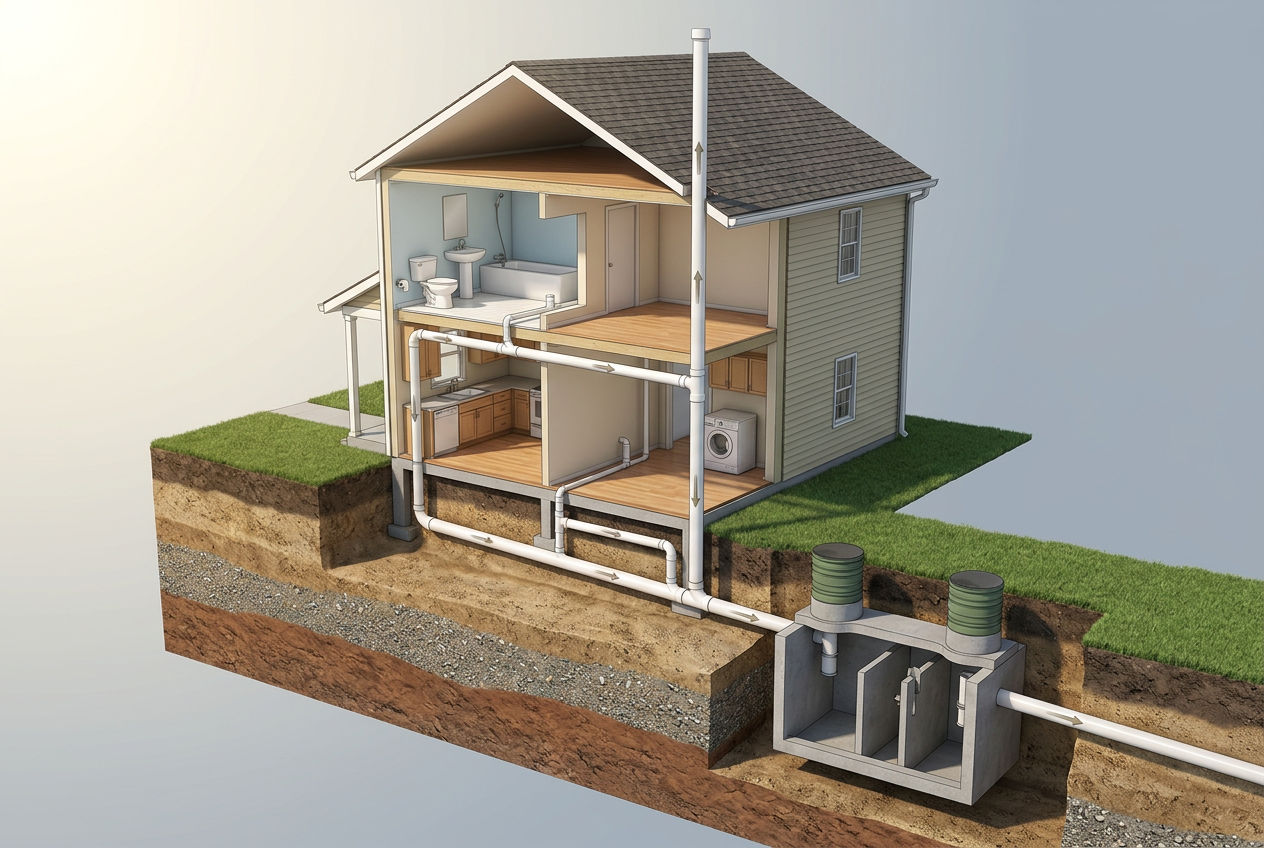
Your home's drain-waste-vent system feeds all wastewater through a single 4-inch main sewer line that exits the foundation and runs downhill to the septic tank. From there, treated effluent flows to a distribution box and into the drain field. Here's how every component in that chain connects, from fixture to soil:
1. Fixture Drains and P-Traps
Every sink, tub, shower, and floor drain has a P-trap — the curved section of pipe beneath the drain. The P-trap holds a small amount of water that blocks sewer gases from drifting back into your home. In a septic-connected home, this matters more than most homeowners realize. If you have a guest bathroom that rarely gets used, the P-trap can dry out, and you'll smell hydrogen sulfide. Run the water for 30 seconds monthly to keep it charged.
2. Branch Drain Lines
Individual fixture drains connect to horizontal branch lines that slope toward the main stack. The International Plumbing Code (IPC) requires a minimum slope of ¼ inch per foot on these horizontal runs — enough to move waste without being so steep that liquid outruns solids.
3. The Main Soil Stack and Vent Stack
Branch lines feed into a vertical main soil stack — typically 3- or 4-inch ABS or PVC pipe — that runs from your basement or crawlspace up through the roof. The top of that stack is open to the atmosphere as a vent stack. Without it, flushing a toilet would create a vacuum that siphons the water out of every P-trap on that floor. Blocked vents (leaves, bird nests, ice caps in winter) cause gurgling drains and slow flushing that homeowners frequently misdiagnose as a septic problem.
4. The Main Sewer Line
All drain flow converges into a 4-inch main sewer line that exits your home's foundation and runs to the septic tank. This pipe maintains that same ¼-inch-per-foot slope. Septic tanks are typically installed 10–25 feet from the home, though local codes vary — some jurisdictions require a 10-foot minimum setback, others push it to 20 feet. The pipe material matters too. Homes built before 1980 often have cast iron or Orangeburg pipe (a fiber-tar composite that deteriorates badly). If you're buying an older home on septic, ask specifically about this pipe — a camera inspection can reveal if it's compromised.
5. The Septic Tank
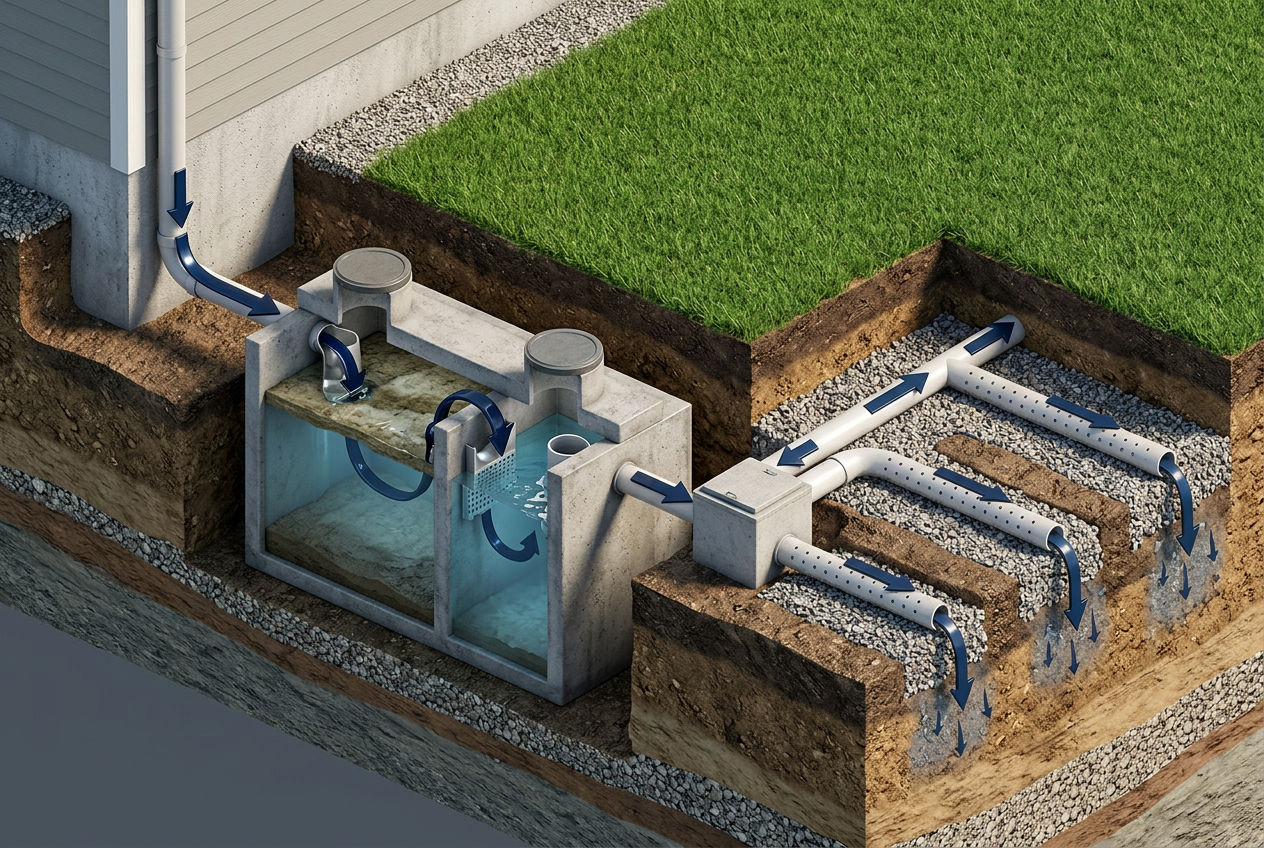
The main sewer line enters the tank through an inlet baffle — a tee-shaped fitting that directs incoming waste downward to prevent disturbing the surface. Inside a standard 1,000- to 1,500-gallon concrete or polyethylene tank, three layers form:
- Scum layer (top): fats, oils, grease, and lighter solids
- Effluent layer (middle): relatively clear liquid
- Sludge layer (bottom): heavy solids that bacteria break down anaerobically
The outlet baffle sits 1–3 inches lower than the inlet baffle, so only the cleaner middle effluent layer flows out. A properly installed Polylok PL-122 effluent filter at the outlet provides an extra layer of protection, catching suspended solids before they reach the drain field. For a deeper look at how the tank itself functions, see our guide on how septic systems work.
6. The Distribution Box and Drain Field
Effluent leaving the tank flows to a distribution box (D-box) — a concrete or plastic junction that splits flow evenly across multiple drain field laterals. Those laterals are perforated pipes (often Infiltrator Water Technologies chamber systems or traditional stone-and-pipe) buried in gravel trenches 18–36 inches deep. The effluent percolates through the soil, where it gets filtered and treated by naturally occurring bacteria before reaching groundwater.
If the D-box is unlevel or cracked, it sends all flow to one or two laterals instead of distributing evenly — overloading that section of the drain field. A simple inspection catches this before it becomes a $10,000–$30,000 drain field replacement.
Septic System Plumbing Diagram: What Does the Flow Look Like?
Picture the flow as a single downhill highway:
Free download
Free: the Septic Fridge Card — what to flush, what never to.
The Do / Don’t card the whole family can see, plus the Survival Kit: emergency flowchart, warning-sign decoder and pump-schedule card. One printable PDF.
[Fixtures] → [P-Traps] → [Branch Lines] → [Soil Stack]
                                                  ↓
                          [Main Sewer Line (4", ¼"/ft slope)]
                                                  ↓
     [Septic Tank (1,000–1,500 gal) — Inlet Baffle → Scum/Effluent/Sludge → Outlet Baffle]
                                                  ↓
                                      [Distribution Box]
                                                  ↓
                             [Drain Field Laterals → Soil Absorption]
Homes with uphill terrain or below-grade fixtures add a pump chamber with a float switch-activated effluent pump (like a Zoeller M267) between the tank and the drain field. The pump fires in timed doses to prevent hydraulic overload.
What Should You Not Put Down the Drain With a Septic System?
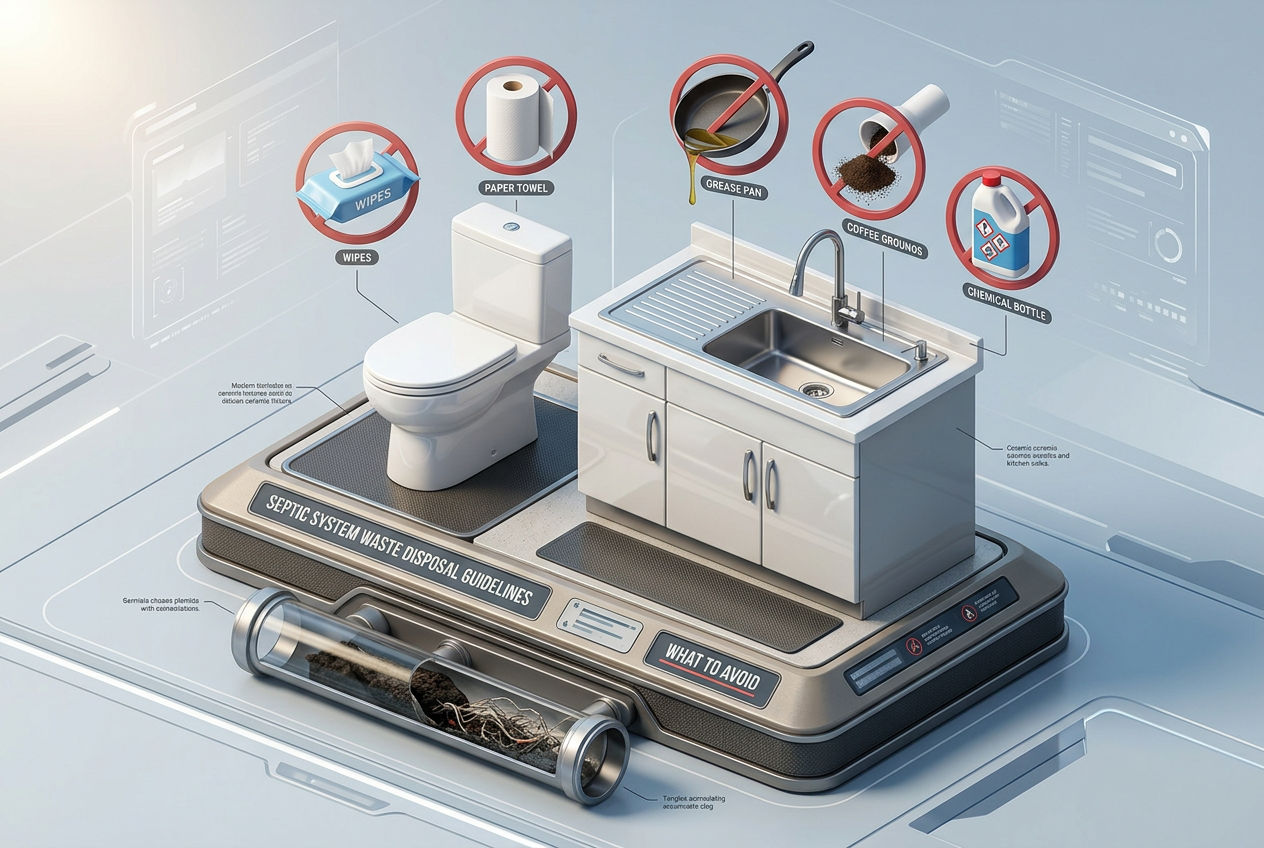
Avoid anything that kills beneficial bacteria or adds non-biodegradable solids to your tank. A disrupted bacterial ecosystem means waste stops breaking down, solids accumulate faster, effluent quality drops, and your drain field clogs with biomat — a thick biological layer that can permanently ruin leach field laterals.
Avoid these:
- Antibacterial soaps and bleach in large quantities — occasional use is fine, but daily disinfectant scrubbing kills the anaerobic bacteria doing the work in your tank
- Flushable wipes — they don't break down in septic tanks, period; they accumulate in the scum layer and jam outlet baffles
- Cooking grease — poured down the drain, it solidifies in the inlet pipe or floats on your scum layer and eventually migrates to the drain field
- Prescription medications — not a bacteria issue, but an environmental contamination issue for your groundwater
- Excess water softener brine — high sodium discharge can affect soil structure in the drain field and disrupt bacterial activity; see our detailed look at water softeners and septic systems
Garbage disposals deserve a special mention. A garbage disposal can double the solids load entering your tank. A 1,000-gallon tank serving a 4-person household normally needs pumping every 3–4 years. Add a disposal and that drops to every 2 years or less. If you're committed to using one, consider a larger tank. Our article on garbage disposals and septic systems covers this tradeoff in detail.
Pumping Schedule: How Often Does a Septic-Connected Home Need Service?
The EPA recommends pumping every 3–5 years for most households. But that's a wide range. Household size, tank capacity, and habits all tighten or extend that window.
Recommended Pumping Frequency by Household Size and Tank Capacity
| Tank Size | 1–2 People | 3–4 People | 5–6 People |
|---|---|---|---|
| 750 gal | Every 4–5 yrs | Every 2–3 yrs | Every 1–2 yrs |
| 1,000 gal | Every 5–6 yrs | Every 3–4 yrs | Every 2–3 yrs |
| 1,250 gal | Every 7 yrs | Every 4–5 yrs | Every 3–4 yrs |
| 1,500 gal | Every 9 yrs | Every 5–6 yrs | Every 4 yrs |
Source: EPA OnSite Wastewater Treatment Systems Manual; intervals assume no garbage disposal.
A licensed pumper uses a sludge judge — a clear acrylic tube — to measure sludge depth before and after pumping. When combined sludge and scum layers occupy more than one-third of tank volume, it's time. Don't wait until you have a backup. See current septic pumping costs in your area.
Worked example: A family of four with a 1,000-gallon tank and no garbage disposal generates roughly 150–200 gallons of wastewater per day. At that rate, sludge accumulates at approximately 50–70 gallons per year. After 3.5 years, the sludge and scum layers together occupy around 210–245 gallons — approaching that one-third threshold. Pumping at year 3–4 keeps the tank functioning efficiently and protects the drain field from solids carryover.
What Are the Most Common Septic Plumbing Problems?
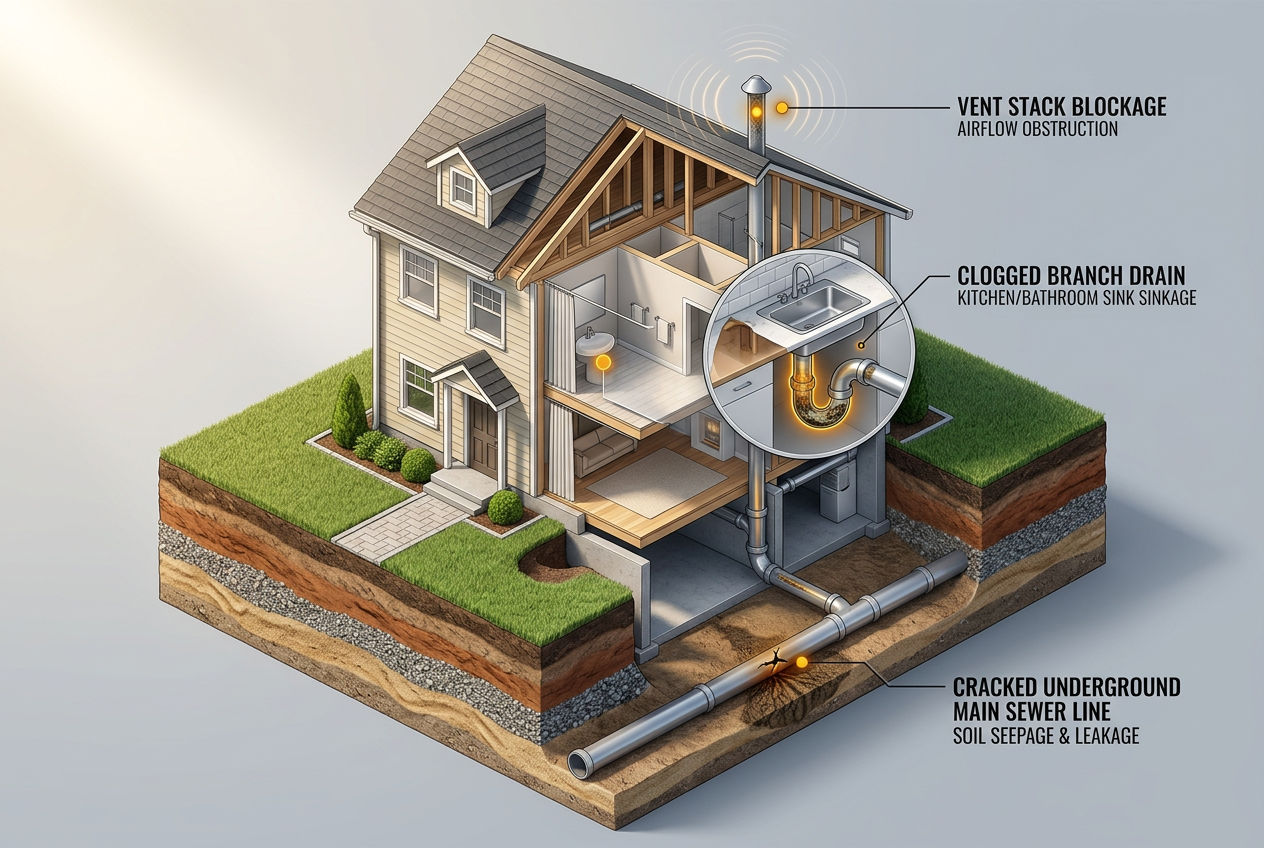
Septic plumbing problems fall into two categories: issues inside the home (pipe and vent related) and issues outside the home (tank and drain field related). Knowing which side of the foundation wall the problem lives on tells you whether to call a licensed plumber or a septic service company — and saves you from paying the wrong one first.
Slow Drains — Plumbing Blockage or Septic Issue?
Here's the diagnostic: if one fixture drains slowly, the blockage is upstream — in the branch line serving that fixture. Call a plumber. If every fixture in the house drains slowly at the same time, the problem is downstream — in the main sewer line, the tank inlet, or the drain field. Call a septic company.
A camera inspection of the main sewer line runs $150–$300 and confirms whether the blockage is in the pipe or past it. Worth every penny before committing to a $500+ pumping service call that doesn't address the real problem.
Gurgling Drains and Toilet Bubbles
Gurgling when you flush is almost always a venting issue, not a septic issue. The vent stack is blocked — leaves, a bird nest, ice in winter. A plumber can clear a blocked vent stack in under an hour. Before calling anyone, go up on the roof and look. A tennis ball-sized debris cap on a 3-inch vent pipe is a 10-minute fix with a plumber's snake.
Sewage Odors in the House
Hydrogen sulfide smell indoors points to a dry P-trap (run water for 30 seconds in unused drains) or a cracked vent pipe inside the wall. Sewage odor outdoors near the tank or drain field suggests either a cracked tank lid, a full tank, or biomat buildup in the laterals. These are different problems requiring different professionals.
Drain Field Saturation and Sewage Surfacing
Sewage surfacing in the yard above the drain field is the most serious septic plumbing problem a homeowner faces. It means the soil can no longer absorb effluent — either from hydraulic overload, biomat accumulation, or failed laterals. Under EPA and most state environmental regulations (including 40 CFR Part 503 guidelines for wastewater systems), surfacing sewage must be addressed immediately — it's both a public health violation and a groundwater contamination risk. Read the warning signs of a failing drain field before it reaches this stage.
Is Septic-Safe Plumbing Hardware Worth the Cost?
When homeowners ask about "septic safe plumbing," they usually mean one of two things: fixtures that reduce water load on the system, or products labeled safe for septic bacterial colonies. Both matter, but in different ways.
Low-flow fixtures are the most impactful hardware upgrade for a septic-connected home. A standard toilet uses 3.5–7 gallons per flush. A WaterSense-certified toilet uses 1.28 gallons per flush. For a family of four flushing an average of 5 times per person per day, that's a reduction from 70–140 gallons per day to 25.6 gallons per day in toilet water alone — meaningfully extending pumping intervals and reducing drain field hydraulic load.
Septic-safe product labels on soaps, detergents, and toilet paper indicate the product is biodegradable and won't disrupt bacterial activity. Scott 1000 and Seventh Generation toilet paper both dissolve rapidly in water — a simple test is to put a few sheets in a jar of water, shake it, and watch whether the paper breaks apart within 10–15 seconds. If it holds together, it's not septic-safe regardless of label claims.
The honest limitation here: no household product is going to rescue a neglected septic system. Septic-safe soaps and single-ply toilet paper reduce marginal stress on the system. They don't substitute for pumping on schedule or fixing a failing drain field.
How Does Adding a Bathroom or Fixture Affect Septic Plumbing?
Adding a bathroom, laundry hookup, or any new fixture to a home on septic isn't purely a plumbing project — it's a septic system capacity question first. Most states require a permit for any addition that increases the home's bedroom count or fixture unit load, because both are used to calculate required tank size and drain field area.

Under the National Environmental Service Center's (NESC) sizing guidelines — referenced in most state septic codes — a 3-bedroom home requires a minimum 1,000-gallon tank; a 4-bedroom home requires 1,250 gallons. Add a bedroom and you may need to upsize both the tank and the drain field.
A perc test (percolation test) determines whether your soil can handle the additional effluent load. Our perc test guide explains what the test measures and what your results mean for expansion plans.
Permitted additions for a full bathroom addition typically run $5,000–$15,000 when they require tank upsizing; unpermitted additions that overload an undersized system can destroy a drain field worth $10,000–$30,000 to replace. Pull the permit.
Seasonal and Regional Considerations for Septic Plumbing
Cold Climates: Frozen Pipes and Tank Access
In Minnesota, Wisconsin, and other northern states, the frost line runs 42–60 inches deep. A main sewer line installed at less than that depth — common in older homes — can freeze solid during a sustained cold snap. Thawing a frozen septic line professionally runs $1,500–$2,500, depending on length and access. Insulating the first 10 feet of the main sewer line where it exits the foundation with rigid foam board (minimum R-10) is cheap prevention. Read our guide on preventing frozen septic pipes for a full cold-climate winterization checklist.
High Water Table Regions
In coastal areas and flood-prone zones, a high water table can prevent the drain field from treating effluent properly — saturated soil has no absorption capacity. Mound systems and drip irrigation systems are engineered alternatives, but they require more maintenance and more frequent inspection. Our high water table septic guide covers the system types approved in these conditions.
Pacific Northwest: Heavy Rainfall and Hydraulic Overload
In western Oregon and Washington, seasonal rainfall can saturate drain fields even when the system is properly sized. Staggering high-water-use activities (laundry, dishwasher, long showers) across different days reduces peak hydraulic load on the drain field during wet months.
Arid Regions: Infrequent Use and Bacterial Die-Off
In Arizona and Nevada, vacation homes and seasonal properties sometimes go months without use. Bacterial populations in the tank decline during extended inactivity. When the home is reoccupied, the system takes time to reestablish its bacterial balance — during which solids break down less efficiently. Avoiding heavy antibacterial product use in the first few weeks after reoccupancy helps the system recover faster.
Sources and Methodology
- U.S. EPA OnSite Wastewater Treatment Systems Manual (EPA/625/R-00/008) — pumping frequency intervals and system overview statistics
- International Plumbing Code (IPC), Section 704 — minimum drain slope requirements (¼ inch per foot)
- National Onsite Wastewater Recycling Association (NOWRA) — installer standards and system sizing guidance
- National Environmental Service Center (NESC) — tank sizing guidelines by bedroom count
- 40 CFR Part 503 — EPA wastewater regulations referenced for surfacing sewage compliance context
- Pumping frequency table intervals are based on EPA guidance cross-referenced with state extension service publications from University of Minnesota Extension and Clemson Cooperative Extension.
- Product mentions (Polylok PL-122, Zoeller M267, Infiltrator Water Technologies, Scott 1000, Seventh Generation) reflect common market availability and are not sponsored placements.
Was this article helpful?
Frequently Asked Questions
Recommended Resources
📖 Related Articles
- What Is a Septic System? How It Works (Visual Guide)
- What Is a Drain Field? (And How Does It Work?)
- Water Softeners and Septic Systems: Safe or Harmful?
- Can You Use a Garbage Disposal with a Septic System?
- Signs Your Drain Field Is Failing (And What to Do)
- Perc Test (Percolation Test): What It Is & How It Works
- Freezing Pipes and Septic: How to Prevent Winter Damage
- High Water Table and Septic Systems: What You Need to Know
- Laundry and Septic Systems: How to Protect Your System
💰 Cost Guides
Find Septic Professionals Near You
Compare licensed, verified septic companies by area — top county markets and cities below, or browse all 50 states.
County markets
Popular cities
