
Quick Answer
Septic field lines are the perforated pipes in your drain field that distribute treated effluent from the septic tank into the surrounding soil. Standard 4-inch perforated PVC costs $3-$8 per linear foot, while advanced chamber and drip systems run $10-$30 per foot. The right type depends on your soil's percolation rate, available yard space, and local health department requirements.
Key Takeaways
- Septic field lines are perforated pipes that distribute effluent into gravel-filled trenches
- Four main types: PVC ($3-$8/ft), chambers ($10-$20/ft), gravelless ($8-$15/ft), drip ($15-$30/ft)
- Standard residential systems use 200-600 linear feet of field lines across 3-6 trenches
- Field lines are buried 18-36 inches deep in gravel beds above the seasonal water table
- Pipe type matters less than soil quality — the soil does the actual treatment, pipes just distribute
Your drain field is essentially a network of pipes buried in the ground. These pipes — called field lines, lateral lines, or leach lines — are responsible for spreading treated effluent evenly across the absorption area so the soil can complete the filtration and treatment process. Different pipe types suit different soil conditions, and choosing the wrong one can lead to uneven distribution, premature failure, or wasted money.
This guide covers the four main types of septic field lines, what each costs, and which works best for your specific situation.
Find a licensed septic installer in your area on SepticTankHub.com
How Do Septic Field Lines Work?
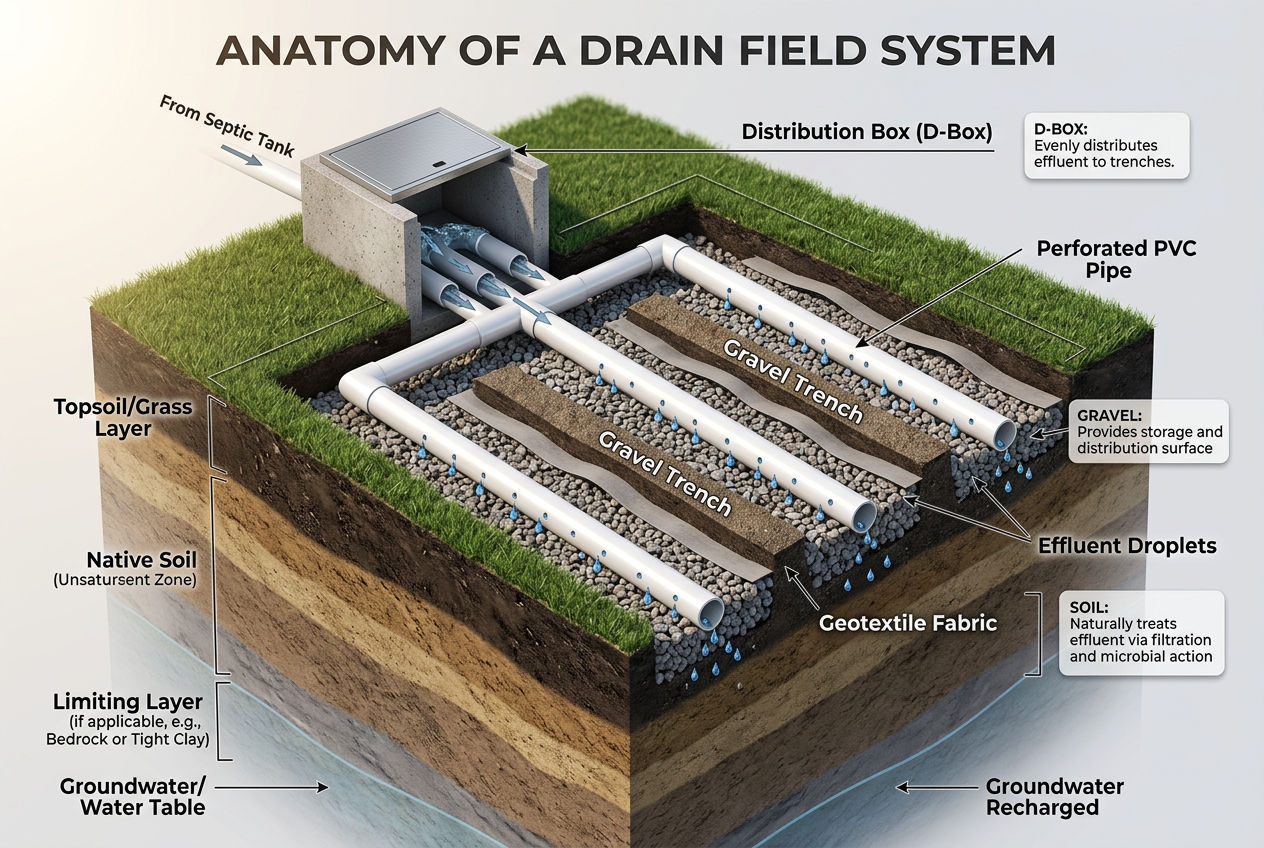
To understand field line types, you first need to understand the job they're doing. For a full system diagram showing where field lines fit, see our visual guide.
Effluent leaves the septic tank through the outlet, passes through the distribution box (which splits flow evenly), and enters the field lines. The pipes have perforations — small holes that allow effluent to seep out into the surrounding gravel bed. From the gravel, effluent moves into the native soil where bacteria in the biomat layer and soil column complete the treatment.
Field lines are laid in parallel trenches, typically 1-3 feet wide and 50-100 feet long. The number and length of trenches depends on the soil's percolation rate (how fast it absorbs water) and the size of the household. Sandy soils absorb quickly and need less trench footage. Clay soils absorb slowly and need significantly more.
The field lines themselves don't treat wastewater — they're just the delivery mechanism. The soil does the treatment. That said, how evenly the pipes distribute effluent directly affects how well the soil can do its job. Uneven distribution overloads some areas while leaving others unused, shortening the overall field life.
Key Insight: The most common cause of field line failure isn't the pipe itself — it's solids from an unpumped septic tank clogging the perforations. PVC field lines can last 40+ years if the upstream tank is maintained. Without regular pumping, the same pipes can clog in 10-15 years.
What Are the 4 Types of Septic Field Lines?
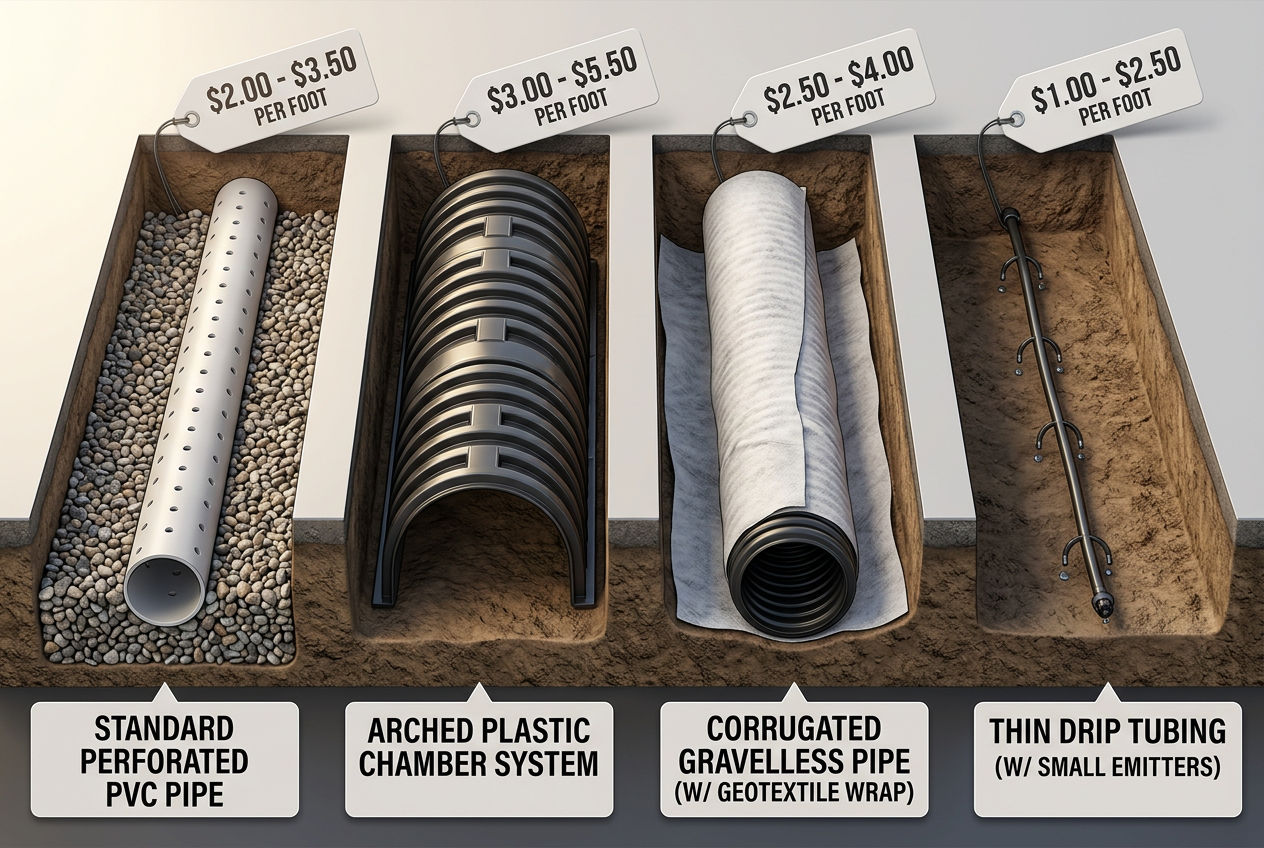
Type 1: Perforated PVC Pipe (Standard)
The most common field line type in conventional septic systems. A 4-inch diameter Schedule 40 PVC pipe with two rows of 1/2-inch holes drilled along the bottom half, spaced every 6-12 inches. The pipe sits in a 12-36 inch gravel bed within the trench.
Cost: $3-$8 per linear foot (pipe + gravel + installation)
Best for: Standard soil conditions with acceptable perc rates (1-60 minutes per inch). This is the default choice for most residential installations.
Pros: Lowest cost, readily available, easy to install and repair, proven 40+ year track record, simple to camera-inspect for maintenance.
Cons: Requires 12-36 inches of washed gravel per trench (adds weight and cost for delivery), gravel can settle unevenly over time reducing pipe slope, small perforations can clog if tank sends solids.
| Spec | Standard Value |
|---|---|
| Pipe diameter | 4 inches |
| Perforation size | 1/2 inch |
| Perforation spacing | 6-12 inches |
| Gravel bed depth | 12-36 inches |
| Gravel size | 3/4 to 2-1/2 inch washed stone |
| Trench width | 1-3 feet |
| Pipe slope | 1/8 to 1/4 inch per foot |
Source: International Private Sewage Disposal Code design standards
Type 2: Chamber Systems
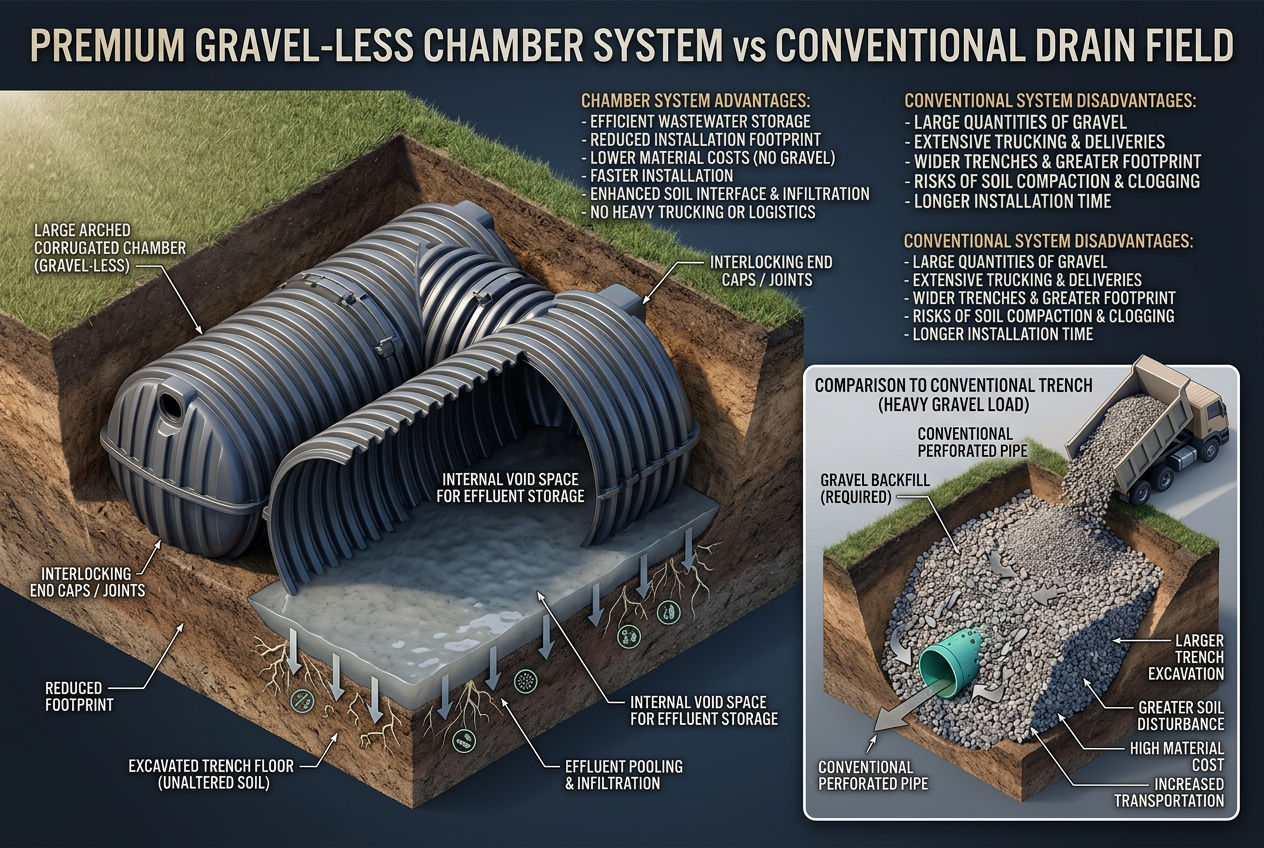
Arched, corrugated plastic chambers (like Infiltrator or ADS) that replace both the pipe and gravel in conventional trenches. The open-bottom chambers sit directly on the trench floor, creating a large void space for effluent storage and distribution.
Cost: $10-$20 per linear foot installed
Best for: Sites where gravel delivery is difficult or expensive, areas with high water tables (chambers provide more storage volume), and DIY-friendly installations.
Pros: No gravel needed (saves $2,000-$5,000 in material and delivery), lighter weight makes installation faster, larger void space provides effluent storage during peak use, easier to inspect and maintain.
Cons: Higher per-foot cost than PVC, requires careful backfill to prevent crushing, may not be approved in all jurisdictions, susceptible to flotation in very high water tables without anchoring.
Pro Tip: Chamber systems are often the best value when you factor in total installed cost. While the chambers themselves cost more per foot than PVC pipe, eliminating the need for gravel delivery and placement can make the total project cost equal or lower — especially on sites with difficult truck access.
Type 3: Gravelless Pipe Systems
Corrugated perforated pipe wrapped in geotextile fabric, installed directly in the trench without a gravel bed. The fabric acts as a filter to prevent soil from entering the pipe while allowing effluent to pass through. Brand names include EZflow and ADS gravelless pipe.
Cost: $8-$15 per linear foot installed
Best for: Sites where gravel is unavailable or prohibitively expensive, tight-access properties where gravel trucks can't reach, and areas where minimizing trench width is important.
Pros: No gravel needed, lightweight and easy to handle, faster installation than conventional pipe + gravel, smaller trenches possible (as narrow as 10 inches).
Cons: Geotextile fabric can clog over time with fine soil particles (especially in silt and clay soils), difficult to clean or rejuvenate once clogged, shorter track record than conventional PVC + gravel.
Type 4: Drip Distribution
Small-diameter (1/2 to 1 inch) tubing with pressure-compensating emitters spaced every 2 feet, installed in shallow (6-12 inch) trenches. A pump and dosing system pressurizes the tubing to distribute tiny, measured amounts of effluent across a wide area.
Cost: $15-$30 per linear foot installed (including pump, controls, and filtration)
Best for: Challenging sites — steep slopes, shallow soil over bedrock, small lots, poor perc rates, and areas near sensitive water bodies where maximum treatment is required.
Pros: Most even distribution of any system, works on slopes up to 30%, shallow installation preserves more usable yard space, uses the entire soil column for treatment, works in marginal soils that reject conventional systems.
Cons: Most expensive option, requires electricity for the dosing pump, needs annual maintenance of filters and emitters, pump replacement every 10-15 years ($500-$1,500), more components mean more potential failure points.
How Much Do Septic Field Lines Cost Overall?
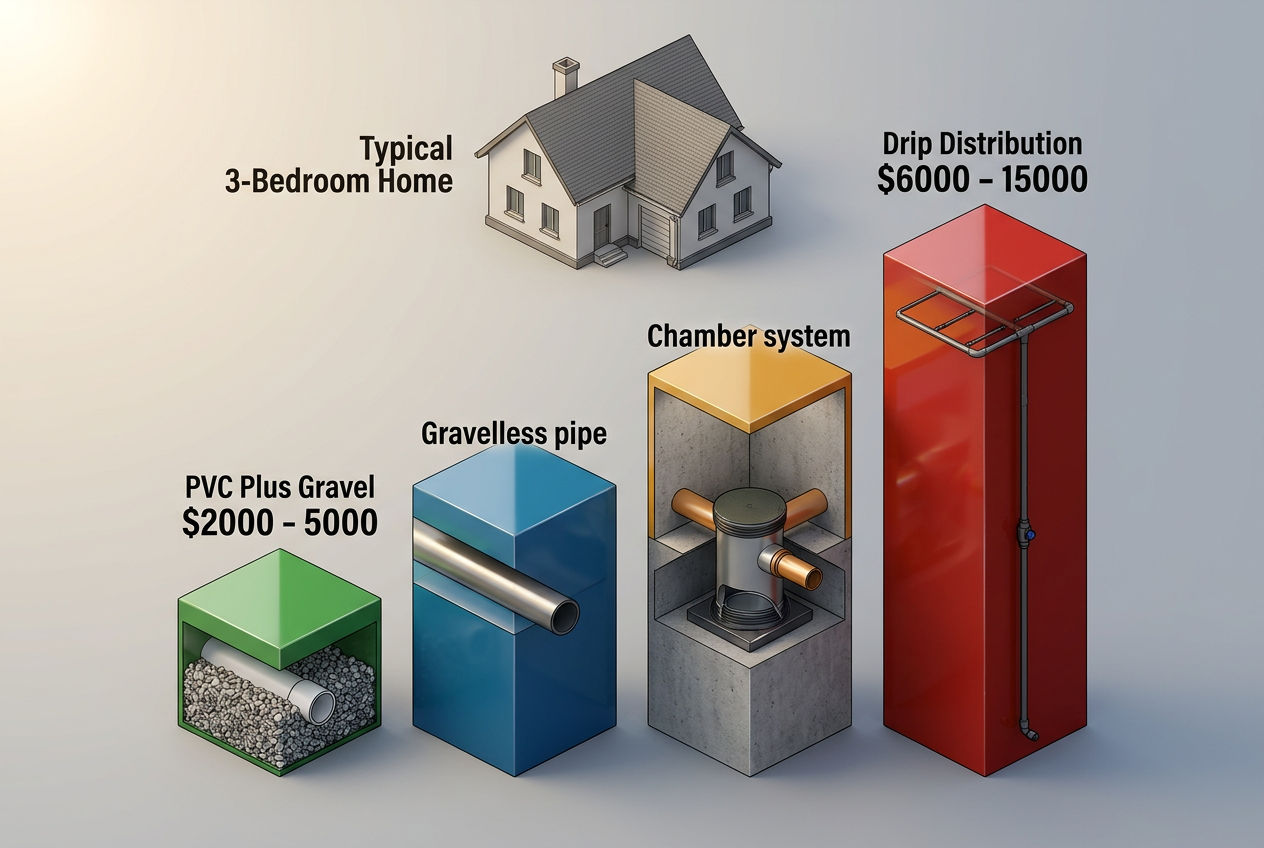
The total cost of field lines depends on type, total footage needed, and local labor rates. Here's what a typical 3-bedroom home (1,000-gallon tank) costs for each type:
| Field Line Type | Cost per Foot | Total Footage Needed | Total Installed Cost | Gravel Required? |
|---|---|---|---|---|
| Perforated PVC + gravel | $3-$8 | 200-400 ft | $2,000-$5,000 | Yes (10-30 tons) |
| Chamber systems | $10-$20 | 150-300 ft | $3,000-$7,000 | No |
| Gravelless pipe | $8-$15 | 200-400 ft | $2,500-$6,000 | No |
| Drip distribution | $15-$30 | 300-600 ft | $6,000-$15,000 | No |
Source: SepticTankHub.com aggregated installer pricing data, 2026
Field lines are one component of the total drain field installation cost. The full project includes excavation, distribution box, backfill, grading, and permits — see our septic installation cost guide for complete breakdowns.
Common Mistake: Choosing drip distribution solely because it works on challenging sites without considering the ongoing maintenance cost. Drip systems need annual filter cleaning, periodic flushing, and eventual emitter replacement. Budget $200-$500/year for maintenance — over 20 years, that's $4,000-$10,000 on top of the higher installation cost.

DIY Septic Blueprint
Thinking about building it yourself?
The complete, plain-English plan to size, permit and install your own septic system — designed for homeowners, not contractors. Skip the $15,000–$25,000 quotes and do it right the first time.
Get the DIY Blueprint — $67 →Instant download · 8 modules + 3 bonus guides · 60-day money-back guaranteeHow to Choose the Right Field Line Type
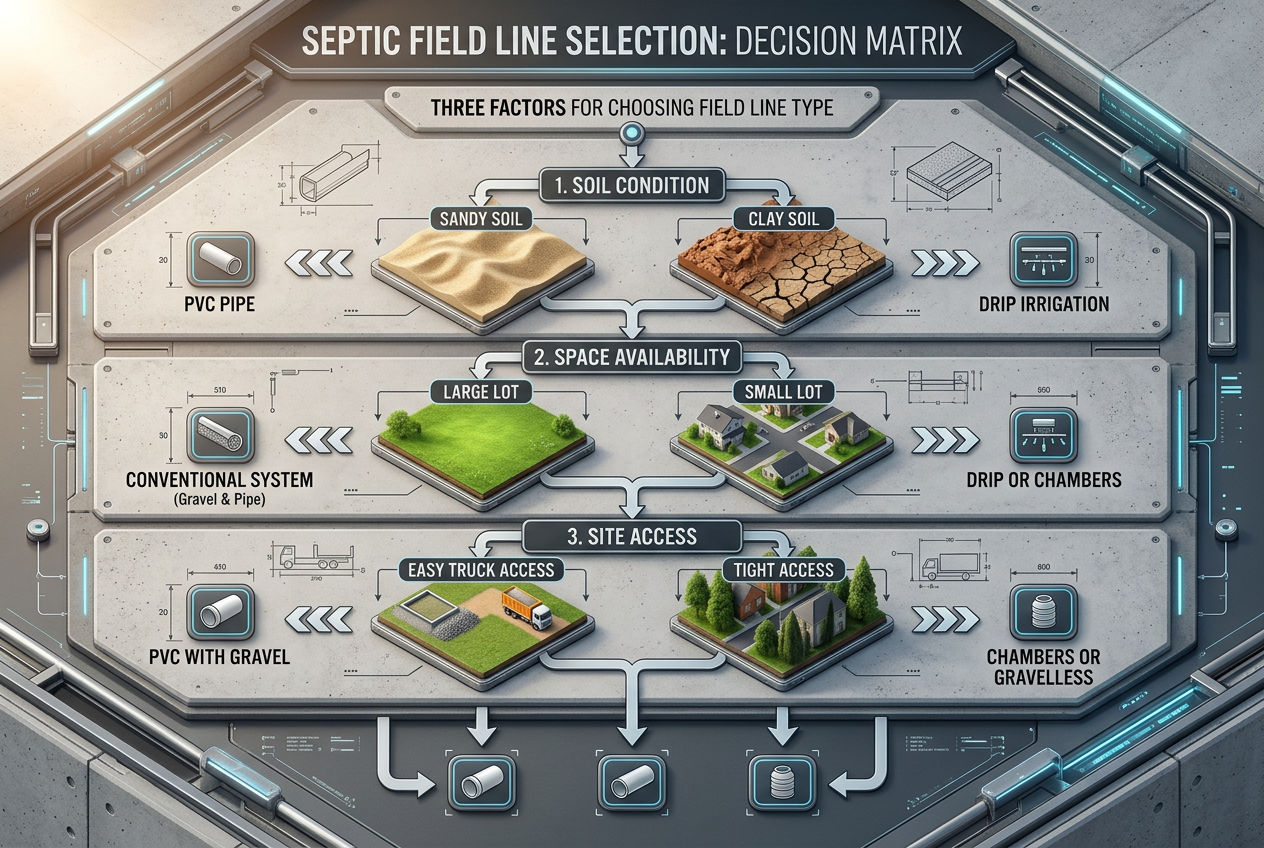
The decision usually comes down to three factors:
1. Soil type and perc rate. If your perc test shows acceptable rates (1-60 min/inch), conventional PVC with gravel is the most cost-effective choice. If rates are marginal (30-60 min/inch), chambers or gravelless may be recommended because they provide more storage volume during peak loading. If rates are poor (60+ min/inch), drip distribution or an alternative system type may be your only option.
2. Site constraints. Limited space favors drip distribution (more footage in less area) or chambers (shorter trenches than PVC). Steep slopes favor drip systems. Difficult truck access favors chambers or gravelless (no gravel delivery needed). High water tables favor chambers with their additional storage volume.
3. Local code requirements. Your county health department may mandate specific pipe types based on soil classification. Some jurisdictions don't approve gravelless systems or require specific chamber brands. Always check with your local installer and permitting office before committing to a pipe type.
In most cases, your septic designer or installer makes this recommendation based on the site evaluation and perc test results. If you're getting quotes from multiple contractors, compare pipe types as well as prices — a lower quote using an inferior pipe type isn't a savings.
Pro Tip: Ask your installer about combining types. Some designs use chambers in the primary trenches (for storage capacity) with conventional PVC in supplemental trenches (for cost savings). Hybrid designs can optimize both performance and budget.
How to Maintain Your Septic Field Lines
Field line maintenance is mostly about protecting them from upstream problems:
Pump the tank on schedule. Every 3-5 years based on household size. This is the single most important thing you can do for your field lines. A properly pumped tank sends clean effluent to the pipes; a neglected tank sends solids that clog perforations and feed the biomat.
Clean the effluent filter. If your system has an effluent filter, clean it every 1-2 years. A clogged filter restricts flow and can cause tank overflow, but a missing or bypassed filter lets solids pass through to the field lines.
Protect the surface. Never drive vehicles over the field. Don't plant trees within 30 feet. Don't install irrigation systems or landscape features that add water to the drain field area.
Watch for early symptoms. Occasional wet spots, faint odors, or slightly green grass are early warnings that deserve attention before they become full field failures. See our drain field troubleshooting guide for the complete diagnostic process.
Sources & Methodology
EPA — Types of Septic Systems — Federal descriptions of conventional and alternative distribution methods including pipe types and design standards
International Code Council — International Private Sewage Disposal Code — Model code for field line specifications, trench dimensions, and installation requirements
University of Minnesota Extension — Septic System Drainfield Design — Research-based guidance on distribution pipe selection by soil type and site conditions
Infiltrator Water Technologies — Chamber System Design Manual — Manufacturer specifications for chamber-based field line systems
SepticTankHub.com Internal Data — Field line type distribution and installed costs from 4,200+ listed septic companies
Free download
Not ready for the Blueprint? Start free.
Grab the free DIY Septic Planning Kit — the permit-first checklist, perc-test cheat sheet, and sizing tables that keep your build from getting red-tagged.
Was this article helpful?
Frequently Asked Questions
Recommended Resources
📖 Related Articles
- What Is a Drain Field? (And How Does It Work?)
- Septic System Diagram: How Every Part Works (Labeled Guide)
- How Deep Should a Drain Field Be?
- What Is a Distribution Box in a Septic System?
- Septic Drain Field Help: Troubleshooting Guide for Homeowners
- Signs Your Drain Field Is Failing (And What to Do)
- Septic Tank Biomat: What It Is and When It's a Problem
- Perc Test (Percolation Test): What It Is & How It Works
- Types of Septic Systems: Complete Comparison Guide
- What to Expect During Septic System Installation
💰 Cost Guides
🔧 Services
Find Septic Professionals Near You
Compare licensed, verified septic companies by area — top county markets and cities below, or browse all 50 states.
County markets
Popular cities
