
A perc test determines if your soil can support a septic system. Learn how percolation testing works, what results mean, and what a failed test means for your land.
Quick Answer
A perc test is a soil percolation test that measures how quickly water absorbs into the ground at a specific site, used to determine whether the soil can support a conventional septic drain field. Results are reported in minutes per inch (MPI). Most residential tests cost $250–$1,000 and take two days from start to finish.
💡 Key Takeaways
- A perc test measures soil absorption rate in minutes per inch (MPI) — the primary factor in sizing and approving a drain field
- Passing results typically fall between 1–60 MPI; heavy clay soils above 60 MPI usually fail conventional system requirements
- Most tests cost $250–$1,000 nationally, though difficult terrain or engineer requirements can push costs to $3,000+
- Results are valid for 2–5 years depending on your state, and requirements vary significantly by county
- A failed perc test doesn't mean your land is unbuildable — alternative septic systems like mound systems often solve the problem
A percolation test tells you — and your local health department — whether the soil on your property can handle the liquid waste output from a home's septic system. Specifically, it measures the soil absorption rate: how many minutes it takes for the water level in a test hole to drop one inch.
That number drives everything downstream. The drain field size, the type of septic system you can install, whether you can get a building permit at all — it all starts with that MPI reading.
According to the EPA, approximately 21% of U.S. homes — roughly 60 million people — rely on on-site wastewater treatment systems. On any property that isn't connected to a municipal sewer, a perc test or equivalent soil evaluation is essentially the foundation of the entire project.
⚠️ Warning: Buying land before you test is how people end up with a beautiful five-acre lot they legally can't build on.
If you're buying rural land, planning a new home, or adding a dwelling unit to an existing property, the perc test is one of the first things you need. Don't skip it.
Here's exactly what happens during a standard percolation test:
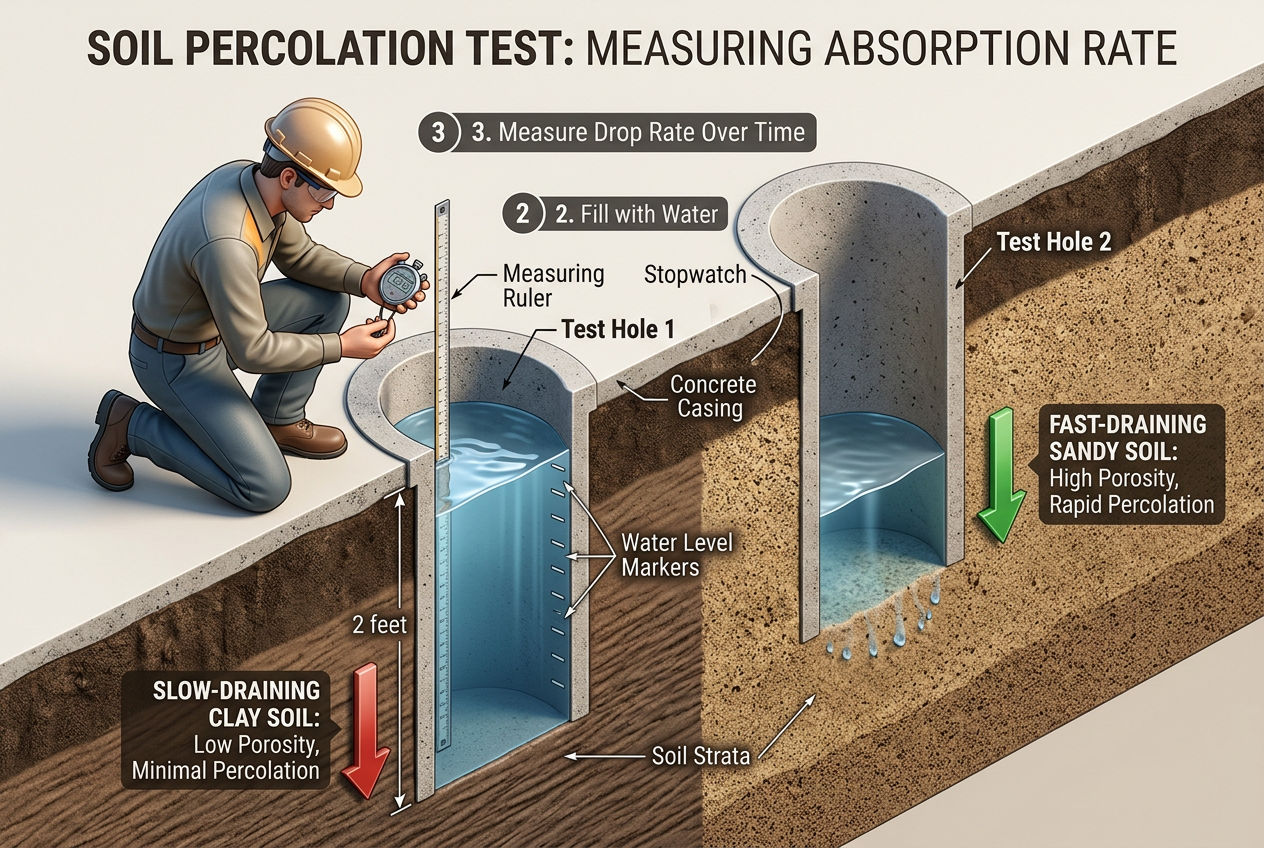
📊 Quick Fact: Total time on-site for the test day runs 4–8 hours. With the pre-soak, you're looking at a two-day process minimum.
The MPI number tells the story. Here's how to read it:
| Result (MPI) | What It Means | System Suitability |
|---|---|---|
| Less than 1 MPI | Too fast — soil won't filter effluent | Conventional system not suitable |
| 1–5 MPI | Excellent drainage (sand/gravel) | Conventional system works well |
| 6–30 MPI | Good absorption (loam) | Ideal for conventional septic |
| 31–60 MPI | Marginal (dense loam or silt) | Modified system may be required |
| Greater than 60 MPI | Failure (heavy clay) | Conventional system not approved |
Source: National Environmental Services Center (NESC), WVU; standard county health department guidelines
✅ Pro Tip: The sweet spot for a conventional drain field is 6–30 MPI. That's soil with enough structure to filter waste without waterlogging.
A result under 1 MPI can actually fail in the opposite direction — sandy or gravelly soils drain so fast that effluent passes through before the soil can biologically treat it.
The key technical concept here is saturated hydraulic conductivity — the rate at which saturated soil transmits water. The perc test is essentially a field approximation of this property, translated into a simple number your county health department can use.
A standard residential perc test costs $250–$1,000 nationally. The final number depends on how many test holes are required, how accessible your land is, and whether your county requires a licensed engineer or soil scientist to conduct or witness the test.
Here's how the cost breaks down:
💡 Key Takeaway: If you're planning a new home on a rural lot, the perc test is a small fraction of your total project budget. A conventional septic system installation runs $3,500–$12,000 nationally. A failed drain field replacement can cost $5,000–$20,000. Spending $400 upfront on a perc test before you buy land — or break ground — is cheap insurance.
In Pennsylvania, a certified Sewage Enforcement Officer (SEO) must witness the test. In North Carolina, many counties require a Licensed Soil Scientist rather than a contractor. These credentialing requirements affect cost. Check with your county health department before hiring anyone.
Find a septic professional in your area who knows your local county requirements.
In most states, no — at least not one that counts. The test needs to be witnessed or conducted by an authorized party, which varies by jurisdiction:
A DIY perc test can be useful for preliminary research — to get a rough sense of whether your soil might pass before spending money on the official process. But it won't satisfy your county health department or support a building permit application.
✅ Pro Tip: Hire someone licensed for your jurisdiction and save yourself the headache. Septic system permit requirements are strict in most states, and a non-witnessed test result is worth nothing on paper.
A failed perc test is not the end of the road. It's disappointing, but it doesn't automatically mean your land is worthless or unbuildable. Here's what typically happens next:
If your property is large enough, you may be able to test a different area with better soil conditions. Clay soils aren't always uniform across an entire lot.
Most states approve alternative systems when conventional options aren't viable. Common options include:
If you're buying property and it fails, this gives you serious leverage. The cost of an alternative system — easily $15,000–$40,000 depending on type — should be reflected in the purchase price.
If your property is near a sewer line, failure may push you toward a connection. Explore the full comparison of septic vs. sewer to understand the cost difference.
⚠️ Warning: Ignoring the result and hoping no one notices doesn't help. Installing a system without proper permits creates liability that follows the property deed. Read more about what can happen with septic work done without a license.
Perc test results are typically valid for 2–5 years, but this varies significantly by state and county. Some jurisdictions require a new test any time the permit lapses or ownership changes. Others honor results for the life of the permit as long as the project moves forward within a defined window.
✅ Pro Tip: If you're buying land with an existing perc test on record, verify the date and check with your local health department before assuming it's still valid. You don't want to be 60 days into a construction loan before discovering the test expired.
This is where things get complicated — in a useful way. Perc testing is not federally standardized. The EPA sets broad guidelines for on-site wastewater treatment, but individual states and counties write their own rules.
| State/Region | Testing Approach | Key Requirements |
|---|---|---|
| North Carolina | Soil morphological analysis | Licensed Soil Scientist required in most counties |
| Virginia | Soil profile/morphology | Primary evaluation method per Onsite Sewage Regulations |
| Pennsylvania | Traditional perc test | Sewage Enforcement Officer (SEO) must witness |
| New England (MA, NH, VT, ME) | Traditional perc test | Rocky, shallow soils make failures common; alternative systems are the norm |
| Florida/Southeast | Traditional perc test | Sandy soils can perc too fast; high water table creates unique challenges (high water table septic system issues) |
| Pacific Northwest (WA, OR) | Traditional perc test | Clay soils and heavy seasonal rainfall; many counties suspend winter testing |
💡 Key Takeaway: Your county health department is the authority. Before you hire anyone or budget anything, call them first.
Timing matters more than most people realize.
Peak demand — land sales spike and builders want to get started — but snowmelt and rain raise water tables and saturate soil. Many northern counties restrict testing from roughly March through May. A test done during this window may produce artificially poor results, or the county may refuse to accept it at all.
The most popular testing window. Dry conditions produce favorable results, but be aware: extremely dry soil can also skew readings in the other direction if it cracks and allows water to drain unusually fast along fissure lines rather than through the soil matrix itself.
Arguably the best time for accurate results in most of the country. Moderate soil moisture reflects typical year-round conditions rather than seasonal extremes.
Testing is restricted in most northern states when the ground is frozen. However, in Texas, the Southeast, and much of the Southwest, year-round testing is generally permitted.
✅ Pro Tip: If you're on a deadline — say, a real estate contract with a perc test contingency — confirm with your county health department that the season and conditions allow for a valid test before you schedule.
It depends on your state and the nature of the transaction.
In many states, sellers are required to disclose known defects — including a failed perc test or a property with no approved septic or sewer option. Failing to disclose can create liability after the sale. Our guide to selling a house with a septic system covers the disclosure rules in more depth.
Ordering a test proactively can actually strengthen your position. It removes uncertainty and gives buyers the confidence to move forward — or gives you time to explore alternative systems and price accordingly.
Cost ranges reflect contractor pricing data from multiple U.S. regions. Individual quotes will vary based on local labor markets, lot conditions, and jurisdictional requirements.
FAQS:
Q: How much does a perc test cost? A: A standard residential perc test costs $250–$1,000 nationally. Simple lots with good access and 2–3 test holes typically run $250–$400. Complex sites — steep terrain, rocky soil requiring a backhoe, or jurisdictions that require a licensed engineer or soil scientist — can push costs to $700–$3,000. Some states also require a Sewage Enforcement Officer or Licensed Soil Scientist to conduct or witness the test, which adds a credentialing fee on top of the contractor's labor. For comparison, a modern soil morphology evaluation (used in states like Virginia and North Carolina as an alternative to traditional perc testing) costs $500–$1,500. Always get at least two quotes and confirm what's included — some contractors charge separately for permit filing or report preparation.
Q: What happens if your land fails a perc test? A: A failed perc test means the soil can't support a conventional septic drain field, but it doesn't mean the land is unbuildable. The most common next step is evaluating alternative septic systems. Mound systems pump treated effluent into an engineered sand-and-gravel bed above grade and work well in areas with heavy clay or shallow soil depth. Aerobic treatment units pre-treat wastewater to a higher standard before dispersal, allowing use in marginal soils. Engineered systems offer fully custom solutions for the most challenging sites. If the property is large, retesting in a different location may also produce passing results. If you're buying land and the test fails, use it to renegotiate the purchase price — alternative systems cost $15,000–$40,000 more than conventional installations, and that difference should come out of the sale price.
Q: How long does a perc test take? A: The full percolation test process takes two days. On day one, a technician digs 2–3 test holes 6–12 inches in diameter and 18–36 inches deep, then fills them with water to pre-soak for 12–24 hours overnight. This saturates the soil to simulate realistic conditions. On day two, the technician measures water level drop at 30-minute intervals over a 4-hour period to calculate the absorption rate in minutes per inch (MPI). Total time on-site during the test day is typically 4–8 hours. Scheduling can add more elapsed time — popular testing seasons (spring and fall) often mean 1–3 week waits for a county-authorized tester. In Pennsylvania, you'll also need to coordinate with your municipality's Sewage Enforcement Officer, which adds scheduling
Compare top-rated companies in your area. Get free, no-obligation quotes from verified providers.
Was this article helpful?
Connect with licensed, verified septic companies in your area.
Get estimates from licensed, verified companies in your area. No obligation.
⚡ Average response time: under 2 hours