
Quick Answer
The best Thetford RV toilet for most campers is the Aqua-Magic Residence — a porcelain-bowl, gravity-flush unit that fits standard black-tank rigs and retails around $175. If your rig has no black tank, Thetford's C223 cassette toilet is the category leader with no real Dometic equivalent. Dometic wins the mid-range porcelain gravity-flush segment with the 310 Series (~$200), which outflushes Thetford's plastic-bowl entry models and suits full-timers who want residential feel without the cassette commitment.
Key Takeaways
- Thetford dominates the cassette toilet category — the best choice if your rig has no black tank or you camp off-grid frequently.
- Dometic leads in mid-range porcelain gravity-flush models, with the 310 Series (~$200) being a top seller for traditional black-tank setups.
- Both brands offer toilets ranging from ~$80 entry-level to $800+ for macerator models.
- Gravity-flush models use 0.5–1.0 gallons per flush; macerator systems drop as low as 0.1–0.5 gallons.
- Seals and gaskets need replacement every 3–5 years regardless of brand — factor that into your long-term cost.
What Is the Difference Between a Thetford RV Toilet and a Dometic RV Toilet?
Thetford RV toilets and Dometic RV toilets differ primarily in flush technology and product emphasis. Dometic focuses on gravity-flush and china-bowl construction for black-tank-equipped rigs. Thetford built its reputation on cassette toilets — self-contained units with a removable waste tank — and remains the dominant brand in that category globally.
That single difference shapes the buying decision completely: who each brand built their lineup for, how their units install, and how you manage waste after the flush.
Dometic's identity: Traditional gravity-flush toilet with a porcelain bowl option. Waste drops directly into your RV black tank. Most Dometic models bolt to a standard 4-inch ABS or PVC flange — same connection you'd find in a conventional setup.
Thetford's identity: Two distinct product lines. Their Aqua-Magic series (gravity-flush, black-tank compatible) competes head-to-head with Dometic. Their Porta Potti and C-Series cassette toilets are a completely different category — no black tank required, no campground hookup needed.
If your RV has a black tank, both brands work. If it doesn't — or if you camp somewhere a dump station is three days away — Thetford's cassette line is in a category by itself. Looking at the full picture of RV waste systems? Our RV plumbing and waste systems pillar guide covers how every component connects.
Side-by-Side Comparison
| Feature | Thetford Aqua-Magic Style II | Dometic 310 Series | Thetford C223 Cassette |
|---|---|---|---|
| Price (approx.) | ~$100 | ~$200 | ~$350+ |
| Flush Type | Gravity | Gravity | Slide-valve sealed |
| Bowl Material | Plastic | Porcelain | Plastic |
| Weight | ~6 lbs | ~17 lbs | ~11 lbs |
| Water per Flush | 0.6–0.8 gal | 0.5–0.7 gal | 0.5 gal |
| Black Tank Required | Yes | Yes | No |
| Bowl Height | ~15 in | ~17 in (comfort) | ~15 in |
| Avg. Lifespan | 5–8 years | 5–10 years | 5–10 years |
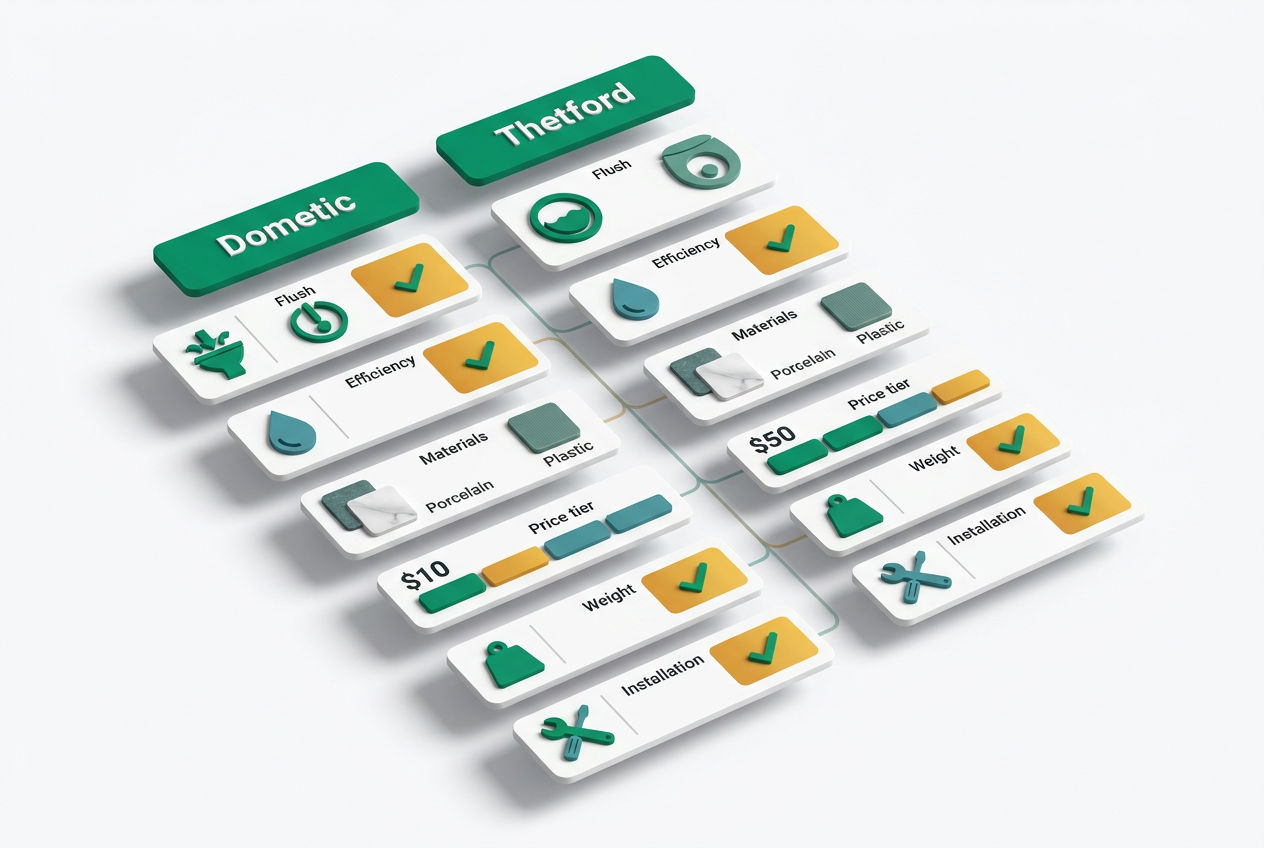
Sources: Manufacturer spec sheets (Thetford, Dometic); pricing reflects national retail averages as of mid-2025.
Are Thetford RV Toilets Good Quality?
Thetford RV toilets are reliable in their price tier, though material quality varies significantly across their product line. The plastic-bowl Aqua-Magic Style II (~$100) is lightweight and functional but not built for heavy daily use. The porcelain-option models in the Aqua-Magic Residence line step up in durability and feel considerably closer to a residential toilet.
The cassette-specific build quality is where Thetford earns its strongest reputation. The C-Series units — particularly the C220 and C223 — use a sealed blade valve system that contains odor between uses. The blade valve physically separates the bowl from the waste cassette every time it closes, which is a mechanical advantage no gravity-flush black-tank toilet can match.
What Thetford doesn't always deliver at the low end: flush power. The Aqua-Magic Style II uses a foot pedal that releases water in a single stream rather than a full-rim rinse. That directional flush works for liquid waste but clearing solid waste from a plastic bowl sometimes takes two flushes. For weekend campers, that's tolerable. For a full-timer logging 200+ flushes a month, it adds up in water consumption and frustration.
According to Thetford's published product specifications, the Aqua-Magic Style II meets EPA WaterSense efficiency guidelines at 0.6 gallons per flush under standard test conditions — but real-world double-flushing can push actual consumption to 1.2 gallons per event.
For more on keeping your toilet and waste system in top shape, the RV toilet replacement guide covers what to expect when components start failing.
How Much Does It Cost to Replace an RV Toilet?
Replacing an RV toilet runs $80–$800 depending on the type and brand, plus $0–$200 for labor if you hire out the install. Most RVers tackle the swap themselves in 30–60 minutes with a wrench, a putty knife, and a new wax ring or flange gasket.

Worked cost example: Say you're replacing a failed Thetford Aqua-Magic Style II with a Dometic 310 Series. The toilet retails for ~$200. Add a replacement flange bolt kit ($8), a new wax ring ($6), and an afternoon of your time. If you hire a mobile RV technician, labor typically runs $75–$150 for a straightforward swap — bringing your total to $275–$350. That's the realistic mid-range replacement scenario most RV owners face.
Here's how the price tiers break down more broadly:
Entry-level ($80–$150): Plastic bowl, gravity flush. Thetford Aqua-Magic Style II sits here. Good for occasional campers or budget builds. Expect to replace seals every 3–4 years.
Mid-range ($150–$350): Porcelain bowl options, improved flush geometry. The Dometic 310 Series (~$200) dominates this tier. Porcelain resists staining better over time and delivers a noticeably stronger flush than plastic-bowl entry models.
Premium ($350–$800+): Cassette systems, macerator toilets, and residential-feel upgrades. Thetford's C223 cassette runs ~$350+. Macerator toilets from both brands push into the $400–$800 range — they grind waste and pump it through smaller-diameter lines, useful in rigs where running a full 3-inch waste line isn't practical.
The full breakdown of replacement costs lives in our RV toilet replacement cost guide. If your waste system connects to a home septic system at any point, also review how a septic drain field works before adding any chemical treatments.
What Is a Cassette Toilet in an RV — and Should You Get One?
A cassette toilet is a self-contained unit with a permanently installed top section (seat, bowl, flush mechanism) and a removable lower waste cassette — essentially a portable holding tank with a capacity of 4–5 gallons. When it's full, you pull it out through an exterior access panel, carry it to a dump station or standard toilet, and empty it. No black tank. No sewer hose. No dump station hookup required.
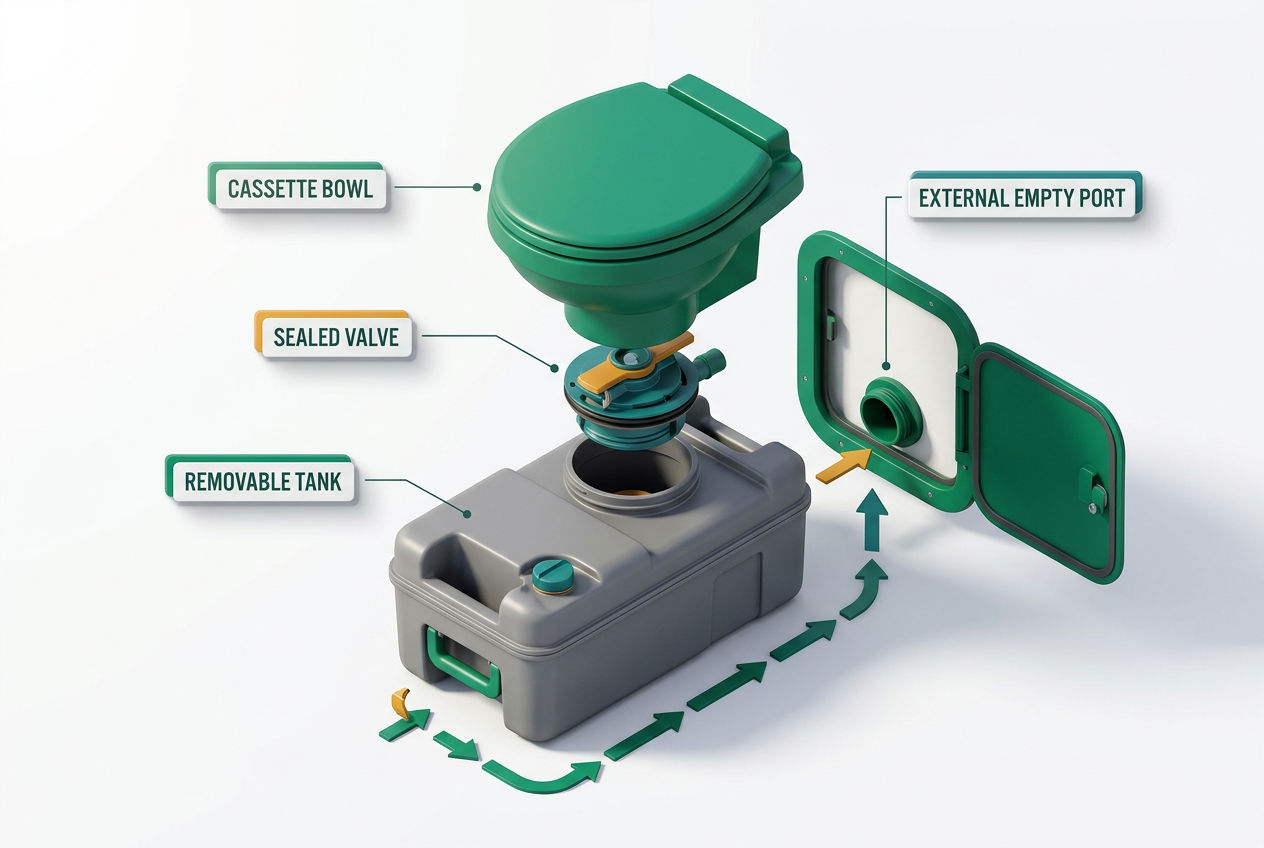
Thetford's C-Series is the gold standard in this category. The C220 and C223 models include a swivel base (so the bowl can rotate toward you in tight spaces), a sealed blade valve, and an electric-flush option on higher trims. The odor containment on these units is better than a gravity-flush black-tank system in hot weather — the sealed valve cuts off the waste chamber from the bowl between uses. Dometic does not offer a competing cassette toilet in the North American market, making this an uncontested Thetford win for off-grid RVers.
Cassette toilet trade-offs to know:
- Capacity is limited. A 4.8-gallon cassette handles roughly 15–20 uses for a couple. Full-timers need to empty every day or two.
- Emptying requires carrying the cassette to a dump point. Fine for campgrounds with toilet facilities. Less fine at 2 a.m.
- Winter RVing advantage: cassette systems are far easier to winterize than a black tank plumbing loop. In the Pacific Northwest and Canadian Rockies, this matters more than most buyers realize — you're draining one removable container instead of blowing out a full black tank line.
If you're evaluating alternatives entirely, our composting toilet guide covers the other major off-grid option. For RVers who spend significant time at campgrounds with septic hookups, understanding how campground septic systems handle RV waste affects which chemical treatments you can safely use.
Which RV Toilet Uses the Least Water?
Free download
Free: the Septic Fridge Card — what to flush, what never to.
The Do / Don’t card the whole family can see, plus the Survival Kit: emergency flowchart, warning-sign decoder and pump-schedule card. One printable PDF.
Macerator toilets use the least water, typically 0.1–0.5 gallons per flush. Standard gravity-flush RV toilets — from both Dometic and Thetford — use 0.5–1.0 gallons per flush depending on how long you hold the pedal. Cassette models typically sit at the lower end, around 0.5 gallons.
For boondockers and dry campers, water usage is a legitimate spec to optimize. Here's what that looks like in real numbers:
A couple dry camping for 5 days at 6 flushes per day each = 60 flushes. At 0.8 gallons per flush (typical gravity-flush), that's 48 gallons from your freshwater tank just for toilet flushing. At 0.5 gallons (efficient cassette or macerator), that drops to 30 gallons — an 18-gallon difference. On a 40-gallon freshwater tank, that gap is the difference between making it four days and six days without a refill.
Dometic's VacuFlush system uses pressurized air assist and claims as low as 0.1 gallons per flush, though those numbers apply under ideal conditions. Real-world usage typically runs 0.2–0.4 gallons. According to Dometic's published VacuFlush specifications (Model 8100 series), the system requires a dedicated vacuum tank and pump — adding installation complexity that gravity-flush swaps don't involve.
Southwest RVers and sun-belt full-timers — where the boondocking culture is strong and water access is genuinely limited — will find this spec worth paying for. For RV park campers with full hookups, it's largely irrelevant.
Your overall water management picture includes the RV black tank treatment choices you make — which directly affects odor control and dump frequency too.
How Long Do RV Toilets Last?
A well-maintained RV toilet lasts 5–10 years. The most common failure point isn't the bowl or frame — it's the seals and gaskets. The ball seal or flapper seal that keeps your black tank odors from venting into the cabin typically needs replacement every 3–5 years. That's true for both Thetford and Dometic. They're rubber gaskets working in a wet, chemically active environment, and no manufacturer has changed that fundamental limitation.
Honest limitation to state plainly: If you use concentrated enzyme or formaldehyde-based treatments at high doses, you'll shorten seal life regardless of which brand you own. The chemical environment inside an RV black tank accelerates rubber degradation faster than mechanical wear does.
Dometic sells replacement seal kits (part #385311658 for the 300/310 series) for around $15–$25. Thetford's equivalent Aqua-Magic replacement seal kits run similar pricing. Both are DIY-friendly repairs that add 2–4 years to a toilet's functional life. The detailed process for both brands is covered in our RV toilet seal replacement guide.
What actually kills toilets prematurely:
- Flushing anything other than RV-safe toilet paper
- Running the toilet dry (no water in the bowl) for extended periods
- Freeze damage from incomplete winterization on black-tank-equipped models
Cassette toilet longevity note: The blade valve mechanism on Thetford C-Series units is the most likely wear point. Thetford sells replacement blade seals for around $20–$30. With proper lubrication using the manufacturer-recommended Thetford Seal Lubricant, valve life typically matches or exceeds the main unit.
Which RV Toilet Is Right for You?
Skip to the row that matches your situation:
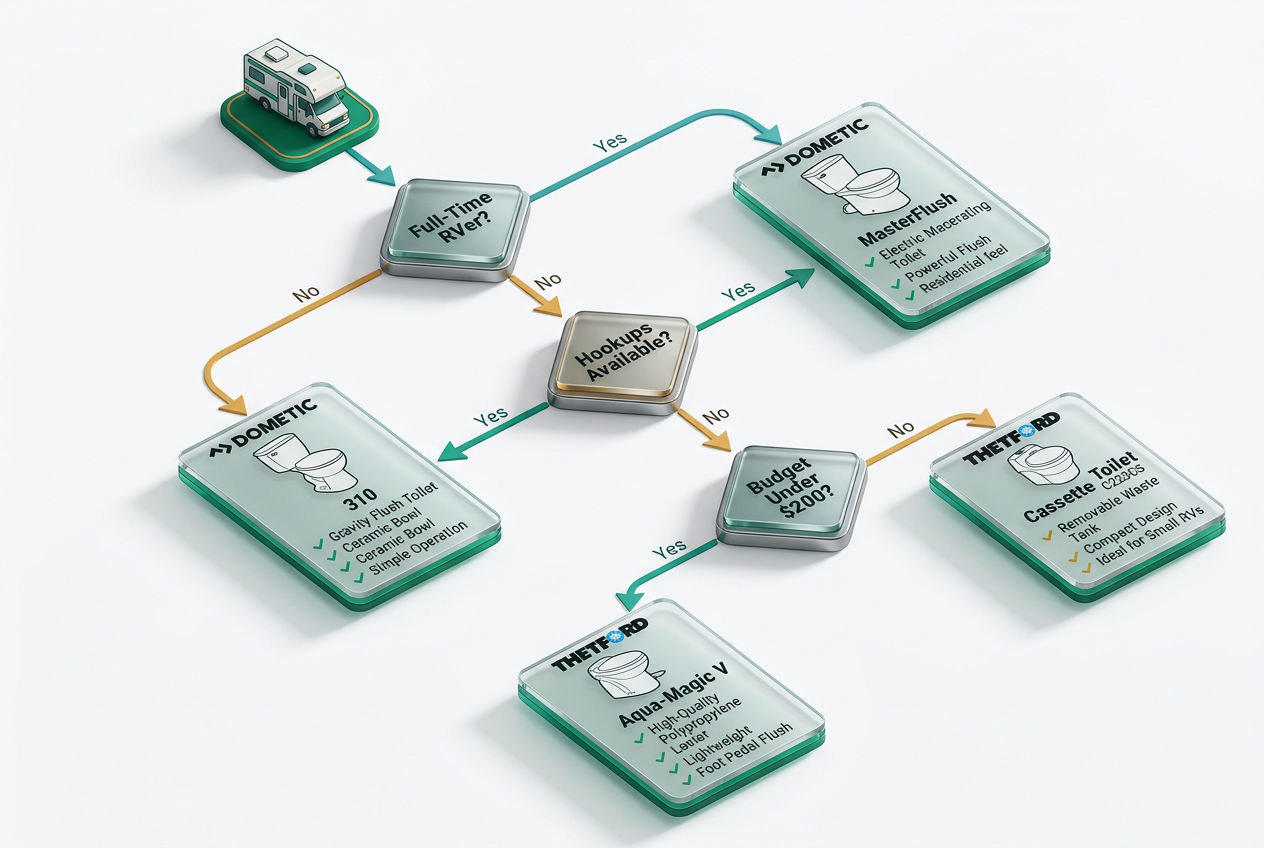
| Your Setup | Best Choice | Why |
|---|---|---|
| Full-time RVer, black tank, want porcelain | Dometic 310 Series | Stronger flush, porcelain durability, comfort height |
| Weekend camper, tight budget | Thetford Aqua-Magic Style II | Lowest cost, lightest weight, easy DIY swap |
| No black tank, off-grid camping | Thetford C223 Cassette | Only real option in this category |
| Boondocker, water conservation priority | Dometic VacuFlush or Thetford C-Series | Both use ≤0.5 gal/flush |
| Upgrading to residential feel | Thetford Aqua-Magic Residence or Dometic 320 | Porcelain, comfort height, both ~$200–$300 |
| Class B van or compact motorhome | Thetford Porta Potti 565E | Smallest footprint, self-contained |
A note on dumping at home: If you ever dump your black tank or cassette into a home septic system, check your tank treatment labels before you go near the cleanout. Thetford's standard Aqua-Kem (blue formula) contains formaldehyde-based biocides that kill the beneficial bacteria your septic tank depends on. Thetford's Aqua-Kem Green is the septic-safe alternative. This distinction matters — one product is fine for septic systems and one actively damages them, yet they sit next to each other on the shelf at most RV supply stores. If your rig connects to home septic at any point, a professional septic pumping and inspection before and after the camping season is worth scheduling.
Frequently Asked Questions
What is the best Thetford RV toilet for full-time living?
The best Thetford RV toilet for full-time RV living is the Aqua-Magic Residence, which offers a porcelain bowl, comfort-height seat at approximately 17 inches, and a full-rim flush pattern that outperforms the entry-level Aqua-Magic Style II. Thetford markets this model specifically at full-timers and residential-comfort buyers, and it retails for approximately $175–$220 at major RV supply retailers. For full-timers logging 200 or more flushes per month, the porcelain bowl resists staining significantly better than plastic alternatives and tolerates daily use without the surface degradation that shows up on plastic bowls within two to three years. The Aqua-Magic Residence bolts to a standard 4-inch flange and requires no special plumbing modifications. Its ball seal still needs replacement every three to five years — budget $15–$25 for the Thetford-branded seal kit. If cassette-style waste management fits your full-timing lifestyle, the C223 is the alternative worth comparing, particularly if you camp off-grid frequently. See our RV toilet replacement guide for installation details.
How does a Dometic RV toilet compare to Thetford for gravity-flush performance?
In gravity-flush performance, the Dometic 310 Series outperforms the Thetford Aqua-Magic Style II in single-flush waste clearing, primarily because of bowl geometry and the full-rim water distribution pattern Dometic uses versus Thetford's single-stream foot-pedal release. Both units use 0.5–0.7 gallons per flush under standard conditions, but the Dometic 310's porcelain bowl and wider water spread mean fewer double-flushes in real-world use. For a couple averaging 60 flushes over a five-day dry-camping trip, that could represent a meaningful reduction in freshwater consumption. The Dometic 310 weighs approximately 17 pounds versus the Thetford Style II's 6 pounds — a relevant consideration for weight-sensitive Class B vans or ultralight trailers. Both toilets mount to standard 4-inch flanges with identical installation procedures. At roughly double the price ($200 vs. $100), the Dometic 310 is the better long-term investment for rigs with permanent black tanks and daily use patterns. Occasional weekend campers can reasonably choose the Thetford on price alone.
Are Thetford cassette toilets worth the money compared to standard RV toilets?
Thetford cassette toilets are worth the price premium specifically for RVers who camp without black-tank dump access or who want to avoid managing a black tank entirely. The C223 retails around $350 — roughly three times the cost of an entry-level gravity-flush unit — but it eliminates the need for a black tank, sewer hose, and dump station hookup altogether. The sealed blade valve system provides noticeably better odor containment than any gravity-flush toilet connected to an open black tank, which matters significantly in smaller rigs where the bathroom and living area share close quarters. The practical limitation is cassette capacity: a 4.8-gallon tank handles approximately 15–20 uses for a couple before requiring emptying. Full-timers in campgrounds with bathroom facilities nearby manage this easily; remote boondockers need to account for daily emptying logistics. Dometic offers no competing cassette product in North America, making this a Thetford-exclusive decision. For truly off-grid RVers, compare cassette toilets against composting alternatives using our composting toilet guide before committing.
What is the cheapest RV toilet replacement option that still holds up?
The cheapest RV toilet replacement that holds up under regular use is the Thetford Aqua-Magic Style II at approximately $80–$100 at major RV retailers. It is a plastic-bowl, foot-pedal gravity-flush unit that weighs roughly 6 pounds, mounts to any standard 4-inch flange, and installs in under an hour without special tools. The realistic lifespan is five to eight years with proper maintenance — specifically, keeping the ball seal lubricated with Thetford Seal Lubricant and never running the bowl dry for extended periods. The main trade-off at this price point is flush power: the single-stream foot pedal does not deliver a full-rim rinse, so solid waste sometimes requires a second flush. For occasional campers using the toilet two to four times per week, this is not a meaningful problem. For anyone camping full-time or hosting multiple occupants in a single rig, the $100 price difference to the Dometic 310 Series is likely worth paying. Seal replacement kits for the Aqua-Magic Style II run $15–$20 and extend service life by several years. Details are in our RV toilet seal replacement guide.
Can you use a Thetford or Dometic RV toilet with a home septic system?
You can connect an RV to a home septic system for dumping, but your tank treatment chemical choice becomes critical and most RVers get this wrong. Standard Thetford Aqua-Kem (the blue formula) contains formaldehyde-based biocides that kill the beneficial bacteria a septic tank requires to process waste. Used repeatedly, it can disrupt the biological balance of a residential septic system and accelerate the need for pumping. Thetford's Aqua-Kem Green is the septic-safe alternative — it uses enzyme-based treatment rather than biocides. Dometic's treatment products follow similar labeling conventions: look for "septic-safe" explicitly on the label before using any tank treatment if your waste connects to a home system at any point. If you're unsure about your home septic system's condition before connecting your RV, scheduling a septic pumping and inspection is the right first step. Understanding how your drain field handles waste loads also helps RV owners avoid overloading a residential system during extended stays.
How do you know when an RV toilet seal needs replacing?
An RV toilet seal needs replacing when you notice black tank odors in the cabin with the toilet closed, visible water trickling past the closed ball valve into the bowl, or resistance and sticking when operating the flush pedal. These symptoms typically appear three to five years into a toilet's life and apply equally to Thetford and Dometic units. The ball seal — a rubber gasket that closes off the black tank from the bowl — is the most common failure point on gravity-flush toilets from both brands. Replacement kits for the Dometic 300/310 series (part #385311658) and equivalent Thetford Aqua-Magic kits retail for $15–$25 and require no special tools beyond a pair of gloves and basic disassembly. According to RVIA maintenance guidelines, annual lubrication of the ball seal with a manufacturer-approved lubricant — Thetford Seal Lubricant or Dometic's equivalent silicone-based product — significantly extends seal life and delays this repair. Ignoring a failing seal allows sewer gases including hydrogen sulfide to enter the living space, which is both a comfort and a health concern. Full replacement procedures for both brands are detailed in our RV toilet seal replacement guide.
Sources & Methodology
- Thetford Corporation product specifications — Aqua-Magic Style II, Aqua-Magic Residence, C220, C223 (thetford.com, accessed June 2025)
- Dometic Group product specifications — 300 Series, 310 Series, 320 Series, VacuFlush 8100 (dometic.com, accessed June 2025)
- EPA WaterSense Program — Toilet efficiency benchmarks and flush volume standards (epa.gov/watersense)
- Recreation Vehicle Industry Association (RVIA) — RV plumbing and sanitation system standards reference
- Retail price sampling — Camping World, Amazon, and RVupgrades national listings, June–July 2025; prices subject to change
Pricing and specifications current as of publication. Always verify current pricing and compatibility with your specific RV model before purchasing.
Was this article helpful?
Frequently Asked Questions
Recommended Resources
Find Septic Professionals Near You
Compare licensed, verified septic companies by area — top county markets and cities below, or browse all 50 states.
County markets
Popular cities
