
Quick Answer
Septic tank covers: concrete vs. plastic lids, standard sizes (20"–30"), replacement costs ($30–$200), how to find buried covers, riser options, and decorative solutions. Complete guide.
Septic tank covers are the access lids that seal your tank's inlet, outlet, and center chamber openings. Most residential systems have one to three covers, typically 20", 24", or 30" in diameter. Concrete lids weigh 50–120 lbs and last 20–40 years; plastic lids weigh 5–25 lbs and can last up to 50 years with UV stabilization. Knowing your cover type, size, and condition is the first step toward avoiding costly pump-out delays, safety hazards, and structural failures.
Key Takeaways
- Most residential tanks have 1–3 access covers; standard diameters are 20", 24", and 30"
- Concrete lids weigh 50–120 lbs and cost $50–$200 to replace; plastic lids run $30–$150
- An open or unsecured cover is a drowning hazard — the EPA classifies open septic tanks as a serious confined-space danger
- Adding a septic tank riser brings the cover to grade level, eliminating the need to dig for every pump-out
- Decorative covers (faux rock, garden features) run $40–$250 and blend seamlessly into landscaping
What Is a Septic Tank Cover, and Why Does It Matter?
A septic tank cover — also called a septic tank lid or septic tank access cover — is the removable cap that sits over each opening on your tank. That's it. But don't let the simplicity fool you. That lid is the only thing standing between your yard and an open hole full of toxic gases and wastewater.
The EPA's septic system guidance lists approximately 21 million U.S. households on septic systems. Every one of them has at least one cover that needs to be accessible, intact, and secured. A cracked lid lets surface water flood your tank, throws off the liquid balance, and can collapse under foot traffic without warning. A buried, forgotten lid means your pumper can't do their job — and that $350 pump-out turns into a $100–$400 locate-and-uncover charge before anyone even opens the tank.
Your tank's covers aren't an afterthought. They're a maintenance access point you'll deal with every 3–5 years at minimum. Understanding what you have — and whether it needs upgrading — saves money and headaches. For a broader look at how covers fit into your system's long-term health, see our septic system maintenance guide.
What Are the Different Types of Septic Tank Covers?
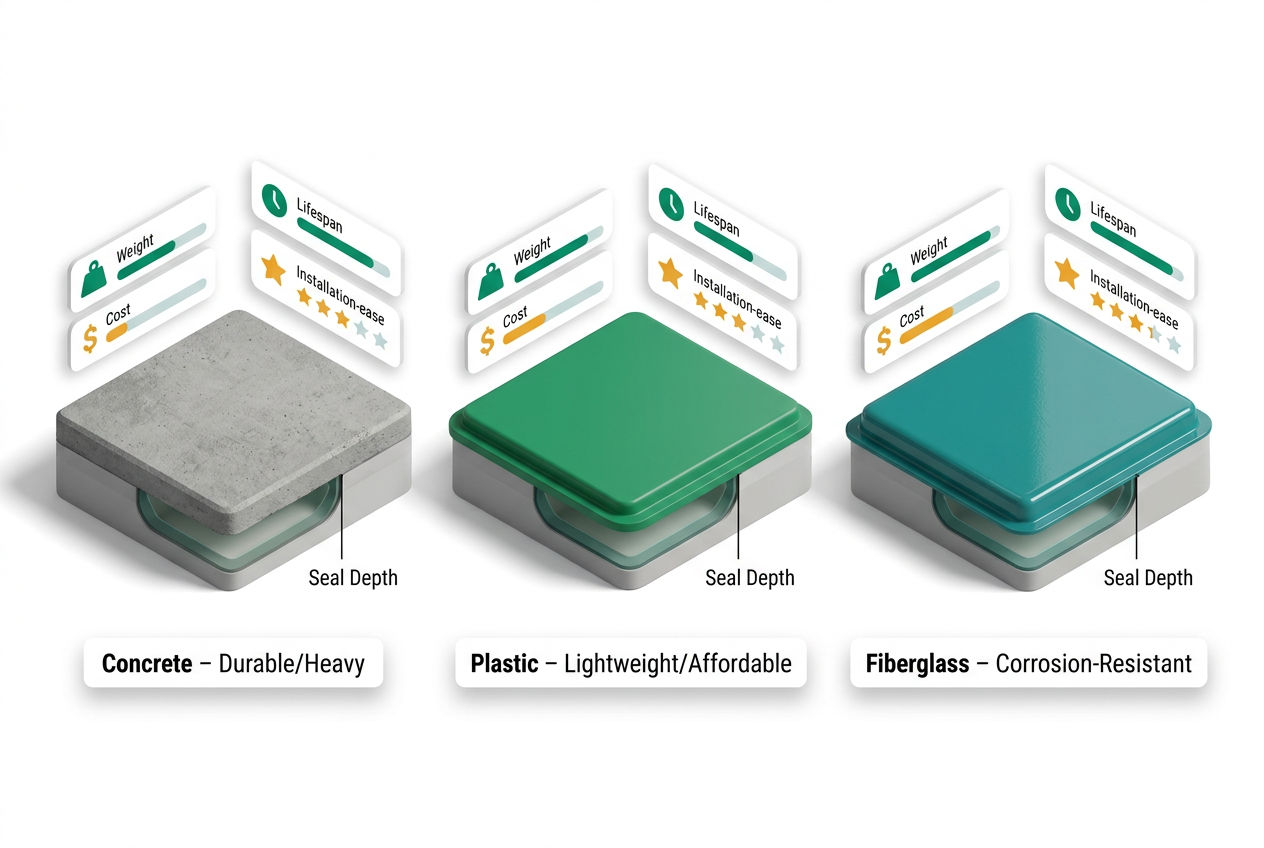
Concrete Septic Tank Covers
Concrete lids are what most older systems use. If your tank was installed before the mid-1990s, there's a good chance you've got solid concrete covers buried a foot or two underground. They're heavy — figure 50–120 lbs for a standard 24" round lid — and they were built to last. Under ideal conditions, a concrete lid holds up for 20–40 years.
The problem is freeze-thaw cycles. In the Northeast and Upper Midwest, ground movement from repeated freezing and thawing cracks concrete lids over time. A hairline crack might seem minor, but it lets in rainwater and snowmelt, which dilutes the tank's bacterial environment and increases pump-out frequency. A fully cracked lid is a structural hazard — 100 lbs of broken concrete sitting over a 6-foot drop.
Replacement concrete lids run $50–$200 depending on size. The bigger issue is lifting them. You'll need two people and a plan for a 120-lb lid.
Plastic Septic Tank Lids and Polymer Covers
Modern plastic septic tank lids — specifically high-density polyethylene (HDPE) or ABS polymer — have taken over new installations. These lids weigh 5–25 lbs. One person can handle them. They don't crack from freeze-thaw movement, and UV-stabilized models carry expected lifespans of 20–50 years.
Infiltrator Water Technologies and Polylok both manufacture polymer lids that are widely used in residential systems. A Polylok PL-122 riser lid, for example, is a ribbed HDPE design specifically engineered to lock down and resist uplift. Cost runs $30–$150 depending on diameter and brand.
The honest limitation: cheaper plastic lids can warp in extreme heat. In the Southwest, a black plastic lid baking in direct sun in Phoenix can degrade faster than the 20-year estimate. Go with a lighter color or cover it with a decorative feature if you're in a hot, sunny climate.
Fiberglass Septic Tank Covers
Fiberglass lids are the middle ground — lighter than concrete, stiffer than plastic, and highly corrosion-resistant. They're common in the Southeast, where acidic soils eat through concrete faster and plastic can feel flimsy. Fiberglass typically lasts 30+ years and handles moisture well. Expect to pay $60–$180 for a replacement fiberglass lid.
Decorative Septic Tank Covers
These are landscape-integration products designed to look like rocks, garden features, or planter bases. They sit over an existing riser or ground-level lid. Quality faux rock covers from brands like ResiRock run $40–$250. They're a legitimate solution if you're tired of staring at a green plastic dome in the middle of your yard.
One thing they can't do: replace a structurally sound lid. A decorative cover goes over a proper access lid, not instead of one.
Septic Tank Cover Size Guide
Getting the size wrong means making a second trip to the hardware store. Here's what's standard:
| Lid Type | Common Sizes | Typical Weight | Material Options |
|---|---|---|---|
| Round (standard) | 20", 24", 30" dia. | 5–120 lbs | Concrete, HDPE, fiberglass |
| Rectangular (older tanks) | 16"×24", 24"×24" | 40–100 lbs | Concrete |
| Riser lids | 12", 20", 24" dia. | 5–25 lbs | HDPE, fiberglass |
| Traffic-rated (H-20) | 24", 30" dia. | 80–200 lbs | Concrete, cast iron |
Source: Infiltrator Water Technologies product specifications; EPA septic system guidance
Standard residential tanks — your typical 1,000 or 1,500-gallon concrete tank — most commonly use 24" lids. If you're replacing an old lid, measure the opening carefully before ordering. The outside diameter of the replacement needs to match (or slightly overlap) the opening, not just the hole itself.
Traffic-rated covers carry an H-20 load rating, which means they're engineered to handle approximately 16,000 lbs per wheel. If your tank is anywhere near a driveway or a surface vehicles cross, you need H-20 rated covers. A standard residential lid will not survive being driven over. The failure is sudden and catastrophic — not a slow sag you'll notice in advance.
How Do You Find a Buried Septic Tank Cover?
This is the number one question homeowners ask before a pump-out. You know the tank is out there. You just can't find the lid.
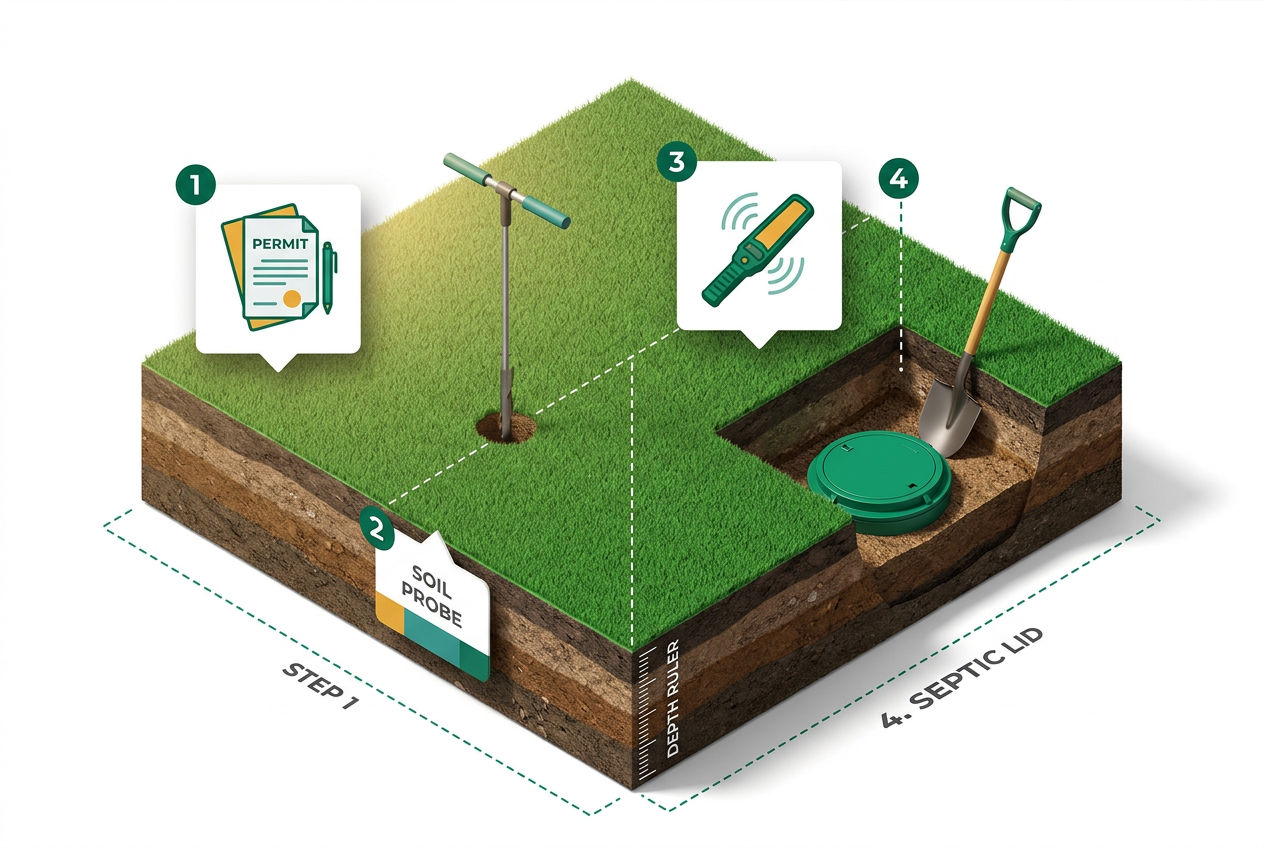
Here's the sequence that works:
- Start with your property records. Most county health departments have septic system permits on file, often with a rough diagram showing tank location. Call your county's environmental health office or check their online portal.
- Check the as-built drawing. If your home was built after 1980, there may be an "as-built" diagram attached to the permit — a sketch showing distances from the foundation or property corners.
- Follow the pipe. Your septic tank sits on the main sewer line leaving your house. In most homes, that line exits through the basement or crawlspace on one wall. The tank is typically 10–25 feet from the house in that direction. Probe the soil with a metal rod every few feet.
- Look for subtle grade changes. In spring, the grass over the tank warms up slightly faster — you may see a subtle green rectangle before the surrounding lawn greens up. In dry summers, the opposite: grass over the tank may go dormant faster.
- Use a soil probe or metal detector. Concrete and metal covers respond to a simple metal probe. Push it down every 12–18 inches in the likely zone.
- Call a professional. If the above fails, a locating service uses electronic ground probes or drain cameras to pinpoint the tank. Cost: $100–$400 depending on your region and how deep the burial is.
Our guide to how to find your septic tank covers covers this process in detail, including how to request county records. Once you find the lid, mark it permanently. A flush-mounted marker stake, a landscape rock, or a riser (more on that below) all work. Just mark it before the first snowfall.
Can You Replace a Concrete Septic Tank Lid With a Plastic One?
Yes — in most cases. Swapping a cracked concrete lid for a polymer replacement is one of the most common DIY septic jobs. The main requirements:
- The opening dimensions must match. A 24" concrete lid gets replaced with a 24" HDPE lid.
- The replacement lid must sit flush and stable over the opening without gaps.
- If the tank is on a slope or in a high-traffic area, a traffic-rated lid may be required.
What you can't do is swap to a lighter lid when the installation requires load-rated covers. Check whether any vehicles cross over the tank before you order a standard residential lid.
Some states have code requirements about cover materials. Washington State and Massachusetts both have stricter-than-average septic regulations. Check with your state's environmental health agency before replacing any structural component.
Our full guide on septic tank lid replacement walks through the process step by step, including how to handle the concrete disposal problem and what to do when the opening dimensions don't match standard sizes.
Should You Install a Septic Tank Riser?
If your lids are buried more than 6 inches below grade, the answer for most homeowners is yes — and the math makes the case quickly.
A septic tank riser is a vertical pipe section, typically 12–24 inches tall, that extends from the tank opening up to ground level. The riser lid sits flush with or just above the lawn surface. No digging. No guessing. Your pumper walks up, lifts the lid, and gets to work.
If you've ever paid a pumper $75–$150 extra to dig up your lids before they could even start the job, you understand the value immediately. At an average pump-out interval of 3–5 years, that's $150–$450 in avoidable dig-up fees over 10 years — against a riser installation cost of $200–$600 per opening.
A concrete tank with three buried lids and three risers installed runs $600–$1,800 total, depending on depth and labor rates. That pays for itself in avoided dig-up fees within two to three pump cycles.
Some states now require risers. Minnesota's MPCA and Washington's Department of Ecology both have regulations mandating that tanks be brought to grade level when major repairs or pump-outs occur. Check your state's requirements before your next service call.
For full specifications, installation process, and cost breakdown by region, see our septic tank risers guide.
How Much Does It Cost to Replace Septic Tank Covers?
Replacement costs depend on material, size, and whether you hire out the labor.

| Cover Type | Material Cost | DIY Feasible? | Pro Installation |
|---|---|---|---|
| Standard plastic lid (24") | $30–$80 | Yes | $150–$300 total |
| Concrete lid (24") | $50–$150 | Difficult | $200–$450 total |
| Fiberglass lid | $60–$180 | Yes | $175–$350 total |
| Traffic-rated H-20 lid | $100–$300 | No | $350–$700 total |
| Riser + lid (complete) | $100–$300 (materials) | Possible | $300–$700 per opening |
A concrete lid on a 1,500-gallon tank buried 18 inches down in rural New England is a different job than a plastic lid on a shallow tank in Georgia. Weight, depth, soil condition, and local labor rates all move the number.
Labor is the variable that catches people off guard. A straightforward lid swap on a shallow tank might run an hour of a plumber's or septic tech's time — $100–$200. A deep, heavy concrete lid that requires excavation and two-person lifting equipment can run $400–$600 before the lid itself is purchased.
For a complete cost breakdown including regional variation, permit requirements, and when to expect additional charges, see our septic repair cost guide. If you're dealing with a failing tank rather than just a cover, our septic tank replacement cost guide covers full system pricing.
Is It Safe to Drive Over a Septic Tank Cover?
Free download
Free: the Septic Fridge Card — what to flush, what never to.
The Do / Don’t card the whole family can see, plus the Survival Kit: emergency flowchart, warning-sign decoder and pump-schedule card. One printable PDF.
Not with a standard residential lid. This is where we stop talking about aesthetics and get serious about structural safety.
Standard residential septic covers — whether concrete or plastic — are rated for pedestrian traffic only. They are not designed to bear vehicular loads. A vehicle crossing over a standard lid creates point loads that can crack a concrete lid instantly or collapse a plastic one. The failure is not a warning sign situation. You won't notice a slow deformation and have time to react. The lid gives way and the vehicle drops partially into an open tank.
If your tank is in or near a driveway, parking area, or any surface that vehicles cross — including lawn equipment like riding mowers and skid steers — you need traffic-rated (H-20) covers. These are engineered to handle approximately 16,000 lbs per wheel. They're heavier and more expensive, but that's the appropriate cost of a safe installation.
If you have an existing standard lid in a vehicle-traffic zone, this is not a defer-until-next-year situation. Contact a septic contractor and get H-20 lids installed before the next time anything heavier than a lawn chair rolls over that ground.
How Do You Keep Septic Tank Covers From Being an Eyesore?
Green plastic domes and grey concrete slabs don't win any landscaping awards. But there are real solutions that work — and a few that look good while quietly creating access problems.
Decorative faux rock covers are the most popular option. Products like the ResiRock line of simulated rock covers sit over your existing riser or flush lid and blend into most landscape styles. Sizes range from covers for a single 24" riser up to large feature rocks that conceal multiple access points. Cost: $40–$250 depending on size and brand. They lift off easily for service access — your pumper doesn't need tools.
Planted borders around a flush riser lid work well if you keep the plants shallow-rooted and maintain a clear 12-inch ring around the lid itself. Ornamental grasses, hostas, and ground covers with fibrous (not deep tap) root systems are safe choices. What to avoid: shrubs, ornamental trees, or anything that will grow roots into the tank opening or make the lid inaccessible. See our guide on trees and plants near septic systems for safe species lists by region.
Painted concrete lids are an option for the truly budget-constrained. Exterior masonry paint in a natural earth tone makes a bare concrete lid less jarring. It won't help with a lid that's buried, but for a flush-mounted lid in a lawn, it blends reasonably well.
Garden art and statuary placed directly over a riser lid — a birdbath, a large pot, a garden sculpture — work aesthetically but create a service problem. If you do this, make sure your pumper knows what's there and that you can move it easily. A birdbath full of water on pump-out day adds unplanned time to the service call.
The underlying rule: any decorative treatment must allow full lid removal in under five minutes without tools. If it can't, it's an access problem waiting to become an emergency.
What Happens If a Septic Tank Cover Fails?
A failed septic tank cover — cracked through, collapsed, or missing entirely — creates three simultaneous problems: a safety hazard, an environmental hazard, and a system performance problem.
Safety: An open or compromised tank is a confined-space danger. The gases inside — hydrogen sulfide, methane, carbon dioxide — are heavier than air and displace oxygen in the tank void. A child who falls in faces drowning. An adult who goes in to help faces gas incapacitation before they reach the bottom. The CDC and OSHA both document fatalities from non-permitted confined-space entry into septic tanks. An open lid is not a maintenance item — it's an emergency.
Environmental: A failed lid exposes the tank to surface runoff. In a heavy rain event, a tank with an open or cracked lid can take in hundreds of gallons of rainwater. That hydraulic overload pushes under-treated effluent into the drain field before the normal settling process completes. Repeated overloading is one of the leading causes of premature drain field failure. Drain field replacement costs $3,000–$15,000. A $100 lid is not the place to defer maintenance.
System performance: Surface water dilutes the bacterial colonies that break down solids in your tank. Fewer bacteria mean slower digestion, faster sludge accumulation, and more frequent pump-outs. A tank that should be pumped every 3–5 years may start needing service every 1–2 years after a season of water intrusion through a failed lid.
If you find a cracked, broken, or missing lid, cover the opening temporarily with a solid board weighted down with concrete blocks — not a tarp, not plywood alone — and schedule replacement within 48 hours. This is not a wait-and-see situation. Connect with a local septic service provider who can assess the damage and replace the cover before your next pump-out is due.
Annual Septic Tank Cover Safety Inspection Checklist
You don't need a professional to do a basic annual cover check. Walk your tank area once a year — spring is ideal — and look for:

- Surface cracks — Run your hand across the lid surface. Hairline cracks in concrete are worth monitoring; cracks wide enough to fit a finger are worth replacing immediately.
- Movement or rocking — A lid that shifts when you step on it has lost its stable seat. Either the opening rim has cracked or the lid no longer fits properly. Both are replacement triggers.
- Hollow or soft feel underfoot — This suggests the lid has cracked through and is now resting on nothing solid. Do not walk on it again. Flag it and call a contractor.
- Rust on fasteners or lid edges — Metal fasteners on cast iron or older steel-reinforced concrete lids that show through-rust are structural failures waiting to happen.
Also check from the perimeter: soft, wet soil around the lid edge can indicate a lid seal failure allowing surface water in or effluent seeping out. Either direction of water movement through the lid joint is a problem.
Frequently Asked Questions About Septic Tank Covers
What size are most septic tank covers?
Most residential septic tank covers use one of three standard diameters: 20 inches, 24 inches, or 30 inches, with 24 inches being the most common size for tanks installed between the 1970s and present. Older rectangular tanks — particularly pre-1960s concrete tanks — sometimes use rectangular lids measuring 16"×24" or 24"×24" rather than round openings. Riser lids, which sit at grade level after a riser extension is installed, typically come in 12", 20", and 24" diameters depending on the riser manufacturer. Traffic-rated H-20 covers are usually 24" or 30" in diameter to accommodate the reinforced construction required for vehicular loads. Before ordering any replacement lid, measure the actual tank opening diameter — the dimension you need is the opening itself, not the old lid's outer edge. Some manufacturers' lids run slightly larger than nominal size to ensure overlap, so verify compatibility with your specific tank and riser model before purchasing.
How do I know if my septic tank lid needs replacing?
Your septic tank lid needs replacing if you can see visible cracks that run through the material rather than just surface scratches, if the lid shifts or rocks when you step on it, or if it feels soft or hollow underfoot — which signals it has cracked through and is no longer structurally supported. Concrete lids that show rust staining (from internal rebar corrosion) or that have developed chunks missing from the edges are also replacement candidates. For plastic lids, look for warping, UV bleaching with surface crazing, or edges that no longer sit flush against the opening rim. A lid that lets surface water into your tank — visible as water staining around the joint after rain — is compromised even if it looks intact. Annual visual and tactile inspection takes less than five minutes and catches these problems before a lid fails suddenly under foot traffic or equipment weight.
What is a septic lid replacement cost?
Septic lid replacement costs typically range from $30 to $450 depending on material, size, and whether you hire professional installation. A standard 24-inch HDPE or plastic septic tank lid costs $30–$80 in materials and is a straightforward DIY replacement for most homeowners — total out-of-pocket under $100. A concrete replacement lid of the same size runs $50–$150 for the material, but the 80–120 pound weight makes professional installation practical for most people, bringing the total to $200–$450. Fiberglass lids fall in the $60–$180 range for materials, with similar installation costs to plastic. Traffic-rated H-20 lids — required anywhere vehicles cross the tank — cost $100–$300 for the lid plus $350–$700 installed. If you need a riser installed at the same time to bring the lid to grade level, budget an additional $200–$500 per opening for materials and labor. Regional labor rates vary significantly — expect higher costs in the Northeast and Pacific Coast states.
Can I cover a septic tank lid with dirt or grass?
You can cover a septic tank lid with a thin layer of topsoil and grass — and many older installations were done exactly that way — but it creates real problems at service time. A buried lid means your septic pumper must locate and excavate before they can open the tank, which typically adds $75–$400 to your pump-out cost depending on burial depth and how easily the lid can be found. Over time, soil and grass also obscure whether the lid is cracking or shifting, removing your ability to do a meaningful visual inspection. The better solution for buried lids is to install a riser extension that brings the access point to grade level, topped with a flush-mounted riser lid. This one-time investment of $200–$600 per opening eliminates excavation costs for the life of the tank. In some states — including Minnesota and Washington — regulations now require that tanks be brought to grade level when service work is performed.
How long do septic tank covers last?
Septic tank cover lifespan depends heavily on material and installation conditions. Concrete lids last 20–40 years under normal conditions but degrade faster in climates with severe freeze-thaw cycles — Northeast and Upper Midwest homeowners often see concrete lid failures at the 15–25 year mark due to ground movement cracking. HDPE plastic lids rated with UV stabilization carry manufacturer estimates of 20–50 years; non-UV-stabilized plastic degrades significantly faster in high-sun climates like the Southwest and should be inspected every 5 years for surface crazing and warping. Fiberglass lids are the most durable in terms of corrosion resistance, commonly lasting 30 or more years in high-moisture and acidic-soil environments like the Southeast. All lid types regardless of material should be inspected annually rather than assumed to be performing until they visibly fail — a lid that looks intact from the surface may have cracked through underneath without any external warning sign.
Is a decorative septic tank cover worth it?
A decorative septic tank cover — typically a faux rock or simulated stone product placed over an existing flush riser lid — is worth it for most homeowners who dislike the look of visible access lids in their yard, with one important condition: the decorative cover must allow full service access in under five minutes without requiring tools or significant effort. Quality products like the ResiRock faux rock series, priced between $40 and $250 depending on size, sit over your riser lid and lift off cleanly so your pumper can open the tank without difficulty. What makes a decorative cover worthwhile versus problematic is the installation: a faux rock placed directly over a recessed lid that still requires excavation provides no functional improvement. The decorative value only works when combined with a properly installed riser that brings the real lid to grade. If you have both a grade-level riser lid and a quality decorative cover over it, you get aesthetics and function without tradeoffs.
What is the difference between a septic tank cover and a septic tank riser?
A septic tank cover — also called a septic tank lid — is the physical cap that seals the opening of your tank. A septic tank riser is the vertical pipe extension that connects your tank's buried opening to ground level, with the cover sitting on top of the riser rather than directly on the tank. Together they form a complete access system: the riser provides the pathway, the lid seals it. On older systems without risers, the tank cover is buried directly over the tank opening — sometimes 12–36 inches underground — requiring excavation before every pump-out. On modern or upgraded systems with risers, the cover sits flush with or just above the lawn surface, making it immediately accessible. The riser itself is typically made of HDPE or PVC pipe in 12", 20", or 24" diameter sections that stack and connect down to the tank opening. Most septic professionals recommend adding risers to buried tanks during the next pump-out service, converting the system to grade-level access permanently.
Sources & Methodology
This guide draws on the following sources:
- U.S. Environmental Protection Agency — Septic Systems Overview: household count data, safety classification of open tanks
- Infiltrator Water Technologies — Product specifications for HDPE riser and lid systems, size and load rating data used in the size guide table
- Polylok, Inc. — PL-122 riser lid specifications, HDPE design and uplift resistance data
- Minnesota Pollution Control Agency (MPCA) — Minnesota Individual Sewage Treatment System rules, riser-to-grade requirements
- Washington State Department of Ecology — On-site sewage system regulations, cover and access requirements
- CDC / OSHA — Confined-space hazard classifications and fatality documentation for septic tank entry
- ResiRock — Decorative cover product specifications and sizing
Cost ranges reflect contractor pricing data collected from septic service providers across multiple U.S. regions. Regional ranges are based on aggregated service call data and do not represent any single provider's rates. All regulatory information should be verified with your local or state environmental health authority before performing any septic system modification.
Was this article helpful?
Frequently Asked Questions
Recommended Resources
Find Septic Professionals Near You
Compare licensed, verified septic companies by area — top county markets and cities below, or browse all 50 states.
County markets
Popular cities
