
Learn how septic tank bacteria break down waste, what kills them, and whether you need additives. Science made simple for homeowners. Updated 2026.
Quick Answer
Published: January 15, 2026 · Updated: January 15, 2026
Septic tank bacteria are the living engine behind every properly functioning septic system. Without them, solid waste doesn't break down, sludge fills your tank within months, and your drain field clogs with undigested organic material. Roughly 21 million U.S. households depend on septic systems, according to the EPA — and every single one depends on bacteria doing their job quietly underground.
💡 Key Takeaways
- A healthy septic tank contains up to 2 billion microorganisms per gallon of wastewater
- Three types of bacteria work your system: anaerobic, aerobic, and facultative
- Household bleach, antibiotics, and harsh cleaners can kill off bacterial colonies
- Most state health departments say bacterial additives are unnecessary for a properly maintained system
- Pumping every 3–5 years (EPA recommendation) protects your bacterial ecosystem more than any additive
Your septic tank isn't a holding container — it's a biological reactor. Wastewater enters from the house, spends 24–48 hours inside the tank, and exits as partially treated effluent into the drain field. During that retention period, bacteria are actively decomposing organic waste, reducing solids, and maintaining the three-layer structure that makes the whole system work.
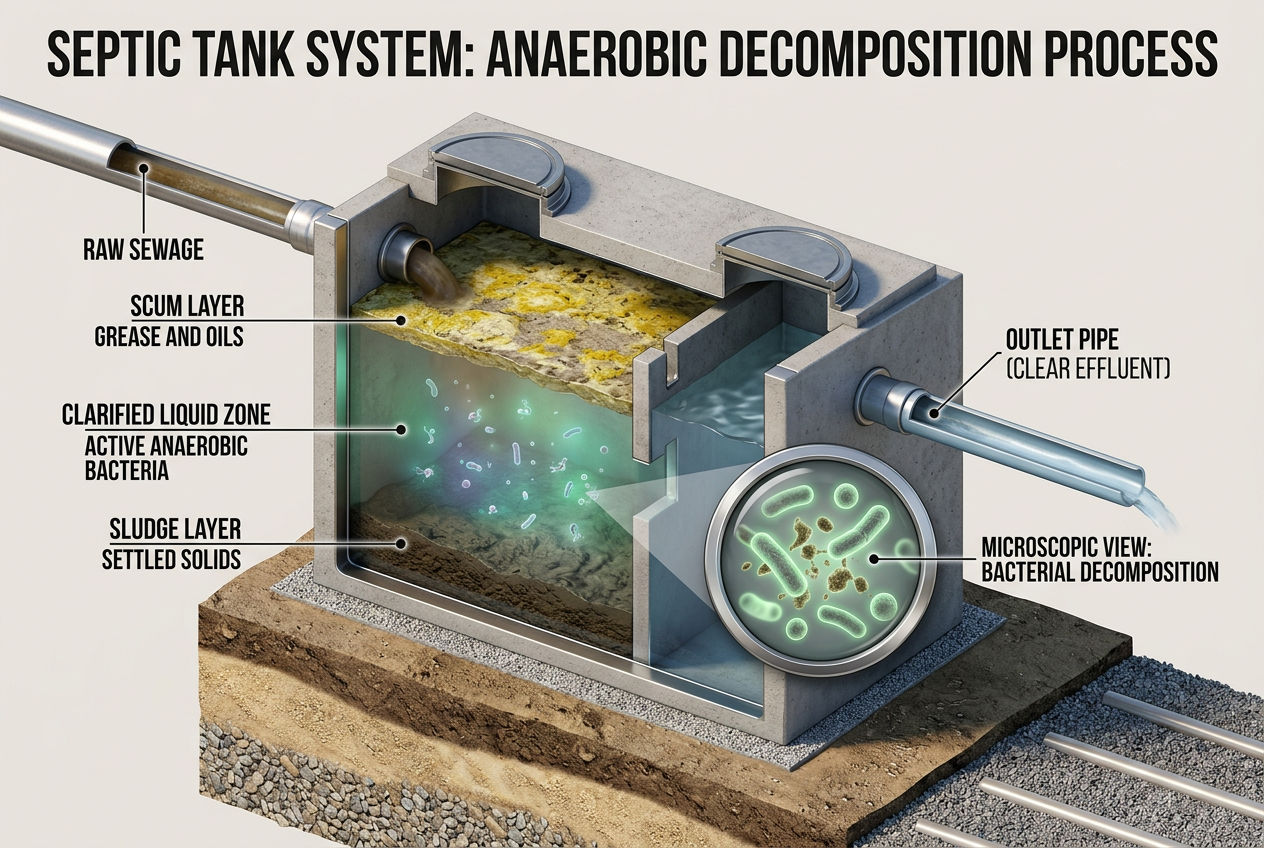
Those three layers are:
📊 Quick Fact: In a standard 1,000–1,500-gallon residential tank, bacterial activity reduces solid waste volume by approximately 40–50%. Without bacteria, you'd be pumping every few months instead of every 3–5 years.
Even with healthy bacterial colonies doing their best, a 1,000-gallon tank serving a 4-person household still needs pumping every 3–4 years — add a garbage disposal and that drops to roughly every 2 years. You can read more about how often to pump your septic tank and what drives that timeline.
Three distinct bacterial populations do the work inside a healthy septic system. Most homeowners have heard of two. The third — facultative bacteria — is where competitors consistently fall short in their explanations, and it's arguably the most important category.
Anaerobic bacteria thrive without oxygen. They dominate the lower sludge zone of your tank and are responsible for the bulk of solid waste decomposition — a process called anaerobic digestion. These microorganisms break complex organic compounds into simpler substances:
They work slowly but steadily. Anaerobic digestion is less efficient than aerobic breakdown but requires no aeration infrastructure, which is why conventional septic tanks are sealed environments. The sludge layer is their territory.
⚠️ Warning: Bacterial activity is temperature-sensitive. The optimal range for anaerobic bacteria is 77°F–95°F. Below 50°F, activity slows dramatically. If you're in Minnesota, Wisconsin, or the upper Midwest and your tank is buried less than 48 inches deep, bacterial processing can slow to a crawl through January and February.
Aerobic bacteria require oxygen. They're largely absent from the main septic tank in a conventional system (which is sealed), but they're critical in two places:
In the drain field, aerobic bacteria form part of the biomat — a dense biological layer that develops at the soil interface and provides a final stage of pathogen removal. A thin, healthy biomat actually improves treatment. An overgrown biomat (often caused by too much undigested solids reaching the field) blocks drainage and causes drain field failure.
✅ Pro Tip: In purpose-built aerobic septic systems, aerobic bacteria handle most of the digestion. These systems discharge higher-quality effluent but require electricity, more maintenance, and annual service contracts. You can compare the two approaches in this aerobic vs. anaerobic septic system breakdown.
Here's what almost no one tells you: facultative bacteria can operate in both oxygen-rich and oxygen-deprived environments. They live throughout the mid-zone of the tank — the effluent layer — and act as a biological bridge between the anaerobic sludge layer and the oxygen-exposed zones above.
When oxygen levels fluctuate (which they do every time a toilet flushes, a washing machine drains, or heavy rain infiltrates), facultative bacteria keep working while the strict anaerobes and aerobes temporarily pause. They're the reason your system doesn't crash every time conditions shift.
⚠️ Warning: Protecting facultative bacteria is one of the strongest arguments against using harsh chemical drain cleaners — they disrupt the mid-zone ecology more than most homeowners realize.
The breakdown process begins the moment wastewater enters the tank.
📊 Quick Fact: The biological oxygen demand (BOD) of effluent leaving a healthy tank is significantly lower than incoming waste — meaning bacteria have already consumed most of the organic material that would otherwise demand oxygen from the receiving environment.
That's why a failing septic system that bypasses bacterial treatment creates serious water quality problems downstream. For a broader look at how all the components connect, see how a septic system works.
| Condition | Bacterial Activity | Notes |
|---|---|---|
| 77°F–95°F soil temp | Optimal | Peak digestion rate |
| 50°F–77°F soil temp | Reduced | Normal in shoulder seasons |
| Below 50°F | Significantly slowed | Northern winters; cold tanks |
| pH 6.5–7.5 | Optimal | Neutral to slightly acidic |
| pH below 6.0 | Suppressed | Excess cleaning products |
| pH above 8.0 | Suppressed | Excess lime or softener salt |
Source: EPA Septic Systems guidance; University of Minnesota Extension Service
This question comes up constantly, especially on product labels at the hardware store.
| Characteristic | Bacteria | Enzymes |
|---|---|---|
| Lifespan | Reproduce continuously | Single-use, consumed in reaction |
| Function | Ongoing waste digestion | Speed up specific breakdown reactions |
| Common types | Anaerobic, aerobic, facultative | Protease, lipase, amylase, cellulase |
| Can replace pumping? | No | No |
| Best used for | Restoring depleted colonies | Breaking surface clogs faster |
A product labeled "enzyme treatment" helps break surface-level clogs faster. A product labeled "bacterial treatment" adds living microorganisms to the ecosystem. Some products include both.
💡 Key Takeaway: Neither eliminates the need for pumping. Neither reverses a failing drain field. Our full guide to septic tank additives walks through the peer-reviewed research on both categories.
This is the practical question most homeowners actually need answered. Several common household products and habits directly harm bacterial colonies.
Can too much water kill septic bacteria? Not directly — but excessive water flow (hydraulic overload) flushes effluent through the tank before bacteria have adequate time to work. Remember that 24–48 hour retention window.
⚠️ Warning: If a household runs 10 loads of laundry in a day, hosts 20 guests over a long weekend, or has a leaking toilet running continuously, wastewater moves through too fast for effective bacterial digestion. Solids carry over into the drain field.
The biomat guide explains what happens next.
Bacterial activity drops sharply below 50°F. In northern climates, tanks buried shallower than 48 inches and with minimal insulating snowpack can experience significant winter slowdown. This isn't failure — it's dormancy. Activity resumes in spring.
However, a system already stressed by other factors can tip into actual failure during a cold winter. Protecting your septic pipes from freezing is part of the same overall strategy.
Probably not — if your system is functioning normally and you're following basic maintenance practices.
A healthy septic system generates its own bacterial population from the organic waste entering it daily. Human waste alone introduces enormous quantities of viable bacteria with every flush. A properly functioning 1,000-gallon tank already contains up to 2 billion microorganisms per gallon. Adding a packet of Rid-X introduces a comparatively small number of bacteria into an environment that already has more than it needs.
📊 Quick Fact: Multiple state health departments have reviewed the evidence and concluded that additives are unnecessary for properly maintained systems. Washington State's Department of Health states that no scientific evidence exists that biological additives benefit properly functioning septic systems. Ohio and Minnesota health agencies echo that position.
The National Sanitation Foundation (NSF) has noted that some biological additives can actually increase suspended solids in effluent, which risks clogging drain field soil over time.
The exception: After a system has been dormant for months (vacant vacation property), after a major bacterial kill event (solvent spill, extreme bleach use), or after a new system installation, a single bacterial treatment product can help kickstart colonization faster than waiting for natural re-establishment.
Our Rid-X review breaks down what these products actually do — and what they don't.
⚠️ Warning: No additive will reverse a failing drain field. If you're seeing warning signs of septic problems, you need a professional inspection, not a box of bacteria from the hardware store.
The best bacterial additive for your septic tank is the one you're already producing naturally — as long as you don't sabotage it.
Spring (April–May): In cold-climate states, bacterial activity ramps back up as soil temperatures rise above 50°F. This is also the highest-risk period for drain field saturation from snowmelt — heavy rain and septic systems explains the hydraulic side of this.
Summer: Peak bacterial activity, but also peak water usage. Guest visits, outdoor hose use, and vacation rentals can overwhelm a tank that's already approaching its pumping interval.
✅ Pro Tip: Monitor your system's performance during peak-use seasons. If you notice slow drains or gurgling sounds, it may be time for pumping even if you're not at the typical 3–5 year interval.
Compare top-rated companies in your area. Get free, no-obligation quotes from verified providers.
Was this article helpful?
Connect with licensed, verified septic companies in your area.
Get estimates from licensed, verified companies in your area. No obligation.
⚡ Average response time: under 2 hours