
Planning a septic system for your tiny home? Compare all system types, costs ($1,500–$25,000), tank sizes, composting toilet options, and permit rules before you build.
Quick Answer
A septic system for a tiny home requires a minimum 500–750 gallon tank in most states, a permitted drain field, and a percolation test before installation. Installed costs range from $3,000 for a basic conventional system to $20,000+ for an aerobic treatment unit on a difficult lot. The right system depends on your soil, your state, and whether your home has wheels or a foundation.
💡 Key Takeaways
- Most states require a minimum 750-gallon septic tank regardless of home size — a few allow 500-gallon tanks for small dwellings
- Tiny houses on wheels (THOWs) are typically classified as RVs and cannot use a permitted residential septic system the same way a foundation home can
- A composting toilet can reduce septic load but is not a legal standalone wastewater solution in most jurisdictions
- Conventional small septic systems cost $3,000–$8,000 installed; aerobic treatment units run $10,000–$20,000
- A percolation test ($250–$1,000) and a septic permit ($200–$1,500) are required before any installation
Most tiny homes on permanent foundations are legally required to have a permitted wastewater system — and in most rural or unincorporated areas, that means a septic system. If your property has no municipal sewer connection available, there is no legal path around it. A tiny home is still a dwelling, and human waste disposal is regulated at the state and county level in all 50 states.
The exception is a tiny house on wheels (THOW). Because most states classify a THOW as a recreational vehicle, it falls under RV regulations rather than residential building codes. That means you can often use an RV holding tank and dump at a licensed dump station — but you cannot hook into a residential septic system without specific county approval, and you definitely cannot just let it drain into the ground.
Even if you plan to use a composting toilet, you'll likely still need a permitted system for greywater (sink, shower, and laundry drainage). Many homeowners are surprised to learn that greywater cannot legally drain onto the soil surface or into a simple French drain in most states. Check with your county health department before assuming composting toilets eliminate your septic requirements.
⚠️ Warning: A composting toilet does not eliminate your septic requirements. You still need a permitted greywater disposal system in nearly every U.S. state — sinks, showers, and laundry all produce regulated wastewater.
⚠️ Don't Skip This Step — Call your county health department before you buy land or start building. A 10-minute phone call can confirm whether your planned wastewater approach is even legal in that jurisdiction, and it costs nothing.
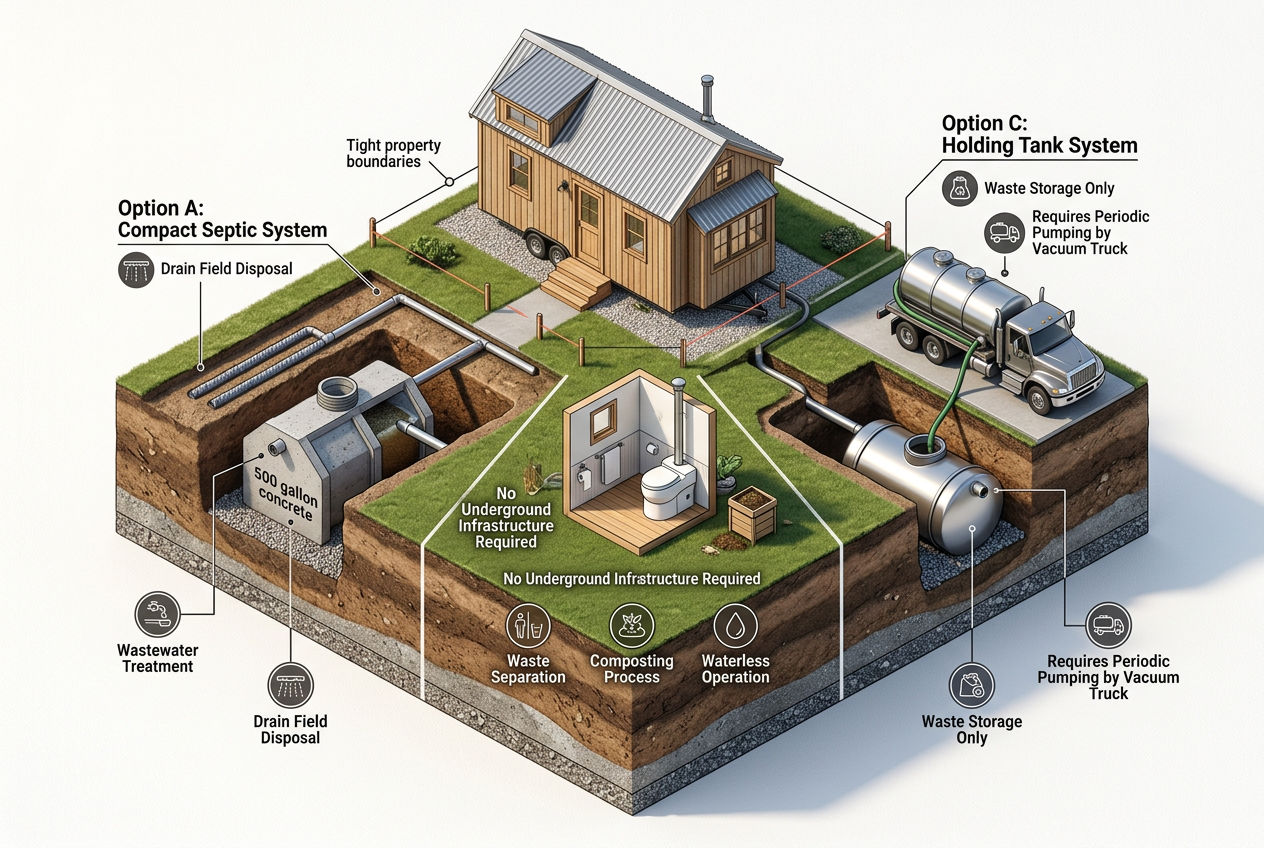
Small footprints call for creative solutions. Here are the six system types most relevant to tiny home builds, compared across cost, footprint, and suitability.
| System Type | Installed Cost | Best For | Limitation |
|---|---|---|---|
| Conventional septic | $3,000–$8,000 | Good soil, adequate lot | Needs perc-passing soil |
| Aerobic treatment unit (ATU) | $10,000–$20,000 | Poor soil, tight lots | Higher maintenance cost |
| Mound system | $10,000–$25,000 | High water table | Large above-ground footprint |
| Holding tank (pump-out) | $1,500–$5,000 + $200–$400/pump | Temporary or remote use | Not a true septic; ongoing cost |
| Composting toilet + greywater | $1,000–$5,000 | Off-grid where permitted | Illegal as sole solution in many states |
| Incinerating toilet + greywater | $2,000–$6,000 | Off-grid, small footprint | High energy use; still needs greywater plan |
Source: National Onsite Wastewater Recycling Association (NOWRA) cost benchmarks; regional installer data.
Conventional septic systems are the most affordable option where soil conditions allow. A standard small system pairs a 750–1,000 gallon concrete or plastic tank with a drain field (also called a leach field) of 150–300 square feet. The tank size is modest, but the drain field still needs room to breathe. If your lot is smaller than a half-acre, this can become a problem fast. For more on the different types of septic systems, our breakdown covers each in detail.
Aerobic treatment units (ATUs) are the go-to solution when soil fails a perc test or the lot is too small for a conventional drain field. An ATU uses an aerator compressor — often a Hiblow HP-80 or similar unit — to inject oxygen into the treatment chamber, accelerating bacterial breakdown. The treated effluent is cleaner than conventional septic output, which is why it's approved for tighter setbacks in many states. The trade-off is cost and ongoing maintenance: most ATUs require a service contract and quarterly inspections.
Mound systems work where the water table sits high or the soil is too dense for a buried drain field. The system pumps treated effluent up into an engineered sand mound above grade. They work well in Florida and parts of the upper Midwest, but the mound itself — typically 2–4 feet tall and 20–40 feet long — is hard to hide on a tiny property. See our full guide on mound septic systems if this is your likely path.
Holding tanks are exactly what they sound like: a sealed underground tank that collects all wastewater with no treatment. A 500–1,000 gallon tank fills up fast. Two people generating 100–150 gallons per day will need a pump-out every 5–10 days. That's $200–$400 every week or two. Holding tanks are a legal temporary solution in some jurisdictions, but they're not sustainable for full-time living.
⚠️ Warning: A holding tank may look cheap upfront ($1,500–$5,000), but the ongoing pump-out costs of $200–$400 every 5–10 days add up to $7,000–$29,000 per year for full-time occupants. This option only makes sense for temporary or seasonal use.
The smallest septic tank most states allow for a residential dwelling is 750 gallons, though a handful of states permit 500-gallon tanks for dwellings classified as "alternative" or limited-occupancy homes. Health departments almost universally size systems by bedroom count, not square footage — so a 200-square-foot tiny home with one bedroom is treated the same as a 1,200-square-foot one-bedroom cottage.
Here's a practical example: a one-bedroom tiny home occupied by two adults generates roughly 100–150 gallons per day of combined blackwater (toilet waste) and greywater (sinks, shower, laundry). A 750-gallon tank holds about 5–7 days of flow before needing biological treatment. That's within normal parameters for a conventional system, but it does mean less buffer than a larger home — and more frequent pump-outs.
For reference, the EPA recommends pumping when the combined sludge and scum layers occupy more than one-third of the tank's liquid volume. For a 750-gallon tank, that threshold arrives faster than it does for a 1,500-gallon tank. Expect to pump a small conventional system every 1–2 years rather than the 3–5 year schedule typical for larger homes. Budget accordingly — pump-out costs run $275–$500 depending on your region. Check how often to pump your septic tank for a full schedule breakdown.
📊 Quick Fact: A 750-gallon tank serving two occupants needs pumping every 1–2 years at $275–$500 per visit — roughly double the frequency of a standard 1,500-gallon residential tank.
The drain field also needs proper sizing based on soil type and daily flow. Sandy soils can handle more volume per linear foot of trench; clay soils require more field area. This is what the percolation test determines.
Composting toilets are appealing for off-grid tiny home builds — they use no water, produce no blackwater, and eliminate the toilet's contribution to your wastewater load entirely. A quality unit like the Nature's Head or Sun-Mar Excel runs $900–$1,200 installed and requires emptying the compost drawer every 4–6 weeks for a two-person household.
But here's what most tiny home blogs won't tell you: composting toilets are not a legal standalone wastewater solution in most U.S. states. Even if your toilet produces zero blackwater, you still have greywater from your sink, shower, and washing machine. That greywater needs a permitted disposal pathway — usually a small septic tank or an engineered greywater system.
States like Oregon, Texas, and Montana have more permissive greywater codes. Oregon's DEQ, for example, allows permitted greywater systems that disperse below-grade with a surge tank. Texas OSSF regulations include a greywater reuse pathway. But in many Northeastern and Midwestern states, greywater must be treated through a full septic system regardless of what handles the blackwater.
The 10-year cost comparison is illuminating. A composting toilet plus a simple greywater system might cost $3,000–$6,000 upfront where permitted, with $100–$200/year in maintenance. A conventional small septic runs $3,000–$8,000 upfront plus $300–$500 every 1–2 years for pumping. Over 10 years, the costs converge — but the composting route only makes sense if your jurisdiction actually allows it.
💡 Key Takeaway: Over 10 years, composting toilet + greywater system costs converge with conventional septic costs ($5,000–$10,000 total). The composting route only saves money if your jurisdiction actually permits it — otherwise, you'll pay for both systems.
Incinerating toilets (brands like Cinderella or Incinolet) are another off-grid option. They burn waste to ash using propane or electricity, leaving a small ash residue to empty weekly. Cost runs $2,000–$4,000 for the unit plus installation. Like composting toilets, they still leave you needing a greywater solution.
A conventional small septic system for a tiny home costs $3,000–$8,000 installed in most regions, including tank, drain field, and basic labor. That's the best-case number — good soil, accessible lot, no rock ledge. Problem sites push costs significantly higher.
Before any installation costs, you're paying $250–$1,000 for a percolation test (perc test) and $200–$1,500 for a septic system permit, depending on your county. These aren't optional. No licensed contractor will install a system without them, and no county will approve a system that wasn't permitted. A professional septic inspection can also help evaluate an existing system on a property you're considering.
For the full picture of what installation costs by system type, our septic installation cost guide breaks down regional pricing in detail. And once your system is in, factor in the ongoing pump-out costs — for a small tank, that's a real annual budget line.
If you're buying land and want a rough budget, here's a realistic scenario: a half-acre lot in rural Tennessee, sandy loam soil, one-bedroom tiny home foundation build. Perc test: $350. Permit: $400. 750-gallon plastic tank plus 200 sq ft of Infiltrator chamber leach field: $5,200 installed. Total before the house itself: roughly $6,000. That's a reasonable baseline for favorable conditions.
📊 Quick Fact: In the Tennessee example above, the $6,000 total septic cost represents roughly 8–15% of a typical tiny home build budget ($40,000–$75,000). On a challenging lot requiring an ATU, septic alone could reach 25–40% of total project cost.
💡 Budget Tip — Always get the perc test done before closing on land. If the soil fails, you're looking at an ATU or mound system that could triple your septic budget — or the lot may not support any on-site system at all.
Every state regulates on-site wastewater treatment, but enforcement happens at the county level in most places. There is no single national tiny home septic standard. What's allowed in Bexar County, Texas may be illegal in Fulton County, Georgia.
That said, the general process is consistent:
For ADUs (accessory dwelling units) — a tiny home built in a backyard or on a larger residential property — many counties now allow connection to the existing septic system if it was originally sized with adequate capacity. If the existing system was sized for a 3-bedroom home at 1,000 gallons and you're adding a 1-bedroom ADU, the math may work. If not, the existing system requires an upgrade or the ADU needs its own system. Our article on septic systems for small lots covers shared-property scenarios in more depth.
Setback requirements are another factor. Most jurisdictions require 50–100 feet between a septic system and any well, 10–25 feet from property lines, and 10 feet from any structure. On a small lot, these setbacks can make a legal system impossible — which is exactly why checking with the county before buying land is critical.
⚠️ Warning: On lots under half an acre, setback requirements alone (50–100 ft from wells, 10–25 ft from property lines, 10 ft from structures) can eliminate every possible drain field location. Always map setbacks before purchasing land.
This is the distinction most tiny home content completely misses. Your sewage rules are almost entirely determined by how your home is classified — not how big it is.
Tiny house on a permanent foundation: Treated as a residential dwelling in most jurisdictions. Requires a permitted septic system or sewer connection, just like any other house. Subject to state health department regulations and county building codes. This is the path for anyone who wants a legal permanent residence.
Tiny house on wheels (THOW): Classified as a recreational vehicle in most states. This means it falls under RV or mobile home regulations, not residential building codes. A THOW can legally use an RV-style holding tank and dump at a licensed dump station. It cannot, in most jurisdictions, permanently connect to a residential septic system without specific county approval — and many counties won't grant it. If a THOW sits on someone's property long-term, some counties will eventually require it to meet residential wastewater standards.
💡 Key Takeaway: How your tiny home is classified — foundation vs. wheels — matters more than its size for septic purposes. A foundation home follows residential septic rules; a THOW follows RV rules. This single distinction determines your entire wastewater compliance path.
The regulatory gap is real and frustrating for THOW owners. Some progressive counties — particularly in Oregon, Colorado, and parts of the Southeast — have created THOW-friendly zoning with provisions for semi-permanent utility hookups. But in most of the country, a THOW on private land is in a gray area that varies by how aggressively the county enforces its codes.
For a deeper comparison of how RV and residential septic systems differ, see RV septic vs. house septic.
Regulations vary widely. Here are the states where tiny home septic questions come up most often:
Texas operates under the OSSF (On-Site Sewage Facility) program, regulated by the TCEQ (Texas Commission on Environmental Quality) and delegated to county authorized agents. Texas allows composting toilets with an approved greywater system and has specific provisions for alternative dwellings. Minimum tank size is 750 gallons for a one-bedroom dwelling.
Oregon has some of the most progressive tiny home and alternative wastewater rules in the country. The Oregon DEQ permits greywater systems that disperse below-grade with a surge tank, making composting toilet setups more viable here than in most states. Tiny homes on foundations are treated as standard dwellings for septic purposes.
Florida requires all septic systems to be designed by a licensed professional engineer or registered environmental health specialist. The high water table in much of the state means mound systems and ATUs are common. Florida's minimum tank size is 900 gallons — larger than most states — which increases costs for tiny home builders.
Colorado has become increasingly THOW-friendly, with several counties creating zoning provisions for tiny homes on wheels with semi-permanent utility hookups. Septic rules are administered at the county level, and soil conditions vary dramatically from the Front Range to the Western Slope.
North Carolina requires a soil scientist to evaluate the site and an authorized agent to issue the improvement permit before any septic work begins. Minimum tank size is 750 gallons. The state has been relatively open to ATUs and innovative systems for challenging sites.
Building a tiny home is an exercise in thoughtful downsizing — and your septic system is no exception. The system that works best for you depends on your soil conditions, your lot size, your state and county regulations, and whether your home sits on a foundation or wheels.
Start with a call to your county health department. Get the perc test done before you commit to a property. Budget $4,000–$10,000 for a complete septic solution on a favorable site, and significantly more if conditions are challenging. And if you're going the composting toilet route, make sure your jurisdiction actually permits it before you build your entire wastewater plan around it.
The right system, properly permitted and installed, will serve your tiny home reliably for decades.
✅ Pro Tip: Before committing to any property or system, complete these three steps in order: (1) call the county health department, (2) get the perc test, (3) get a system design and cost estimate. Skipping any step — or doing them out of order — is the most common and most expensive mistake tiny home builders make.
Compare top-rated companies in your area. Get free, no-obligation quotes from verified providers.
Was this article helpful?
Connect with licensed, verified septic companies in your area.
Get estimates from licensed, verified companies in your area. No obligation.
⚡ Average response time: under 2 hours