
Quick Answer
Septic drain field repair costs $1,500-$10,000 depending on the problem and the method your contractor uses to fix it. Not every failing drain field needs full replacement — in fact, most field problems can be resolved with targeted repairs like pipe jetting, lateral line replacement, or mechanical aeration that cost a fraction of a new field. This guide covers the six most common repair methods, what each costs, and how to determine whether repair or replacement is the right call for your situation.
Key Takeaways
- Most drain field problems can be repaired without full replacement ($1,500-$10,000 vs $5,000-$20,000+)
- Six repair methods: pipe jetting, lateral replacement, biomat treatment, aeration, terraling, and resting/diversion
- The right repair depends on what's failing — pipes, soil, or both
- A camera inspection ($200-$400) before any repair prevents wasting money on the wrong fix
- Full replacement is a last resort after targeted repairs have failed
A failing drain field doesn't automatically mean you need a $15,000 replacement. The symptoms — wet spots, slow drains, sewage odor — could be caused by a clogged pipe, compacted soil, or excessive biomat growth, and each of those has a targeted repair that costs far less than tearing everything out and starting over.
The problem is that some contractors default to full replacement because it's the easiest recommendation (and the biggest invoice). Understanding the specific repair methods available helps you ask the right questions, evaluate proposals, and avoid paying for more work than you actually need.
If you haven't yet identified what's causing your field problems, start with our drain field troubleshooting guide to narrow down the cause before requesting repair quotes.
Find a licensed drain field repair contractor on SepticTankHub.com
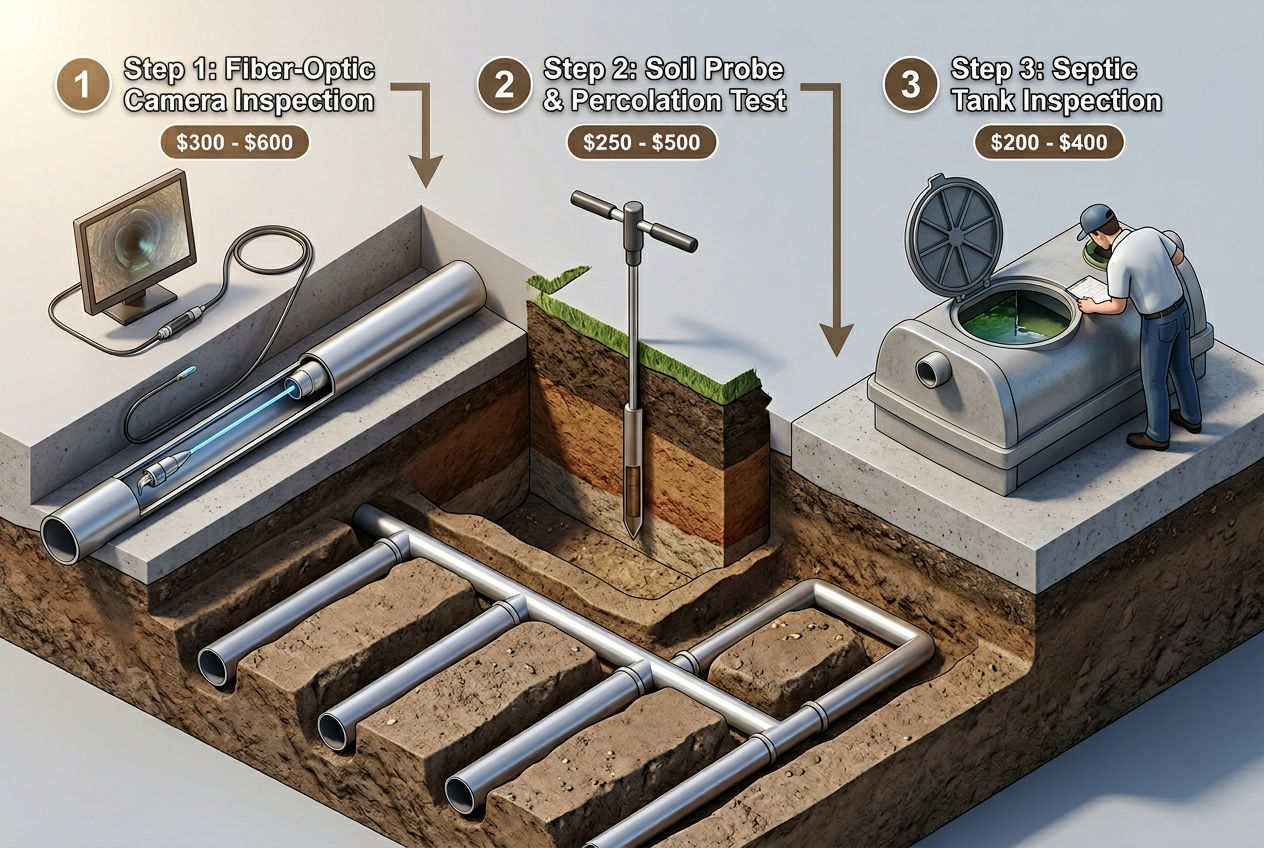
Step 1: Diagnose Before You Repair
Every drain field repair should start with a diagnosis. Skipping this step is the single most expensive mistake homeowners make — you can spend $5,000 on the wrong repair and still end up needing the right one afterward.
Camera inspection ($200-$400). A fiber-optic camera pushed through the field lines reveals pipe condition: cracks, root intrusion, crushed sections, sediment buildup, and offset joints. This tells your contractor exactly which lines are damaged and which are still functioning.
Soil probe ($100-$300). A technician pushes a probe into the soil at multiple points across the field to assess saturation depth, compaction, and the depth of the biomat layer. This determines whether the soil is still capable of absorbing effluent or has permanently failed.
Tank inspection. Before any field repair, the tank should be pumped and inspected. A tank that's been sending solids into the field lines — due to a broken baffle, missing effluent filter, or neglected pumping — will destroy any field repair within months if the upstream problem isn't fixed first.
Pro Tip: Ask your contractor what diagnostic steps they'll perform before starting repair work. If the answer is "we'll just dig it up and see," get a second opinion. A $300-$600 diagnostic visit saves thousands by identifying the actual problem.
The 6 Drain Field Repair Methods
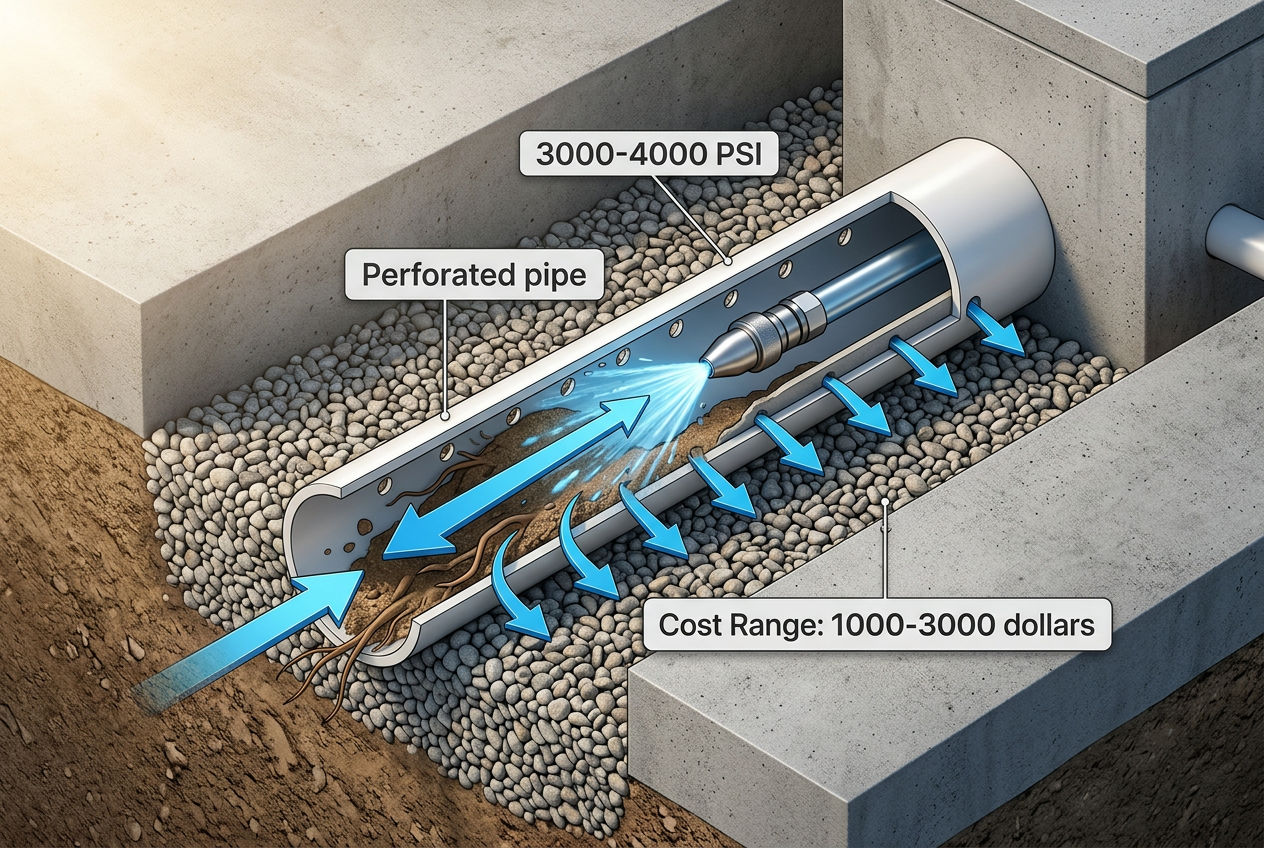
Method 1: Pipe Jetting (Hydro-Jetting)
A high-pressure water jet (3,000-4,000 PSI) pushed through the field lines to blast out sediment, grease, roots, and biomat buildup that's clogging the pipe perforations. Similar to hydro-jetting a sewer line, but calibrated for perforated drain field pipe.
Cost: $1,000-$3,000 depending on total footage and number of lines
When it works: Clogged perforations from accumulated solids or biomat, early-stage root intrusion, grease buildup from kitchen waste. Works best when the pipes themselves are intact and the soil is still absorbing — the blockage is just in the pipe.
When it doesn't work: Crushed or collapsed pipe, severely degraded soil that can no longer absorb, or situations where the gravel bed itself is clogged with fines. Jetting the pipes won't help if the soil below is the bottleneck.
Timeline: 1 day. No excavation required in most cases — jetting is done through cleanout access points or the distribution box.
Method 2: Lateral Line Replacement
Excavating and replacing one or more individual trench runs (laterals) while leaving the rest of the field intact. The old pipe and gravel are removed, new pipe and aggregate are installed in the same trench or a parallel trench.
Cost: $2,000-$5,000 per lateral (trench)
When it works: A single trench has failed — crushed pipe from vehicle traffic, severe root damage in one run, or localized soil failure. The other trenches are still functioning normally.
When it doesn't work: If all trenches show equal symptoms, replacing individual laterals is just replacing the field one expensive piece at a time. In that case, full replacement is more cost-effective.
Timeline: 1-2 days per lateral. Requires excavation equipment (mini-excavator or backhoe).
Common Mistake: Replacing the trench that's showing symptoms without checking the distribution box. If the distribution box is tilted or damaged, it may be sending all the flow to one trench while others sit idle. A $300-$500 D-box repair can fix what looks like a lateral line failure.
Method 3: Biomat Treatment and Reduction
The biomat is a bacterial layer that forms naturally at the gravel-soil interface in every drain field. It's actually beneficial in thin layers — it helps treat effluent. But when it grows too thick (from overloading or poor tank maintenance), it becomes a waterproof barrier that prevents absorption.
Chemical treatment ($500-$1,500): Hydrogen peroxide or specialized septic chemicals are introduced through the distribution box to break down excessive biomat. This is a temporary measure — if the underlying cause (inadequate pumping, overloading) isn't fixed, the biomat grows back.
Field resting ($0-$500): If your system has an alternate field area (many newer systems include a designated reserve area), switching flow to the alternate side allows the overloaded side to dry out and the biomat to decompose naturally. This takes 6-12 months but is the most effective long-term treatment.
When it doesn't work: When the biomat has grown so thick that the soil structure beneath it has permanently changed. At that point, the soil itself needs restoration (see Method 4) or replacement.

DIY Septic Blueprint
Thinking about building it yourself?
The complete, plain-English plan to size, permit and install your own septic system — designed for homeowners, not contractors. Skip the $15,000–$25,000 quotes and do it right the first time.
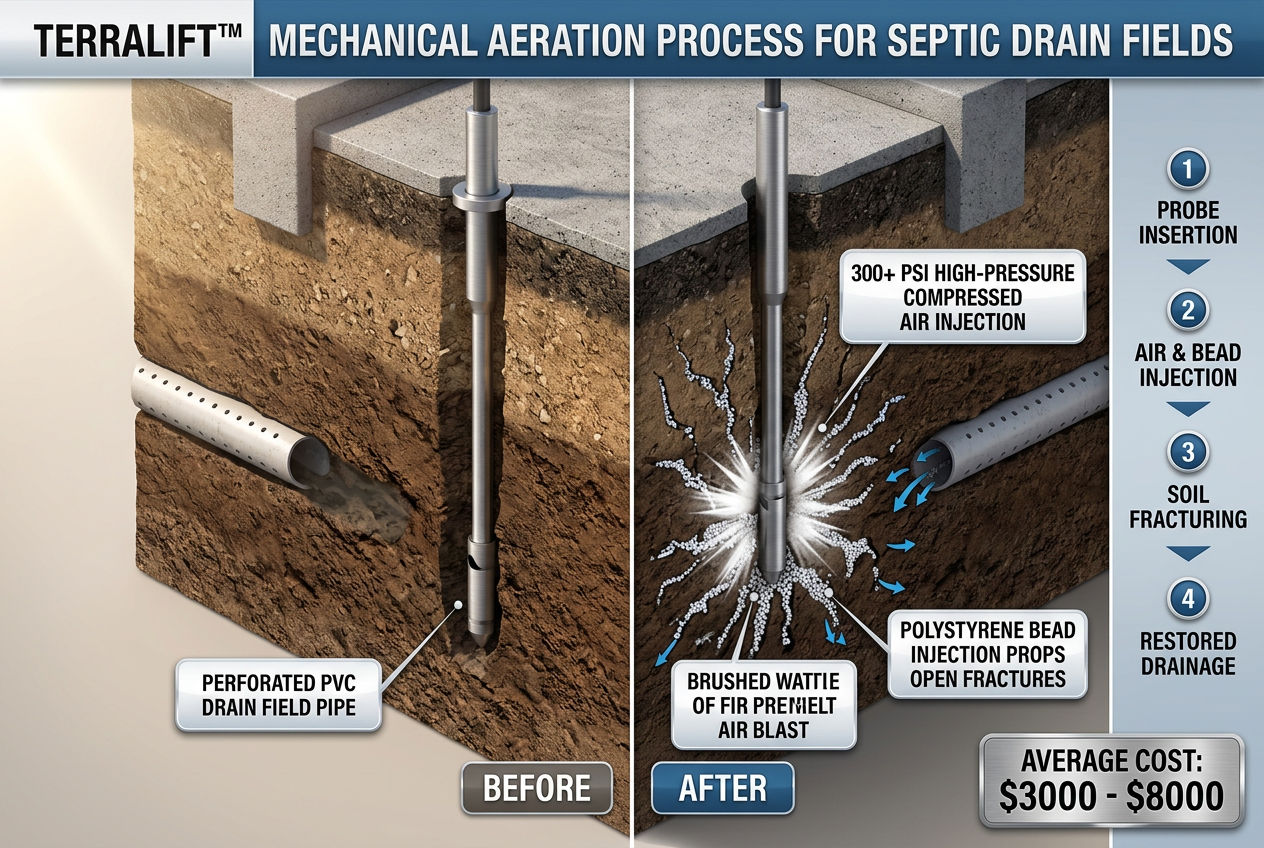
Get the DIY Blueprint — $67 →Instant download · 8 modules + 3 bonus guides · 60-day money-back guaranteeMethod 4: Mechanical Aeration (Terralift or Similar)
A specialized probe is driven into the ground at intervals across the drain field. Compressed air (300+ PSI) is injected through the probe to fracture compacted soil, break up biomat, and restore drainage paths. Some systems also inject polystyrene beads to hold the fractures open.
Cost: $3,000-$8,000 depending on field size
When it works: Compacted soil from surface traffic, clay soils that have sealed over time, or fields where the biomat has caused soil structure collapse. Aeration works best when the pipes are still intact and the soil just needs to be loosened.
When it doesn't work: If the soil was marginal to begin with (barely passing the perc test), aeration provides temporary relief but the soil will compact again within a few years. It's also ineffective if the gravel bed is clogged — the soil below may be fine, but the gravel above is the bottleneck.
Timeline: 1-2 days. No excavation — the probes are inserted from the surface, making this one of the least disruptive repair methods.
Key Insight: Aeration is controversial in the septic industry. Some contractors swear by it; others consider it a temporary fix that delays inevitable replacement. The reality is somewhere in between — it works well for specific conditions (compacted soil, thick biomat) but isn't a universal solution. Ask for references from homeowners who had the treatment 3+ years ago to gauge long-term results.
Method 5: Surface Water Diversion
Sometimes a failing drain field isn't a drain field problem at all — it's a water management problem. If surface runoff, roof downspouts, sump pump discharge, or landscape grading sends water toward the field, the soil becomes saturated from above and can't absorb effluent from below.
Cost: $500-$3,000 depending on scope
Repairs include: Regrading the soil surface to slope away from the field ($1,000-$2,500), extending downspouts and sump pump discharge away from the field area ($200-$800), installing a French drain or curtain drain upslope of the field to intercept groundwater ($1,500-$3,000), and removing impervious surfaces (patios, walkways) that direct water toward the field.
When it works: Seasonal failures that coincide with heavy rain or snowmelt. If the field works fine during dry months but fails in spring, water diversion may be the only repair needed.
Timeline: 1-3 days. Often doesn't require any work on the field itself.
Method 6: Distribution Box Repair or Leveling
The distribution box splits effluent flow evenly among all the lateral lines. If it settles, tilts, or develops cracks, one trench gets most of the flow while others get little or none. The overloaded trench fails while the underused trenches still have decades of capacity.
Cost: $300-$1,500
Repairs include: Leveling a tilted D-box ($300-$500), replacing a cracked D-box ($500-$1,000), installing flow equalizers or leveling devices ($200-$500), and re-establishing connections to lateral lines ($500-$1,500).
When it works: Uneven symptoms across the field — one area saturated while the rest is dry. A simple D-box leveling can restore even distribution and give the overloaded trench time to recover.
Quick Fact: Distribution box problems are one of the most underdiagnosed causes of drain field failure. A 2-degree tilt in the D-box can send 80% of the flow to a single trench. Most contractors check the D-box during any field inspection, but if yours didn't, request it specifically.
How Much Does Drain Field Repair Cost? Complete Breakdown
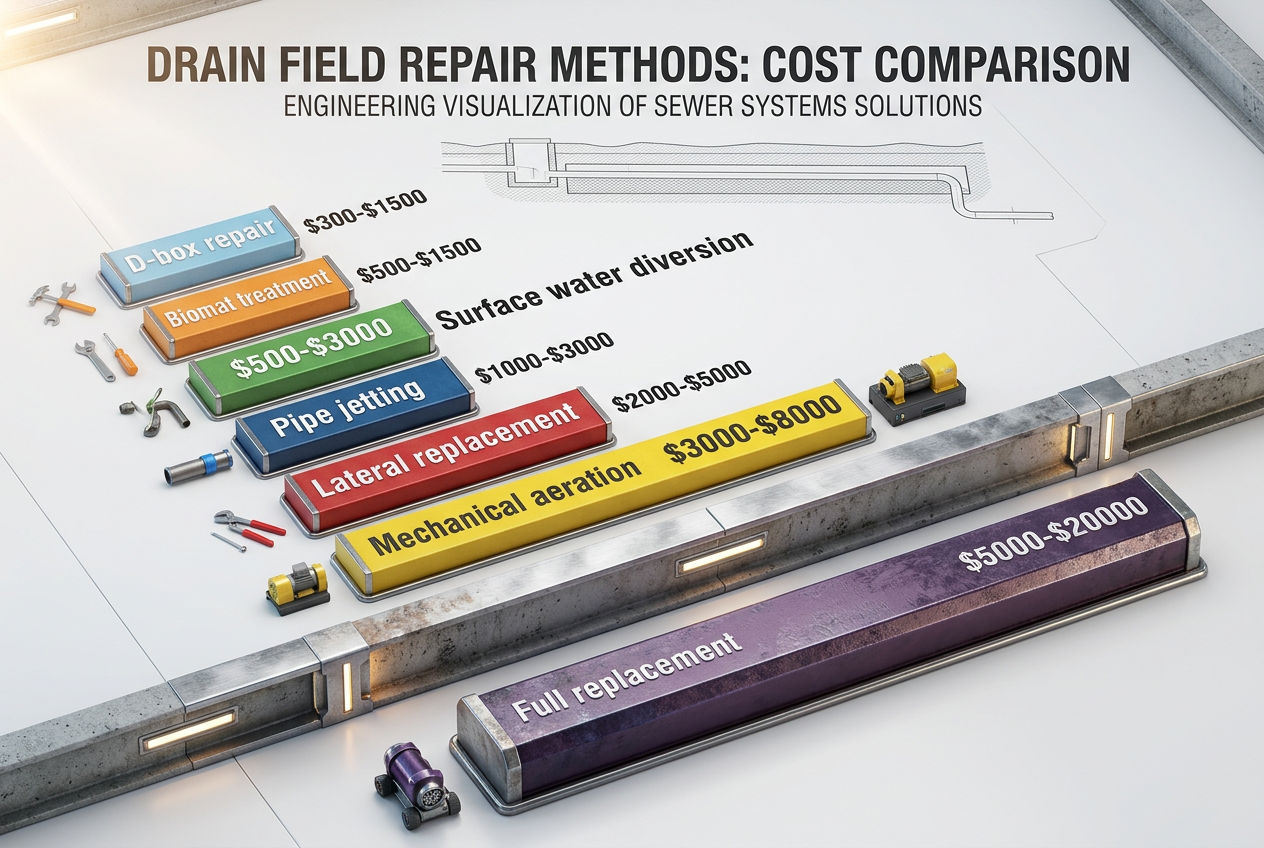
| Repair Method | Cost Range | Excavation Required? | Typical Duration | Best For |
|---|---|---|---|---|
| Pipe jetting | $1,000-$3,000 | No | 1 day | Clogged perforations, roots |
| Lateral replacement | $2,000-$5,000/trench | Yes | 1-2 days/trench | Crushed pipe, root damage |
| Biomat treatment | $500-$1,500 | No | 1 day + recovery | Excessive biomat, overloading |
| Mechanical aeration | $3,000-$8,000 | No | 1-2 days | Compacted soil, sealed biomat |
| Surface water diversion | $500-$3,000 | Sometimes | 1-3 days | Seasonal saturation |
| D-box repair/leveling | $300-$1,500 | Minimal | Half day | Uneven flow distribution |
| Full replacement | $5,000-$20,000+ | Yes | 3-5 days | Soil exhaustion, total failure |
Source: SepticTankHub.com aggregated contractor pricing data, EPA septic system maintenance guidelines, and University of Minnesota Extension research
For a detailed breakdown of full replacement costs by region, soil type, and system size, see our drain field replacement cost guide.
When Is Replacement the Only Option?
Targeted repairs can fix most drain field problems, but some situations genuinely require full replacement. Here's how to tell:
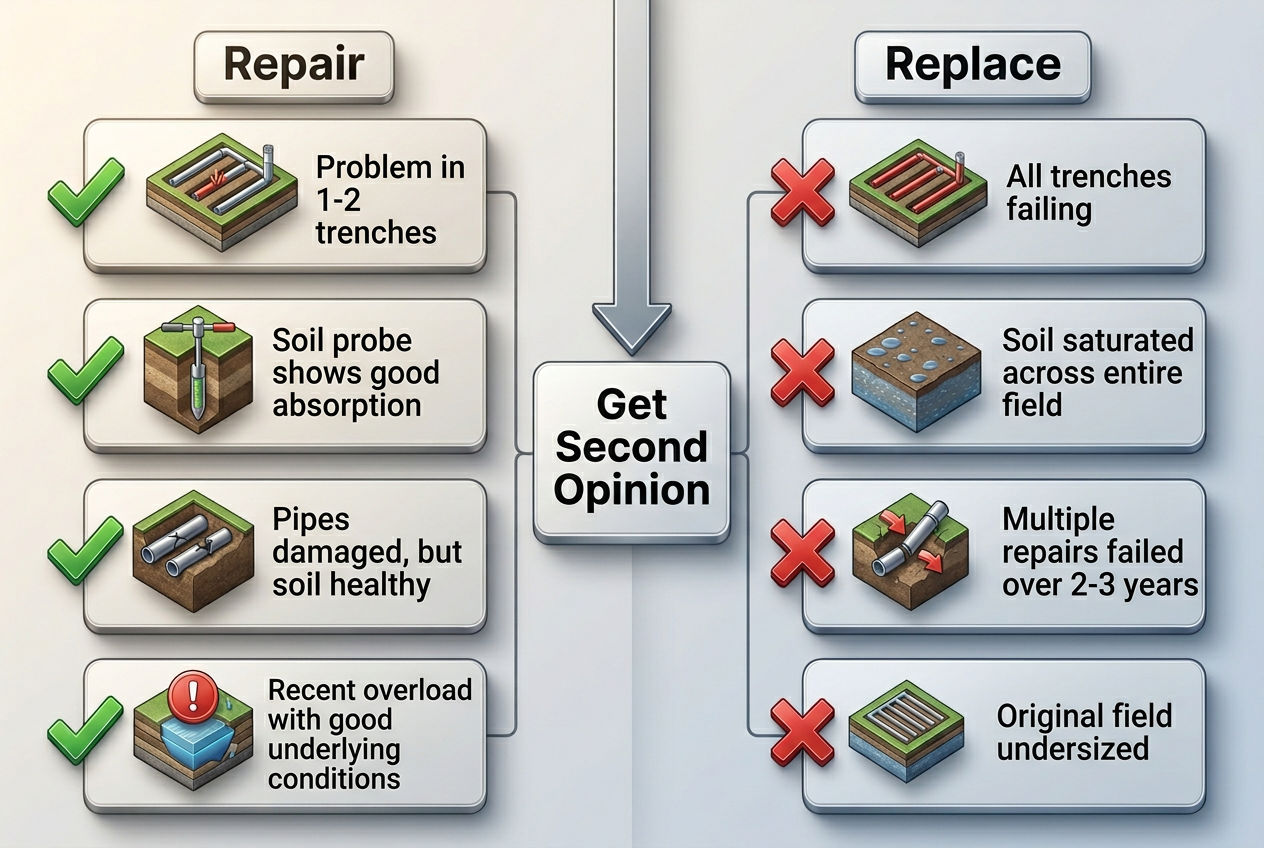
Repair is likely sufficient when: the problem is isolated to one or two trenches, the soil probe shows adequate absorption capacity in most of the field, the pipes are damaged but the soil is healthy, or the field was recently overloaded but has good underlying conditions.
Full replacement is likely necessary when: all trenches are failing simultaneously, the soil probe shows saturation and compaction across the entire field, multiple repair attempts over the past 2-3 years haven't resolved the problem, or the original field was undersized for the household (the soil can't handle the volume regardless of condition).
Get a second opinion when: a contractor recommends full replacement without performing diagnostic testing. A responsible contractor will camera-inspect the lines, probe the soil, and check the distribution box before recommending the most expensive option. If the first quote jumps straight to replacement, get another contractor's evaluation.
For the complete list of failure indicators, see our guide on signs your drain field is failing.
Pro Tip: When getting quotes for drain field repair, ask each contractor: "What's the least invasive repair that would fix this problem?" A good contractor will recommend the most targeted (and often least expensive) repair that addresses the root cause, then escalate only if that doesn't work.
How to Prevent Future Drain Field Repairs
The most effective drain field repair is the one you never need. These maintenance practices protect your field from the problems that lead to expensive repairs:
Pump the tank on schedule. Every 3-5 years based on household size. The number one cause of drain field repair is solids reaching the field from a neglected tank. Follow the schedule in our septic maintenance guide.
Protect the field surface. Never park vehicles or place heavy structures over the drain field. Compacted soil from above is one of the most common — and most preventable — causes of field failure.
Manage water use. Spreading laundry loads across the week, fixing running toilets promptly, and diverting surface water away from the field all reduce the volume your field has to absorb.
Know your field's lifespan. Even perfectly maintained drain fields have a finite life. Understanding how long drain fields last helps you plan financially for the eventual replacement and recognize when repair costs are approaching the diminishing-returns threshold.
Find a licensed drain field repair contractor in your area on SepticTankHub.com
Sources & Methodology
EPA — Homeowner's Guide to Septic Systems — Federal guidelines on septic system maintenance, repair indicators, and homeowner responsibilities
University of Minnesota Extension — Drainfield Rehabilitation — Research-based guidance on drain field repair methods including aeration, resting, and biomat management
National Environmental Services Center — Maintaining Your Septic System — Technical guidance on drain field diagnostics, repair techniques, and prevention strategies
International Code Council — International Private Sewage Disposal Code — Standards for drain field repair permitting, contractor licensing, and system modifications
SepticTankHub.com Internal Data — Drain field repair pricing and method frequency data from 4,200+ listed septic companies
Free download
Not ready for the Blueprint? Start free.
Grab the free DIY Septic Planning Kit — the permit-first checklist, perc-test cheat sheet, and sizing tables that keep your build from getting red-tagged.
Was this article helpful?
Frequently Asked Questions
Recommended Resources
📖 Related Articles
- Signs Your Drain Field Is Failing (And What to Do)
- Septic Drain Field Help: Troubleshooting Guide for Homeowners
- How to Fix a Saturated Drain Field
- What Is a Drain Field? (And How Does It Work?)
- Septic Field Lines: Types, Cost & How They Work (2026 Guide)
- How Long Do Drain Fields Last? Lifespan Guide
- Septic System Repair: Complete Guide to Costs, DIY & When to Call a Pro
- Septic Tank Biomat: What It Is and When It's a Problem
- The Complete Septic Tank Maintenance Guide
💰 Cost Guides
🔧 Services
Find Septic Professionals Near You
Compare licensed, verified septic companies by area — top county markets and cities below, or browse all 50 states.
County markets
Popular cities
