
Concrete vs plastic septic tank — compare cost, lifespan, installation, and durability. Find out which material is right for your property and soil type.
Quick Answer
Choosing between a concrete vs plastic septic tank is one of the first real decisions you'll make when installing or replacing a septic system. Get it wrong and you're looking at premature failure, costly repairs, or a tank that floats out of the ground after a wet spring.
This guide breaks down both materials across every factor that matters — cost, lifespan, installation, durability, maintenance, and local code compliance — so you can make a confident call.
📊 Quick Fact: Concrete tanks last 40–100+ years compared to 20–40 years for polyethylene, but installation costs can be 40–60% higher due to crane requirements.
⚠️ Warning: High water table properties face real floating risk with plastic tanks unless proper anchoring ballast is used — empty plastic tanks have been documented rising completely out of saturated soil during spring floods.
Both materials do the same fundamental job — collect and begin treating household wastewater through settling and anaerobic bacterial action. But they handle stress, soil conditions, and time very differently. Here's a side-by-side snapshot before we dig into the details.
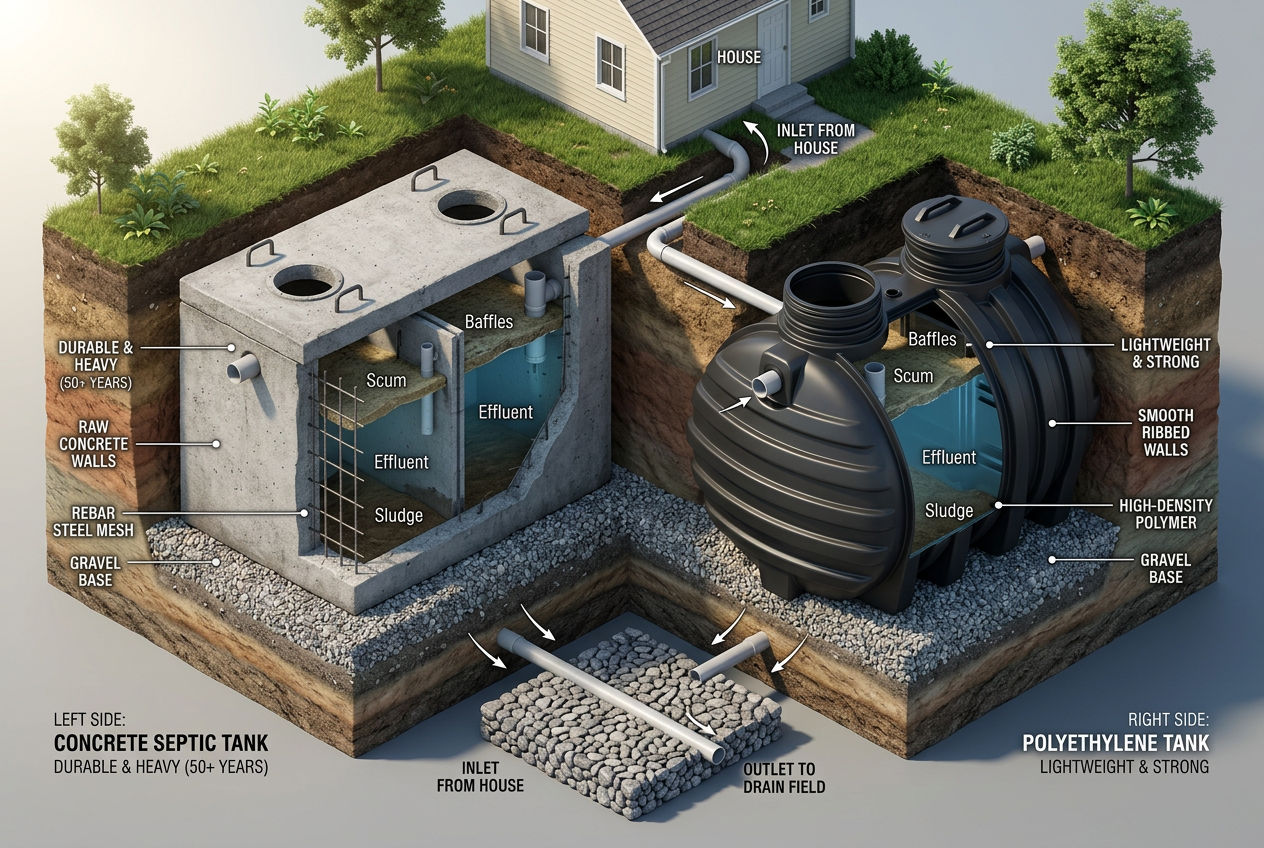
| Attribute | Concrete | Plastic (Polyethylene) |
|---|---|---|
| Tank-only cost (1,000 gal) | $700–$2,500 | $500–$2,500 |
| Total installed cost | $2,500–$8,000+ | $1,500–$5,000 |
| Weight (1,000 gal) | 8,000–10,000 lbs | 150–300 lbs |
| Lifespan | 40–100+ years | 20–40 years |
| Crack resistance | Lower | Higher (flexible) |
| Buoyancy/floating risk | None | Moderate–High (wet soils) |
| Heavy equipment required | Yes (crane) | No |
| Traffic load tolerance | Excellent | Limited |
| Chemical/acid resistance | Moderate | Excellent |
| Local code acceptance | Universal | Varies by jurisdiction |
Data sources: EPA septic system guidance; ASTM C1227 (precast concrete); IAPMO certification standards for polyethylene tanks. Costs vary by region.
💡 Key Takeaway: The 50x weight difference (8,000 lbs vs 150 lbs) drives almost every practical difference between these materials — from installation logistics to buoyancy risk to lifespan expectations.
A concrete septic tank — more precisely, a precast concrete septic tank — is manufactured off-site in a controlled facility, then delivered and lowered into an excavated pit using a crane. The tank is constructed from 3,000–5,000 PSI reinforced concrete, cast in sections with a baffle wall separating the inlet and outlet chambers.
Most residential installations use a two-compartment design:
The outlet end should include an effluent filter — such as a Polylok PL-122 or Zabel A1800 — to protect the leach laterals from suspended solids.
Precast concrete tanks must meet ASTM C1227 standards for residential applications. A properly manufactured and installed tank can last generations. That said, they're not without problems.
A plastic septic tank — often called a polyethylene septic tank or poly septic tank — is rotationally molded in a single seamless piece. That seamless construction is one of its biggest advantages: no joints, no mortar, no seams to fail.
You don't need a crane, a concrete truck, or a crew of five.
Plastic tanks should meet IAPMO certification or equivalent ASTM standards. Reputable manufacturers like Infiltrator Water Technologies produce polyethylene tanks that are rated for standard soil loads, though they typically are not rated for vehicle traffic above them without additional protective measures.
Exceptional lifespan. A well-maintained concrete septic tank lasts 40–100+ years. Some tanks installed in the 1950s and 1960s are still in active service. If you're building a forever home, this matters.
Handles soil and traffic loads. Concrete's compressive strength (3,000–5,000 PSI) means it resists:
Zero buoyancy risk. At 8,000–10,000 lbs, a 1,000-gallon concrete tank isn't going anywhere. Buoyancy is simply not a factor.
Universal code acceptance. Every state and county in the U.S. accepts concrete septic tanks. If you're in a jurisdiction with strict or uncertain code requirements, concrete is the safe choice.
Long-term bacterial environment. After an initial curing period, concrete provides a stable, relatively neutral environment for the anaerobic bacteria that break down waste.
Heavy equipment required. Getting a 10,000-lb tank into a hole in your yard requires a crane. Crane and heavy equipment rental adds $500–$1,500 to your project. In tight access situations — a narrow lot, a steep hillside, a property with overhead power lines — this can become a real problem or a cost multiplier.
⚠️ Warning: Concrete expands and contracts with temperature changes. In freeze-thaw zones like New York, Vermont, or Minnesota, repeated cycles can open hairline cracks in the tank body and, more commonly, at the inlet/outlet joints.
Can crack over time. Cracked tanks leak untreated effluent into surrounding soil — a serious environmental and health problem. Watch for signs of septic tank failure like wet spots or odors above the tank.
Concrete septic tank problems with acid erosion. Hydrogen sulfide gas produced inside the tank creates sulfuric acid that slowly degrades the concrete over decades. This is accelerated by:
New concrete can disrupt bacterial balance. Fresh concrete leaches alkaline compounds at pH 11–13. This can temporarily suppress the anaerobic bacteria your system depends on for the first few weeks to months after installation. The tank typically self-corrects as the concrete cures and the bacterial population rebounds.
Higher installation cost. Total installed cost for a concrete system runs $2,500–$8,000+, compared to $1,500–$5,000 for a comparable plastic tank. See our septic installation cost guide for a regional breakdown.
Lightweight and easy to transport. This is the headline advantage. A 1,000-gallon polyethylene tank weighs 150–300 lbs. You can:
For rural properties, mountain cabins, or any site where crane access is expensive or impossible, plastic is a practical solution.
✅ Pro Tip: Rotational molding produces a one-piece tank with no seams, joints, or mortar connections. There's no joint to fail, no mortar to erode — a major advantage over concrete's multi-piece construction.
Seamless and watertight. Concrete tanks rely on sealed joints at the inlet, outlet, and between sections — each a potential leak point.
Excellent chemical resistance. Polyethylene doesn't corrode. Hydrogen sulfide, acidic effluent, and aggressive soils won't degrade the tank walls the way they can attack concrete over decades.
Lower installation cost. No crane, lighter excavation equipment, shorter install time. Total installation typically runs $1,500–$5,000. That's a meaningful savings on a tight budget.
Crack-resistant. Plastic is flexible. It absorbs soil movement without cracking, which is an advantage in areas with expansive clay soils or freeze-thaw cycles.
⚠️ Warning: This is the biggest risk. If your water table rises above or near the bottom of a lightweight plastic tank, buoyancy forces can literally push the tank out of the ground — especially if it's empty or partially empty during high-water events.
Plastic septic tanks can float. A 300-lb tank in saturated soil is no match for hydrostatic pressure. Mitigation requires:
This adds cost and complexity.
The EPA notes that high water table conditions require special design considerations for any septic component. If your water table comes within 24 inches of the tank bottom, consult a licensed designer before choosing plastic.
Shorter lifespan. Most manufacturers warranty polyethylene tanks for 20–30 years. Realistic field lifespan is 20–40+ years — solid, but roughly half that of a well-maintained concrete tank.
Not rated for vehicle traffic. Standard polyethylene tanks are not designed to bear vehicle loads. If a truck or tractor ever needs to cross above the tank location, you'll need to verify the tank's load rating or install a concrete traffic cover.
Not approved everywhere. Some municipalities and states require concrete or restrict plastic. Certain counties in Florida, Texas, and North Carolina have specific concrete requirements. Always verify with your local health department or county engineer before buying a tank.
Limited large-size options. For commercial or high-volume applications requiring tanks above 1,500 gallons, concrete is often the only practical option.
Fiberglass tanks occupy the middle ground. They're lighter than concrete (typically 400–600 lbs for a 1,000-gallon unit) but heavier and structurally stiffer than polyethylene. Lifespan runs 25–50 years. They share plastic's chemical resistance and concrete's moderate soil load tolerance — but without excelling at either.
For a deep comparison of fiberglass as an option, see our dedicated fiberglass vs concrete septic tank guide.
| Attribute | Fiberglass |
|---|---|
| Cost (tank only) | $1,200–$2,000 for 1,000 gal |
| Buoyancy risk | Moderate (lighter than concrete, heavier than poly) |
| Lifespan | 25–50 years |
| Code acceptance | Widely accepted, but verify locally |
If plastic isn't approved in your area and you want something lighter than concrete, fiberglass is worth pricing out.
Not every situation calls for the same answer. Here's how to think through the decision based on your actual conditions.
High water table: If your water table is within 3 feet of the surface, neither material is a simple install. Concrete wins on buoyancy. If plastic is your only option (access, code, cost), insist on a concrete ballast pad or anchor straps — and have a licensed designer stamp the plan. Check whether your area qualifies for a mound system or other alternative if conventional burial depth isn't achievable.
📊 Quick Fact: Frost lines in Minnesota reach 42–60 inches deep, but properly buried tanks rarely freeze. The bigger problem is thermal cycling at the soil surface stressing joints over decades.
Freeze-thaw zones (Minnesota, Vermont, Maine, upper Midwest): Concrete cracking from thermal cycling is a documented problem. Plastic's flexibility helps here — but verify local code, because some northern counties still default to concrete specifications.
Remote or rural properties: Plastic wins almost every time on logistics. Getting a crane to a property 10 miles down a dirt road in rural Oregon or Montana costs real money. A poly tank on a flatbed trailer is a different problem entirely.
The installation process is largely the same: excavate the pit, set the tank, connect inlet and outlet pipes, backfill. The differences are in the equipment required and the labor time.
Equipment and crew requirements:
Simplified logistics:
Both installations require:
For a full walkthrough of the process, see our septic system installation guide.
It doesn't, much. Both materials require the same core maintenance:
Pumping costs typically run $275–$500 depending on tank size and region.
✅ Pro Tip: Concrete tanks should have their seals and joints inspected during every pump-out, since these are the most likely failure points as the tank ages. Ask your pumper to probe the joints and note any effluent seepage in the soil surrounding the inlet/outlet pipes.
Monitoring for cracks or settling — especially important for:
For a complete maintenance calendar, see our septic tank maintenance guide.
Florida has among the most complex septic regulations in the country — administered through county health departments under Florida DOH oversight. Many Gulf Coast and South Florida counties require concrete tanks due to high water tables and sandy soils. If you're in Collier, Lee, or Sarasota County, verify requirements before assuming plastic is an option.
Freeze-thaw cycles are the dominant concern. Frost lines in Minnesota reach 42–60 inches — deep enough that properly buried tanks rarely freeze, but thermal cycling at the soil surface still stresses joints over decades. Plastic's flexibility is an asset here if local code permits it.
Wet winters mean high water tables in valley and lowland areas. The same buoyancy concerns that apply in Florida apply here. Rural mountain properties, however, favor plastic for the logistics advantage.
The Texas Commission on Environmental Quality (TCEQ) oversees septic systems, but regulatory authority is often delegated to county-level Designated Representatives. Some Texas counties — particularly in East Texas — require or strongly prefer concrete. Others accept polyethylene. Check with your county's On-Site Sewage Facility (OSSF) authority.
Concrete wins on longevity, structural strength, and universal code acceptance. If you're planning to stay in your home for 40+ years, have standard site access, and your budget supports the higher installation cost, a precast concrete tank is the lower-risk long-term investment.
Plastic wins on installation logistics, upfront cost, and chemical resistance. For remote properties, tight budgets, or sites where crane access is prohibitively expensive, polyethylene offers a reliable 20–40 year solution at half the installed cost.
💡 Key Takeaway: Neither material is universally superior. Match your choice to your site conditions, budget, timeline, and local code requirements — not to generic advice that ignores your specific situation.
Compare top-rated companies in your area. Get free, no-obligation quotes from verified providers.
Was this article helpful?
Connect with licensed, verified septic companies in your area.
Get estimates from licensed, verified companies in your area. No obligation.
⚡ Average response time: under 2 hours