
Can you have a water softener with a septic system? Get the science-backed answer, real data, and a decision framework to protect your drain field.
Quick Answer
A water softener and septic system can coexist safely in most homes. The landmark 2012 Water Quality Research Foundation (WQRF) study — conducted by Virginia Tech — found that water softener discharge does not damage septic tank biology and may actually improve drain field soil percolation in certain conditions. That said, soil type, softener efficiency, and local regulations all shape whether this setup works safely for your specific property.
Key Takeaways
Most homeowners asking this question have heard two contradictory things: a plumber told them it's fine, and a neighbor swears it killed their drain field. The truth sits in the middle — and it depends on what's actually happening inside your system.
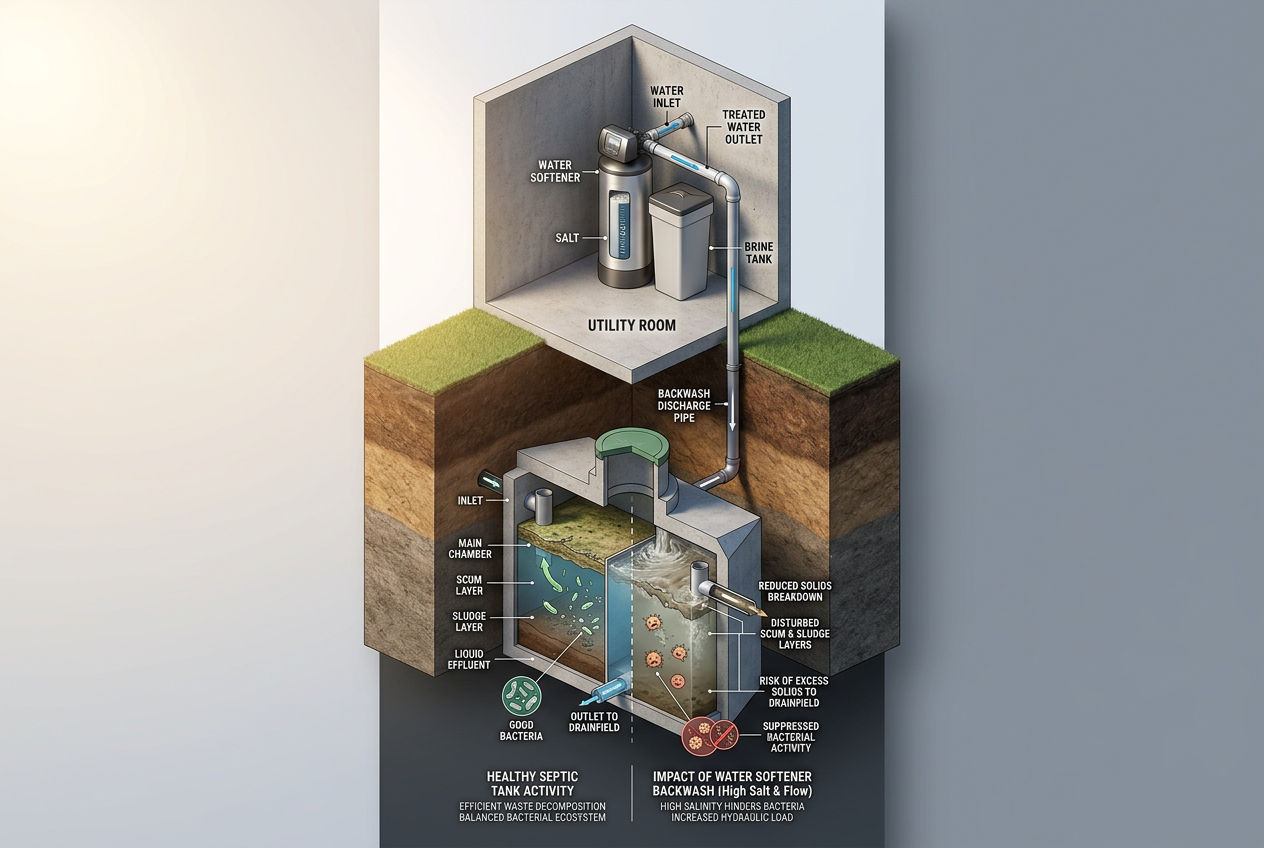
During the regeneration cycle, a salt-based water softener flushes concentrated brine through your home's drain line and into your septic tank. That brine contains sodium concentrations ranging from 2,000 to 6,000 mg/L, plus the calcium and magnesium it stripped from your hard water. The questions are: does that kill your septic bacteria, and does it damage your drain field?
💡 Key Takeaway: The bacterial kill-off fear is mostly overblown. The WQRF study found that sodium at concentrations typical of residential softener discharge did not eliminate the anaerobic bacteria responsible for waste digestion in a septic tank. Beneficial bacteria are hardier than most people assume.
Your tank already handles bleach residue, detergents, and personal care products — a regeneration flush isn't the same as pouring a gallon of bleach down the drain.
⚠️ Warning: The drain field soil concern is more legitimate. High sodium loading over time can cause clay particles in the soil to swell and deflocculate. When that happens, the soil's hydraulic conductivity drops, meaning effluent can't percolate out fast enough.
If your drain field sits in heavy clay soil — common across the Midwest, Southeast, and Mid-Atlantic — long-term sodium accumulation is a real risk, even if your tank biology stays healthy.
The safest option, where local codes allow, is a separate discharge point — either a dedicated dry well or a direct line to daylight — so regeneration water bypasses your septic tank entirely. This eliminates both the hydraulic loading and sodium concerns in one move.
That said, most existing homes aren't plumbed for a separate drain, and retrofitting one adds $500–1,500 in labor and materials. For the majority of homeowners, the softener drains to the septic tank, and that's where managing volume and salt type becomes important.
⚠️ Warning: Never discharge water softener brine directly onto your lawn or into a storm drain. The sodium damages grass, garden soil, and in many municipalities, storm drain discharge of brine is a code violation.
This is the hydraulic loading question — and it's one many installers skip over.
A standard timer-based water softener regenerates every 3–7 days and discharges 50–100 gallons of brine water per cycle. For a household already at or near its system's daily flow design limit, adding an unpredictable 50–100 gallon dump — often at 2 a.m. when the timer kicks in — can temporarily hydraulically overload a tank.
Here's a worked example. A 1,000-gallon septic tank serving a family of four is designed for roughly 400–480 gallons per day of wastewater input. If a timer-based softener dumps 80 gallons in a single regeneration cycle, that's a 17–20% surge on top of normal daily flow. Do that twice a week and you've added 160 gallons weekly — not catastrophic, but it does push effluent through the tank faster, reducing the settle time that separates solids from liquid before it reaches the drain field.
✅ Pro Tip: The fix is straightforward: choose a demand-initiated regeneration (DIR) softener. DIR units only regenerate when you've actually used a set number of grains of hardness — not on a fixed schedule.
A quality DIR unit (brands like Fleck 5600SXT or Clack WS1) regenerates 30–50% less often than timer models, which means less water and less salt going to your septic system overall.
Switching from sodium chloride to potassium chloride (KCl) reduces sodium loading on your drain field soil. Potassium is a soil nutrient rather than a structural disruptor, so it doesn't cause the clay swelling that sodium does.
The downside is cost. As of 2025, potassium chloride pellets run $25–40 per 40-pound bag, versus $6–10 for sodium chloride. That's roughly 3–5× more expensive per cycle, and a standard regeneration uses 6–12 lbs of salt. Over a year, you could spend $200–400 more on potassium chloride alone.
For most households on sandy or loamy soils, the extra cost isn't necessary. If your drain field sits in clay-heavy soil, your water is extremely hard (17+ grains per gallon), or you already have signs of sluggish drainage, potassium chloride is worth the investment.
Yes — under specific conditions. The signs of drain field failure you'd watch for include:
The damage mechanism is soil deflocculation. Sodium ions in the effluent displace calcium and magnesium in the clay mineral structure of the soil. The clay swells and loses its aggregate structure. Pore spaces close up. The drain field stops absorbing effluent at its designed rate.
📊 Quick Fact: The calcium and magnesium that your water softener removes from your household water were actually beneficial to your drain field soil. The WQRF study noted that these minerals improve soil hydraulic conductivity. Hard water effluent, without a softener, actually helps keep clay soils more permeable.
This doesn't mean you should skip a softener if you need one. It means you should know your soil type. A soil percolation test — the same perc test used to size a new system — tells you whether your soil can tolerate increased sodium loading over time.
This comparison comes up constantly, and it's worth being direct.
Salt-free water conditioners (also called water conditioners or descalers) don't remove calcium and magnesium from your water. Instead, they alter the crystalline structure of those minerals so they don't stick to pipes and fixtures. No salt is used. No brine is generated. No regeneration cycle flushes into your septic tank.
From a septic system standpoint, a salt-free conditioner is the safer option — full stop. Zero sodium loading. Zero hydraulic surge. Nothing changes about what your septic system processes.
The trade-off is performance. If you have very hard water — say, 15–20+ grains per gallon as found across Indiana, Wisconsin, Minnesota, and the Texas Hill Country — a salt-free conditioner may not fully prevent scale buildup in water heaters, dishwashers, and fixtures. Salt-based softeners actually remove the hardness minerals. Conditioners just change how those minerals behave.
| Treatment Type | Removes Hardness? | Brine to Septic? | Sodium Impact | Relative Cost |
|---|---|---|---|---|
| Salt-based softener (NaCl) | Yes | Yes (50–100 gal/cycle) | High | $ (salt ~$8–15/mo) |
| Salt-based softener (KCl) | Yes | Yes (50–100 gal/cycle) | Low | $$$ (KCl ~$30–60/mo) |
| Salt-free conditioner | No (conditions only) | No | None | $$ (no ongoing salt cost) |
| DIR salt-based softener | Yes | Reduced (~30–50%) | Moderate | $$ (efficient salt use) |
| Separate drain line | N/A (any softener) | Bypasses septic | None to septic | $$ (one-time install) |
Data sources: Water Quality Association (WQA), Water Quality Research Foundation (WQRF), manufacturer specifications.
✅ Pro Tip: If your primary concern is protecting your drain field and your water hardness is 7–12 grains per gallon, a salt-free conditioner is a reasonable solution. If your hardness is 15+ gpg and you're getting white scale on everything, you likely need a true salt-based softener — in which case, go DIR with potassium chloride or route the discharge to a dry well.
This is where many online articles fall short — they give you the national picture and ignore the fact that your county might have already made this decision for you.
Massachusetts Title 5 (310 CMR 15.000) includes specific provisions that restrict discharge from water treatment equipment, including softeners, into septic systems without prior approval. If you're buying a home in Massachusetts and the existing softener drains to the septic tank, your Title 5 inspection may flag it.
California has multiple water districts — particularly in the Central Valley and Southern California — that prohibit water softener brine discharge into septic systems due to groundwater salinity concerns. This is enforced at the district level, not statewide, so enforcement varies.
Connecticut and several county-level jurisdictions in Texas have restrictions or guidance documents that discourage or prohibit softener discharge into on-site septic systems.
Wisconsin (SPS 383) and Minnesota (7080–7083) have detailed guidance documents addressing this scenario. Neither outright bans it, but both require that the system be sized to handle the additional hydraulic load.
⚠️ Warning: Before installing a water softener on a septic property, call your county health department — not a plumbing contractor, not a water softener dealer. The health department knows what's permitted in your jurisdiction.
A septic inspection by a licensed professional before installation is the smartest $200–400 you'll spend.
Before your installer hooks anything up, work through these five questions:
Sandy or loamy soils tolerate sodium loading far better than clay-heavy soils. If you're in the Southeast or Midwest and your property has heavy red or gray clay, sodium loading is a genuine concern. A soil analysis or perc test gives you a real answer.
A 1,000-gallon tank serving three people has less buffer for hydraulic surges than a 1,500-gallon tank. Know your tank size. If you're unsure, your county health records or a licensed pumper can confirm it. Understanding how your septic system works before adding load to it is basic due diligence.
Check with your county health department before installation. If you're in Massachusetts, California, or Connecticut, assume there's a restriction until confirmed otherwise.
If you have an aerobic septic system rather than a conventional anaerobic tank, the calculus shifts slightly.
Aerobic systems introduce oxygen into the treatment process, which makes the bacterial community more active and — some argue — more sensitive to chemical inputs including high-sodium brine.
Mound systems and drip-irrigation systems are similarly more sensitive because they rely on precise hydraulic loading rates to distribute effluent across a constructed absorption area. A 100-gallon brine dump in three hours can temporarily saturate a mound system's distribution network in a way it wouldn't affect a standard leach field with more soil volume.
✅ Pro Tip: If you have a mound system or a drip-irrigation system, treat the water softener discharge question more conservatively — DIR unit, potassium chloride, and seriously consider the separate drain line option.
If you already have — or are about to install — a water softener alongside a septic system, these practices reduce your long-term risk:
Pump your septic tank on the shorter end of the recommended interval. For a 1,000-gallon tank serving a four-person household, that means every 3 years rather than every 5. The added water volume from regeneration cycles accelerates sludge turnover. Review how often to pump your septic tank for your specific tank size.
Use the minimum effective salt setting. Most softeners are set higher than needed. Have a water treatment professional test your actual hardness and program the unit accordingly.
Switch to a DIR unit if you're still on a timer model. This single change reduces brine discharge volume more than any other adjustment.
Inspect your drain field annually. Walk the leach field area after heavy rain and look for standing water, unusual grass growth patterns, or soft spots in the soil.
Compare top-rated companies in your area. Get free, no-obligation quotes from verified providers.
Was this article helpful?
Connect with licensed, verified septic companies in your area.
Get estimates from licensed, verified companies in your area. No obligation.
⚡ Average response time: under 2 hours