
Quick Answer
A clogged septic drain field is one of the most urgent problems a septic homeowner can face — it causes sewage backups in the house, standing water in the yard, and foul odors that won't go away. The good news: most drain field clogs can be cleared without full field replacement. Professional unclogging methods like hydro-jetting ($1,000-$3,000) and mechanical aeration ($3,000-$8,000) restore function in 1-3 days, and immediate steps like pumping the tank can provide same-day relief.
Key Takeaways
- A clogged drain field usually starts with solids from an unpumped tank reaching the field lines
- Pump the tank first ($300-$600) — this alone resolves the problem in 30-40% of cases
- Professional unclogging methods: hydro-jetting ($1,000-$3,000) and mechanical aeration ($3,000-$8,000)
- Never pour chemical drain cleaners, Drano, or bleach into the system — they kill beneficial bacteria
- Full replacement ($5,000-$20,000+) is a last resort after unclogging methods have failed
When the drains slow down, the yard starts smelling, and there's spongy ground where there shouldn't be, the drain field is telling you something is blocked. The question is what's blocked — the pipes, the soil, or both — and the answer determines which unclogging method will actually work.
Before calling a contractor, there are a few things you can check yourself. And before authorizing any expensive repair, understanding the five causes of drain field clogs helps you evaluate whether the proposed fix addresses the actual problem.
If you're still in the diagnosis stage, our drain field troubleshooting guide walks through the step-by-step process to identify exactly what's going wrong.
Find a drain field repair specialist on SepticTankHub.com
What Causes a Drain Field to Clog?
Drain field clogs fall into five categories. Knowing which one you're dealing with determines the right unclogging approach — and prevents wasting money on the wrong fix.
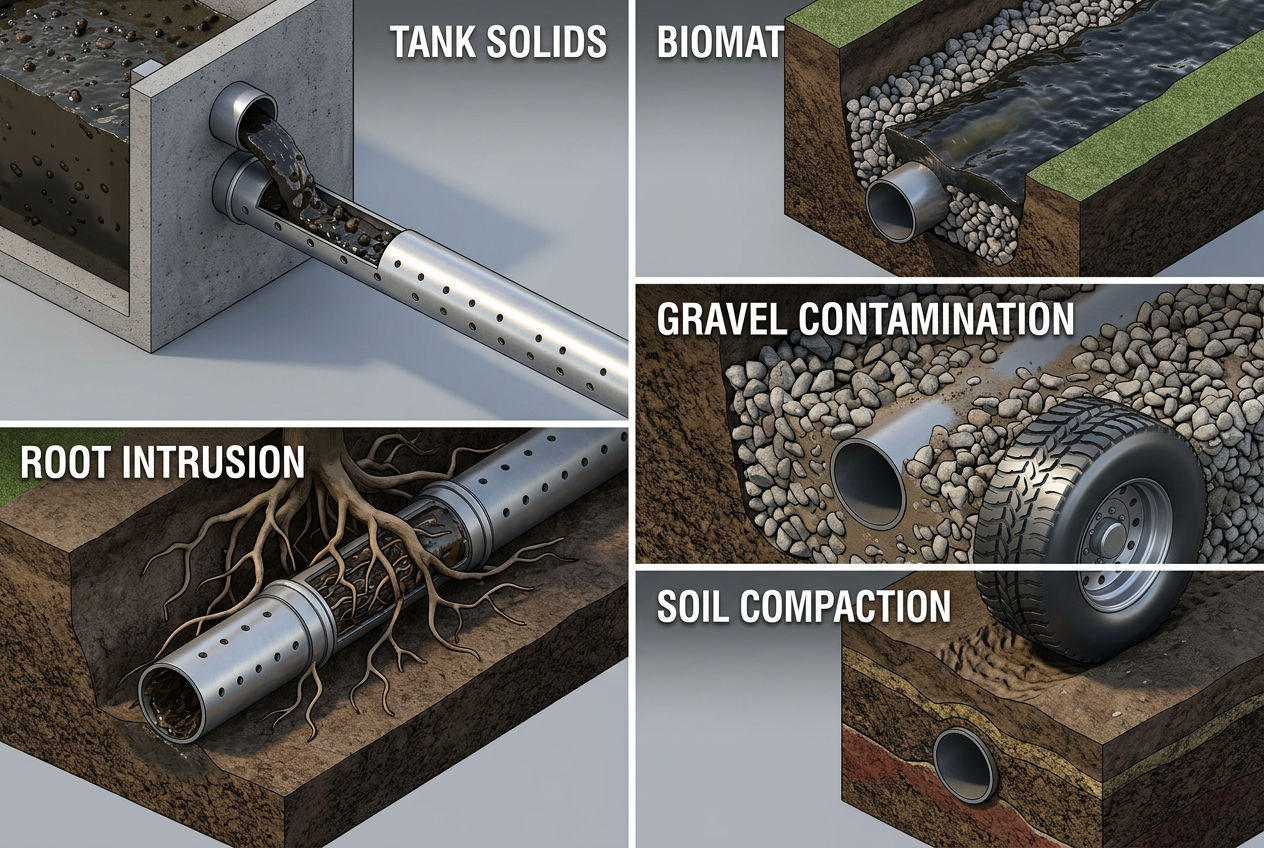
Cause 1: Tank Solids Reaching the Field Lines
The most common cause of drain field clogs. When the septic tank isn't pumped on schedule (every 3-5 years), the sludge layer rises until solids overflow through the outlet and travel into the field lines. These solids plug the pipe perforations and create an impermeable mat in the gravel bed.
How to identify it: The tank hasn't been pumped in 5+ years, multiple drains in the house are slow simultaneously, and the effluent filter (if installed) is heavily clogged or bypassed.
Fix: Pump the tank immediately, then have the field lines jetted to clear accumulated solids from the perforations.
Cause 2: Excessive Biomat Buildup
The biomat is a bacterial layer that forms naturally at the gravel-soil interface. A thin biomat is normal and helps treat effluent. But when the field is consistently overloaded — too much water use, a undersized field, or poor effluent quality from a neglected tank — the biomat grows so thick it becomes a waterproof barrier.
How to identify it: The field worked fine for years but has gradually declined. Wet areas appear during heavy use periods (morning showers, laundry days) and dry out during low-use periods.
Fix: Reduce the hydraulic load (pump the tank, reduce water use), and either chemically treat the biomat or rest the field for 6-12 months to allow natural decomposition.
Cause 3: Root Intrusion
Tree and shrub roots seek out the moisture and nutrients in drain field trenches. They enter through pipe joints, grow into perforations, and eventually form dense mats inside the pipe that block effluent flow entirely.
How to identify it: A camera inspection shows root masses inside the pipe. The clog is localized to trenches near trees or large shrubs. One or two trenches are failing while others function normally.
Fix: Hydro-jetting to cut and flush out root masses, followed by removing the offending trees or installing root barriers.
Cause 4: Gravel Bed Contamination
If the washed stone in the trench wasn't properly cleaned during installation, fine particles (silt, clay, crusher dust) fill the void spaces between stones over time. This reduces the gravel bed's ability to store and distribute effluent, creating a clog at the gravel level rather than the pipe level.
How to identify it: The system has never performed well since installation, or performance has declined steadily from the first year. Jetting the pipes doesn't improve function because the clog is in the gravel, not the pipe.
Fix: This is one of the harder clogs to address. Mechanical aeration can help break up compacted fines, but severely contaminated gravel may need excavation and replacement with properly washed stone. In some cases, this effectively means replacing that portion of the field.
Cause 5: Soil Compaction
Vehicles, heavy equipment, livestock, or even repeated foot traffic over the drain field compresses the soil above and between the trenches. Compacted soil loses its pore structure, which is what allows water to percolate through. The result is a "lid" of compressed soil that prevents effluent from dispersing.
How to identify it: There's a history of vehicles parking or driving over the field. Wet spots appear in tire track patterns. The soil surface is visibly compressed compared to adjacent undisturbed areas.
Fix: Mechanical aeration (Terralift) to fracture the compacted layers, followed by strict prevention measures — no vehicles, no heavy equipment, no structures on the field ever again.
How to Unclog a Drain Field: Step-by-Step
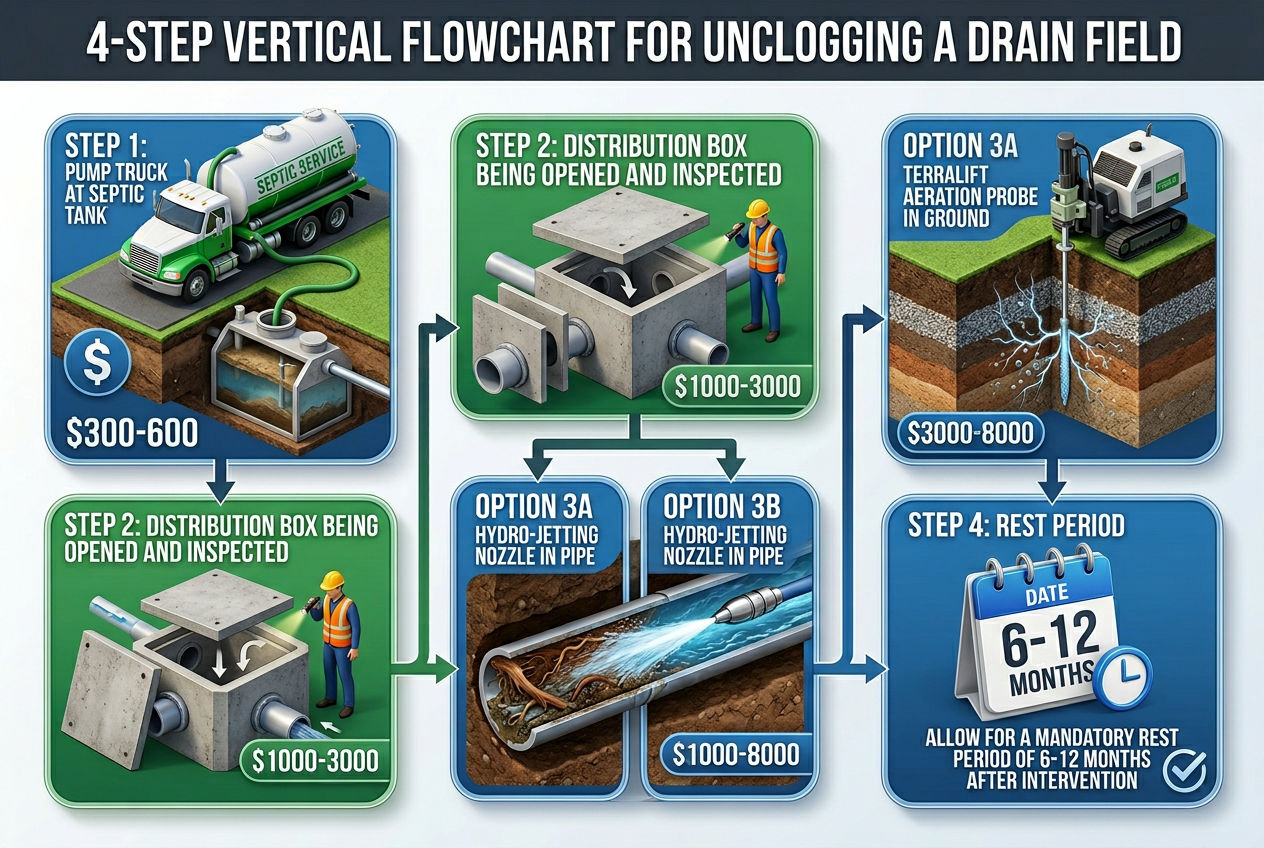
Step 1: Pump the Septic Tank (Do This First — Always)
Before any drain field work, the tank must be pumped. This serves two purposes: it removes the source of solids that may be feeding the clog, and it temporarily eliminates the hydraulic load on the field, giving the clogged area time to drain.
Cost: $300-$600
In roughly 30-40% of drain field clog cases, pumping the tank and reducing household water use for 1-2 weeks is enough to resolve the problem. The field was overloaded but not permanently damaged, and removing the load allows it to recover.
If symptoms persist after pumping and a 2-week rest, the clog is in the field itself and needs professional treatment.
Step 2: Check the Distribution Box
Open the distribution box and inspect the outlet pipes. If one outlet is submerged (standing water) while others are dry, the clog is in that specific trench — not the entire field. If all outlets are submerged, the clog affects the full system.
Also check if the D-box is tilted. A shifted D-box sends most effluent to one trench, overloading it while others sit idle. Leveling the D-box ($300-$500) can instantly redistribute the load and allow the overloaded trench to recover.
Pro Tip: Mark the distribution box location with a stake or landscape marker. During a drain field emergency, being able to find the D-box quickly — even in the dark — saves critical time and avoids having to dig blindly.
Step 3: Professional Unclogging (When Pumping Isn't Enough)
If the field is still clogged after pumping the tank and checking the D-box, it's time for professional intervention. The two primary unclogging methods are:
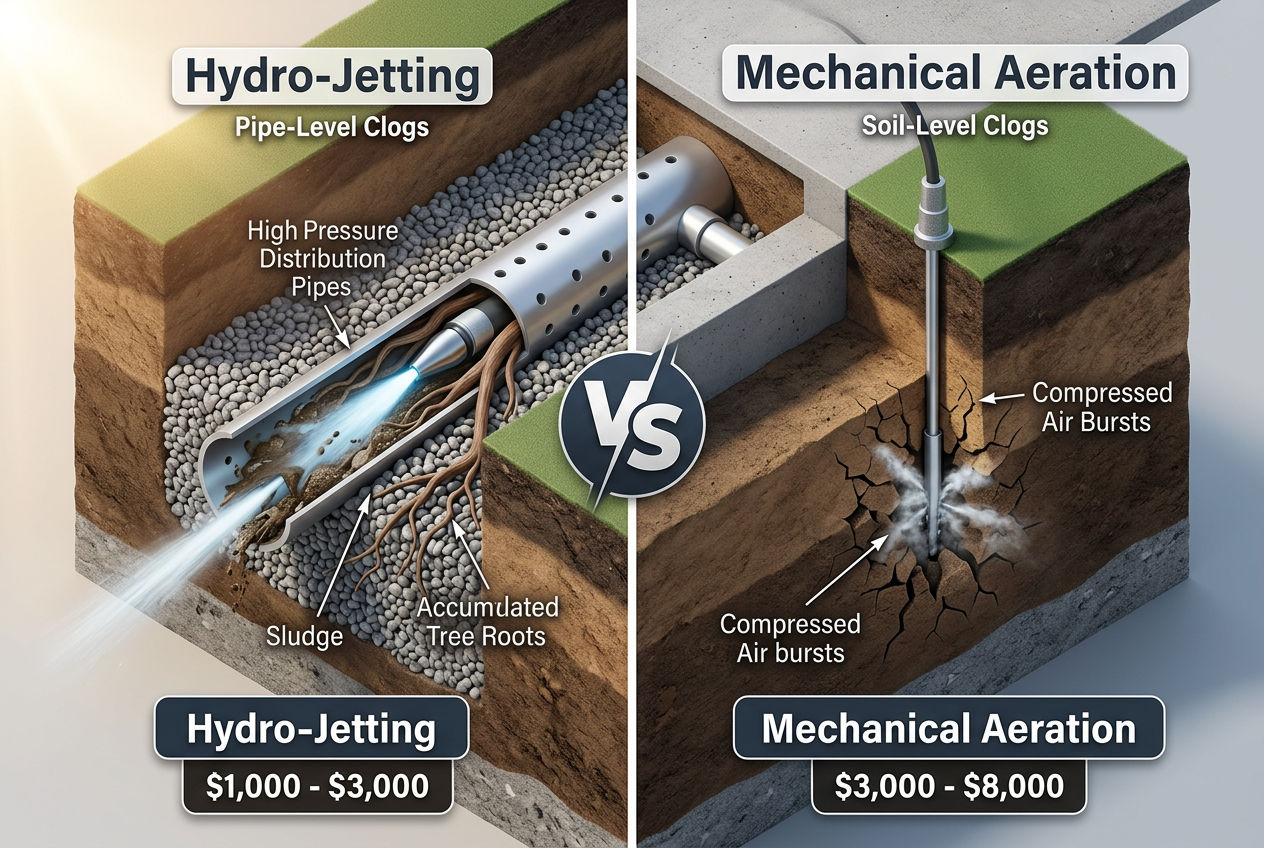
Hydro-jetting ($1,000-$3,000). A specialized high-pressure nozzle is pushed through the field lines to blast out roots, sediment, and biomat buildup from the pipe perforations. This is the most direct approach for pipe-level clogs and can be completed in a single day without excavation.
Mechanical aeration ($3,000-$8,000). A Terralift or similar machine drives probes into the ground and injects compressed air to fracture compacted soil and break up biomat at the soil level. This addresses clogs that are below the pipe — in the gravel bed or the native soil — where jetting can't reach.
For a complete breakdown of all repair methods and when each applies, see our drain field repair guide.
Step 4: Rest Period (For Biomat-Related Clogs)
If the clog is caused by excessive biomat, the most effective long-term solution is resting the field. This means diverting effluent flow to an alternate drain area (if your system has one) and allowing the clogged side to dry out for 6-12 months. During this rest period, the biomat decomposes naturally as aerobic bacteria break it down in the absence of incoming moisture.
Not every system has an alternate area available. If yours doesn't, your contractor may recommend alternating sections of the field using valves in the distribution box — using half the field while the other half rests.
What NOT to Do When Your Drain Field Is Clogged
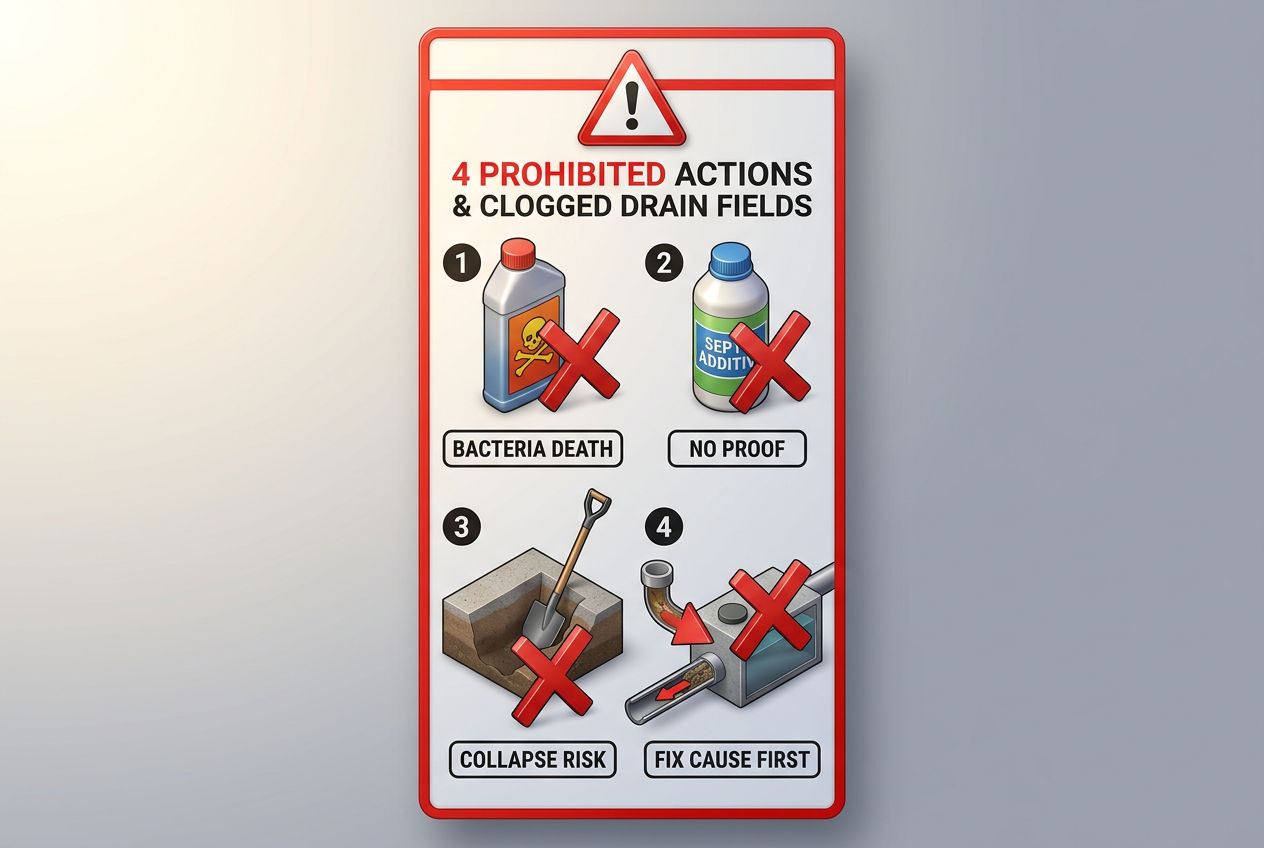
These common "fixes" either don't work or make the problem worse:
Don't pour chemical drain cleaners into the system. Drano, bleach, and similar products kill the beneficial bacteria in both the tank and the drain field soil. The biomat and soil bacteria are essential for treating effluent. Killing them creates a bigger problem than the clog.
Don't use septic additives marketed as "drain field restorers." Products claiming to dissolve biomat or "rejuvenate" your drain field have no proven effectiveness. Some contain chemicals that damage soil structure, making absorption worse. The EPA does not recommend septic additives for drain field problems.
Don't try to dig up and "flush" the field yourself. Excavating drain field trenches without proper equipment and knowledge risks collapsing the pipe, disturbing the gravel bed, and compacting the soil — all of which create new problems.
Don't ignore the upstream cause. If the clog was caused by solids from an unpumped tank, jetting the field lines clears the symptom but doesn't fix the cause. The clog will return within months if the tank isn't maintained. Fix the tank problem first, then unclog the field.
Common Mistake: Spending $3,000-$8,000 on mechanical aeration when the real problem is a $300 distribution box that needs leveling. Always diagnose before committing to an expensive repair. A camera inspection ($200-$400) and D-box check ($100-$200) together cost less than a single aeration treatment.
How to Prevent Drain Field Clogs
Every drain field clog has a root cause, and most of those causes are preventable with basic maintenance:
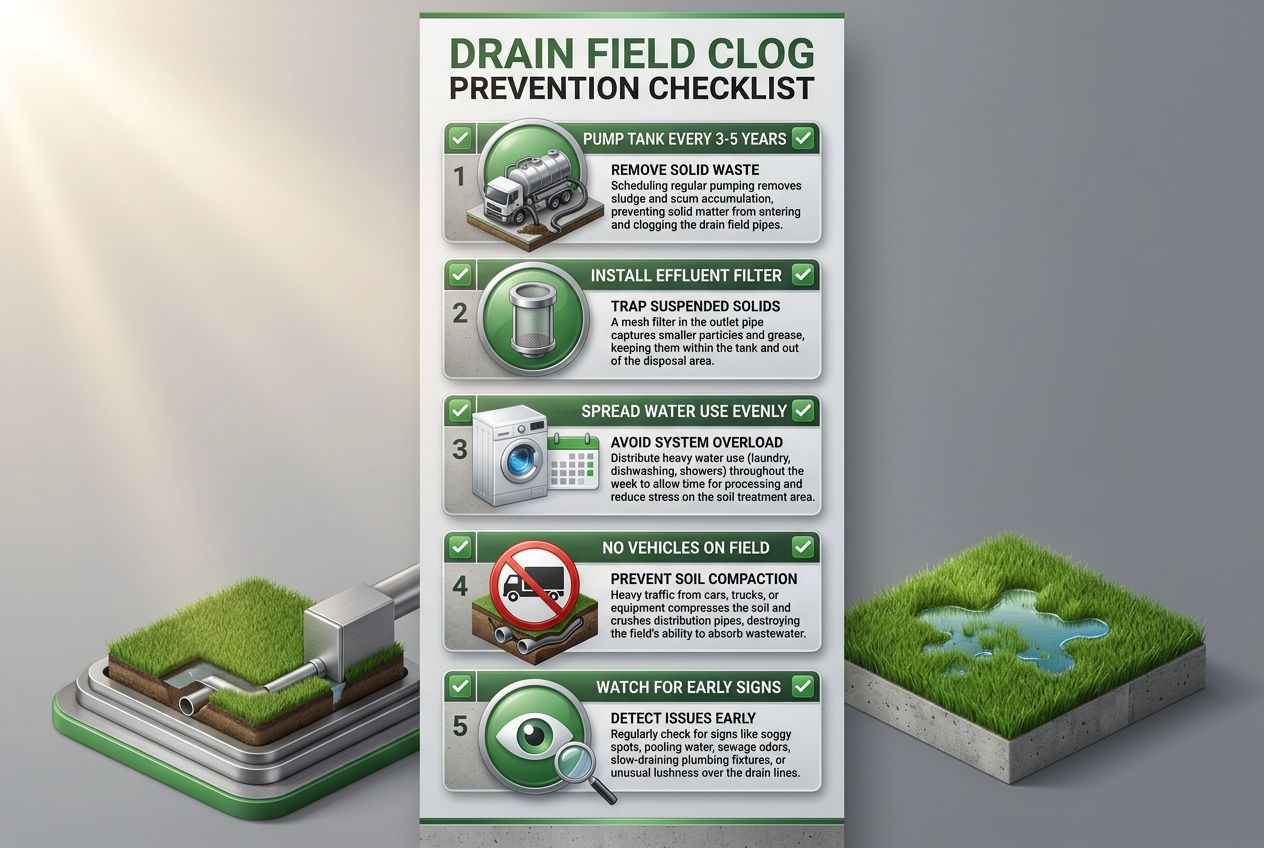
Pump the tank on schedule. The single most effective prevention measure. Regular pumping keeps solids in the tank where they belong instead of in the field lines. Follow the schedule recommended for your household size — typically every 3-5 years.
Install and maintain an effluent filter. An effluent filter on the tank outlet catches solids before they can reach the field. Clean it every 1-2 years — a clogged filter is better than clogged field lines, because the filter is a $20 part that takes 10 minutes to clean.
Manage water use. Spread laundry loads across the week. Fix running toilets and leaky faucets. Consider high-efficiency fixtures. Every gallon that doesn't enter the septic system is a gallon the drain field doesn't have to absorb.
Protect the field surface. Keep vehicles, heavy equipment, and permanent structures off the drain field area. Don't plant trees within 30 feet of the trenches. Signs of a failing drain field are easier to spot when the surface isn't covered by a deck or parking area.
Know the warning signs. Slow drains, gurgling toilets, wet spots in the yard, and sewage odors near the field are all early indicators of a developing clog. Addressing these when they first appear is far cheaper than waiting until the field fails completely.
Find a licensed septic contractor for drain field service on SepticTankHub.com
Sources & Methodology
EPA — Homeowner's Guide to Septic Systems — Federal guidance on drain field maintenance, failure indicators, and homeowner responsibilities
University of Minnesota Extension — Drainfield Rehabilitation and Replacement — Research-based guidance on biomat management, aeration effectiveness, and drain field recovery methods
National Environmental Services Center — Pipeline Newsletter — Technical articles on septic drain field unclogging techniques and prevention strategies
EPA — Septic System Additives — Federal position on the effectiveness of chemical and biological septic additives for drain field treatment
SepticTankHub.com Internal Data — Drain field service call data and unclogging method frequency from 4,200+ listed septic companies
Free download
Not ready for the Handbook? Start with the free Fridge Card.
The Do / Don’t card the whole family can see, plus the Survival Kit: emergency flowchart, warning-sign decoder and pump-schedule card. One printable PDF.
Was this article helpful?
Frequently Asked Questions
Recommended Resources
📖 Related Articles
- Septic Drain Field Help: Troubleshooting Guide for Homeowners
- Signs Your Drain Field Is Failing (And What to Do)
- How to Fix a Saturated Drain Field
- Septic Drain Field Repair: Methods, Cost & When to Replace Instead
- Septic Field Lines: Types, Cost & How They Work (2026 Guide)
- Septic Tank Biomat: What It Is and When It's a Problem
- How Often Should You Pump Your Septic Tank?
- Septic Effluent Filters: Do You Need One?
- What Is a Distribution Box in a Septic System?
💰 Cost Guides
🔧 Services
Find Septic Professionals Near You
Compare licensed, verified septic companies by area — top county markets and cities below, or browse all 50 states.
County markets
Popular cities
