
Hearing septic tank gurgling? Learn the 6 most common causes, DIY fixes that actually work, and when to call a pro before a $300 problem becomes a $15,000 one.
Quick Answer
Septic tank gurgling occurs when negative air pressure forms in your drain lines, forcing air back through fixture traps and creating a bubbling or glug-glug sound. A single gurgling drain often indicates a localized clog. Multiple gurgling fixtures at once — especially after rain or heavy water use — typically point to a full tank, saturated drain field, or blocked vent pipe that requires prompt attention.
💡 Key Takeaways
- Gurgling from one fixture usually means a localized clog; gurgling from multiple fixtures signals a system-wide problem.
- A full 1,000-gallon tank, blocked plumbing vent, clogged effluent filter, or failing drain field are the four most common causes.
- Gurgling that persists more than 24–48 hours is a warning sign — not something to wait out.
- Septic tank pumping ($400–$600 national average) resolves the majority of gurgling complaints.
- Ignoring gurgling that stems from drain field failure can turn a $600 pump-out into a $3,000–$15,000 repair.
It's a low, wet bubbling — like someone blowing through a straw into a half-full glass of water. Sometimes it's a single glug after a toilet flushes. Other times it's a sustained gurgle from every drain in the house simultaneously. Some homeowners describe it as a "sucking" sound from the floor drain after the washing machine empties.
The sound itself comes from negative air pressure in the drain lines. When water rushes through a clogged or restricted pipe, it pulls air behind it. That air has to come from somewhere — so it gets yanked back through the water sitting in your P-traps, creating the gurgle. That same negative pressure is why you'll sometimes also notice a faint sewer gas smell coming from drains when the gurgling starts.
📊 Quick Fact: Confirming you're dealing with a septic-related gurgle (rather than a straightforward drain clog) comes down to pattern. Does it happen at one sink, or everywhere at once? Does it get worse after a rainstorm? Does flushing the toilet cause the bathtub drain to gurgle? Those patterns point straight to the septic system.
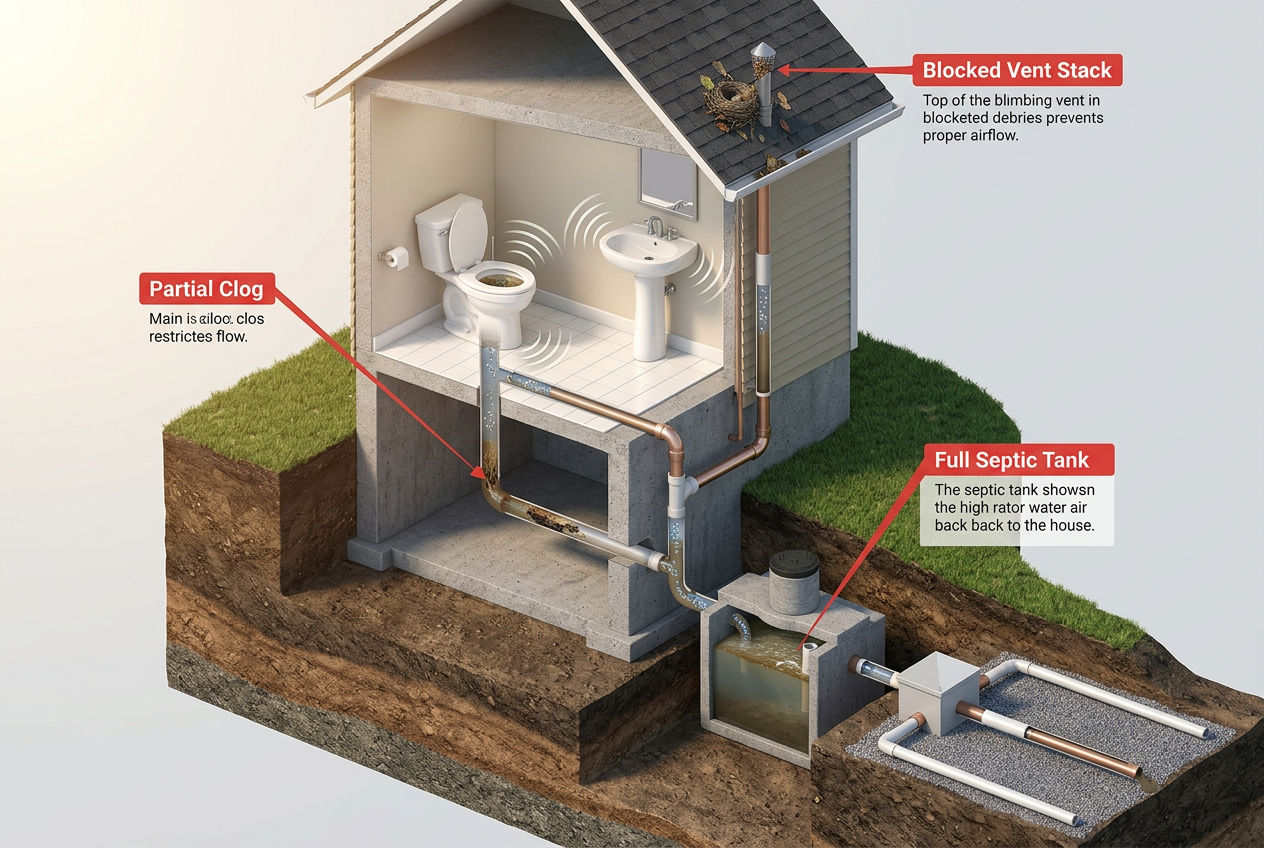
This is the number-one cause. A standard 1,000-gallon tank serving a 4-person household holds a year's worth of settled solids before the sludge layer rises within 12 inches of the outlet baffle — the threshold where flow restriction begins and gurgling starts. If the scum layer (floating fats and grease) gets within 6 inches of the outlet baffle, same problem.
The EPA recommends pumping every 3–5 years for most households. Many homeowners wait 7–10 years, then wonder why their drains are making noise. Add a garbage disposal and that pumping interval drops to every 2 years — the extra solid load is that significant.
Check for other signs your septic tank needs pumping alongside the gurgling:
Every drain in your house connects to a vent stack — typically a 3- or 4-inch PVC or cast iron pipe that exits through your roof. Its job is to equalize air pressure in the drain lines. Block it, and you get gurgling every time water moves through those pipes.
Vent blockages happen fast. A bird's nest, a tennis ball from a kid's misthrown shot, wind-blown leaves, or a wasp nest can seal off a vent stack in hours. In cold climates — Minnesota, Wisconsin, the upper Northeast — ice can cap the vent opening entirely during a cold snap.
✅ Pro Tip: That ice dam costs you nothing to diagnose and is often fixed by pouring hot water down the vent from the roof. A professional vent clearing runs $100–$300 if you'd rather not climb up there yourself.
Many tanks installed after the mid-1990s have an effluent filter — a cartridge-style screen that fits inside the outlet baffle and catches solids before they exit toward the drain field. Common brands include:
These need cleaning every 1–3 years. Ignore that, and the filter restricts outflow enough to back up liquid in the tank and create gurgling at your fixtures.
A clogged effluent filter is an easy fix: pull the cartridge, rinse it over the tank opening with a garden hose, reinsert. Takes 10 minutes. But if your filter is clogged and you've never serviced it, have the whole tank inspected — the solids buildup is likely significant. Read more about effluent filter maintenance and replacement.
When the drain field — the network of perforated leach laterals buried in gravel-filled trenches — can't absorb effluent fast enough, liquid backs up into the tank. The tank backs up into the house pipes. The house pipes gurgle.
Biomat buildup is the usual culprit in an aging field. Biomat is a dense layer of anaerobic bacteria and organic matter that forms on the soil interface beneath the leach laterals. Over years, it seals off absorption capacity. Clay soils are far more prone to biomat-induced failure than sandy soils — a critical distinction if you're in the Pacific Northwest, the Mid-Atlantic, or the Midwest.
⚠️ Warning: Drain field repair or replacement runs $3,000–$15,000 depending on the size of the failed area and your soil conditions. That price gap is why catching the early gurgling matters.
See our full breakdown of drain field problems and repair options.
Picture this: your system is working perfectly until three days of heavy spring rain. Then every drain starts gurgling. This is classic high water table interference. When groundwater rises — from snowmelt, prolonged rain, or a regional flood event — it saturates the soil around your drain field trenches. Effluent from the tank has nowhere to go. Backpressure builds. Gurgling follows.
The EPA notes that residential drain fields typically become temporarily saturated when an area receives more than 2 inches of rainfall within a 24-hour window, or during extended wet periods over several days. In coastal Southeast states like Florida, Georgia, and the Carolinas, high water tables are semi-permanent in low-lying areas — septic gurgling after rain is practically seasonal for some homeowners.
For a deeper look at what happens underground during heavy precipitation events, read our article on how heavy rain affects your septic system.
Your tank has two baffles:
Older concrete tanks built before 1980 often used concrete baffles that corrode and collapse over time. When the outlet baffle fails, solids exit prematurely and can clog the distribution box or leach laterals, creating flow restriction and gurgling.
Baffle inspection requires opening the tank lid. A licensed pumper can assess baffle condition during a routine pump-out. Replacement costs $150–$500 depending on material (Tee-style plastic baffles are now standard) and access. More detail on septic tank baffle repair.
A toilet gurgling when it flushes — or worse, bubbling on its own without anyone using it — is one of the clearest indicators of a septic system problem rather than a simple drain clog. Here's why: your toilet connects directly to the main drain line with virtually no intervening trap. When the main line experiences backpressure, the toilet is the first fixture to show it.
If your toilet gurgles only when you flush it, start with the vent stack. If the toilet gurgles or bubbles on its own — without flushing — treat that as an urgent sign of either a full tank or main line backup.
⚠️ Warning: Stop running water in the house and call a septic professional the same day. An overflowing tank or backed-up main line can push sewage through floor drains within hours.
Bathtub gurgling and drain gurgling in septic-served homes often appears after the toilet symptoms start — because the bathtub sits lower than other fixtures and is often the first place you'll see actual sewage backup if a full tank goes unaddressed.
If your bathtub gurgles only when you run the kitchen sink or flush the toilet — not when you use the tub itself — that cross-fixture gurgling is a signature of negative air pressure in the shared drain stack, almost always caused by a blocked vent pipe or a full tank.
📊 Quick Fact: Gurgling limited to the kitchen sink alone is often a localized issue: grease buildup in the drain line between the sink and the main pipe, or a clogged inlet to the tank from kitchen waste.
Check our guide on slow drains and septic systems for additional diagnostic steps.
Septic gurgling after rain happens for two reasons, and they're related.
First, heavy rain saturates the soil around your drain field, temporarily eliminating its absorption capacity. Effluent backs up into the tank. The tank level rises. Your drain lines experience backpressure. The result: gurgling starts or gets noticeably worse within 12–24 hours of a major storm.
Second, groundwater intrusion. In low-lying areas or properties with high water tables, rainwater can actually infiltrate the tank itself through:
This adds clean water volume to the tank and overwhelms it faster. This is especially common in Florida's flatwoods regions and coastal South Carolina, where the seasonal water table sits just 18–36 inches below grade.
💡 Key Takeaway: If gurgling consistently appears only after rain and resolves within 2–3 days, your system is likely temporarily saturated but functional. If it persists beyond 72 hours or is getting worse year over year, you're watching drain field capacity decline.
A professional septic inspection will tell you which situation you're dealing with.
Use this quick severity guide:
| Gurgling Pattern | Likely Cause | Severity | Suggested Action |
|---|---|---|---|
| One fixture, occasional | Partial drain clog or vent issue | Low | Try vent clearing; monitor |
| One fixture, persistent | Localized clog or baffle problem | Moderate | Inspect + clean vent; professional assessment |
| Multiple fixtures after rain | Temporarily saturated drain field | Moderate | Reduce water use; monitor 48–72 hrs |
| Multiple fixtures, no rain | Full tank or drain field failure | High | Schedule pump-out within days |
| Toilet bubbling unprompted | Main line backup or full tank | Urgent | Stop water use; call same day |
| Sewage odors + gurgling | Active backup or baffle failure | Emergency | Call emergency septic service |
Sources: EPA Septic Systems Program; National Association of Wastewater Technicians (NAWT) diagnostic guidelines
⚠️ Warning: Gurgling that persists for more than 24–48 hours without an obvious cause (like a recent storm) consistently indicates a problem beyond a temporary or minor clog. The 10–20% annual septic system failure rate cited by the EPA often traces back to ignored early warning signs — and gurgling is one of the earliest.
Get on the roof with a flashlight and look down the vent pipe. If you can see a blockage within reach, remove it. For ice caps in winter, slowly pour boiling water down the vent. For deeper clogs, a plumber's snake fed down from the roof can clear most debris. Cost: $0–$50 in supplies.
If you've recently hosted guests, run multiple laundry loads, or filled a pool with city water on well bypass — you may have simply overloaded the system. The average household uses roughly 300 gallons per day; spiking to 500–600 gallons during a holiday weekend can overwhelm a 1,000-gallon tank.
Immediate water reduction steps:
If you know your tank has one, pull and rinse it. Wear gloves. Rinse over the open tank so solids fall back in rather than into the yard.
✅ Pro Tip: Avoid using septic additives as a fix. Bacterial additives like Rid-X add beneficial microbes, but peer-reviewed research shows they don't eliminate the need for pumping and won't reverse drain field clogging. If gurgling is your symptom, adding bacteria is like taking a Tylenol for a broken arm — it addresses nothing structural.
Read the honest breakdown in our septic additives review.
The most common fix, and often the most immediate relief. A licensed pumper vacuums out the sludge and scum layers, restoring full tank capacity. National average cost is $400–$600 for a standard 1,000-gallon tank, though a 1,500-gallon tank in rural Minnesota might run $500–$750 due to drive time and equipment access.
See current regional pricing at our septic pumping cost guide.
If the clog is deep in the vent stack and a snake from the roof won't reach, a plumber with a hydro-jet can clear it from below. Cost: $100–$300 for most residential jobs.
A full inspection — including opening the tank, checking both baffles, probing the distribution box, and assessing the drain field — runs $250–$600 nationally. Worth every dollar if you've had gurgling for more than a few weeks without a clear cause.
Compare top-rated companies in your area. Get free, no-obligation quotes from verified providers.
Was this article helpful?
Connect with licensed, verified septic companies in your area.
Get estimates from licensed, verified companies in your area. No obligation.
⚡ Average response time: under 2 hours