
Learn what a septic tank baffle does, the difference between inlet and outlet baffles, signs of failure, repair costs ($150–$1,500), and when to call a pro.
Quick Answer
A septic tank baffle is a plastic or concrete fitting positioned at the tank's inlet and outlet openings that controls how wastewater enters and exits. Inlet baffles direct raw sewage downward so it doesn't disturb the floating scum layer. Outlet baffles keep solids and grease trapped inside the tank so only clarified effluent flows to the drain field. A failed baffle can destroy a drain field — turning a $300 repair into a $30,000 replacement.
Key Takeaways
A baffle controls the flow of wastewater inside your septic tank so solids stay where they belong. Without one, raw sewage would slosh straight through the tank and carry grease, scum, and undigested solids out to your drain field — which is essentially a filter that cannot be unclogged once it's fouled.
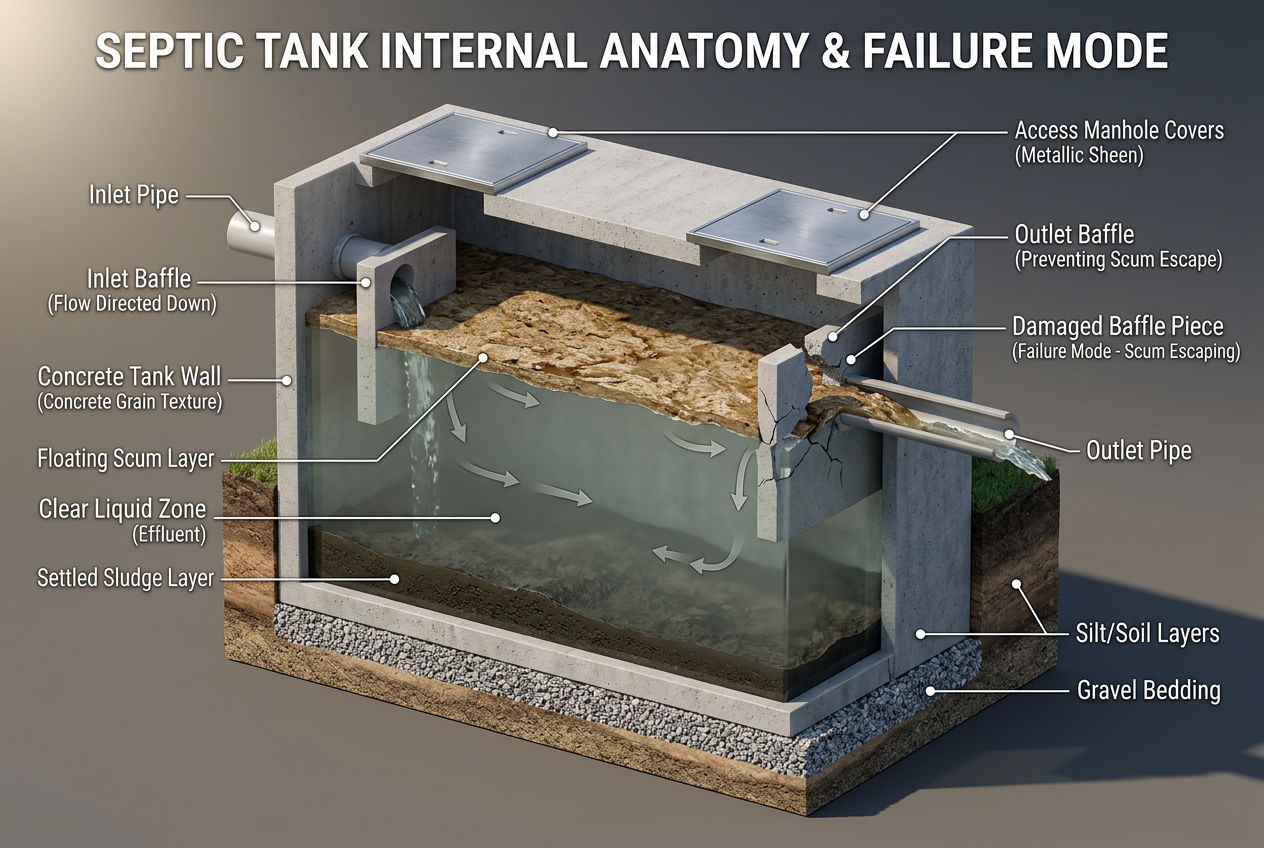
Inside every septic tank, waste separates into three distinct layers:
The inlet and outlet baffles make sure only the clear middle zone exits the tank. They extend downward below the liquid surface (typically 6–12 inches, per EPA and most state health department guidelines) so they pull from or discharge into that clear middle zone — not the scum or sludge.
📊 Quick Fact: Most state health departments specify baffles must extend 6–12 inches below the liquid surface to effectively block scum and sludge layers from exiting the tank.
If you want a broader picture of how everything fits together, the how a septic system works guide covers the full flow path from toilet to soil.
People often treat these as interchangeable. They're not.
The septic tank inlet baffle sits at the point where the main sewer line from your house enters the tank. Its job is to deflect incoming waste downward instead of letting it jet across the surface. Without it, the turbulence from flushing and draining would break up the scum layer and push floating debris toward the outlet — exactly what you don't want.
The septic tank outlet baffle does the more critical job. It acts as a final barrier between the tank contents and your drain field. It extends below the liquid surface so outgoing effluent is drawn from the clear zone, not the scum layer floating above it. Most outlet baffles also extend several inches above the liquid line to physically block grease from escaping.
⚠️ Warning: A failed outlet baffle sends solids and grease directly into your leach field, clogging the soil pores and potentially destroying the entire drain field system — the outlet baffle failure is the expensive one.
| Component | Typical Failure Symptoms | Financial Impact |
|---|---|---|
| Inlet Baffle | Odors inside house, accelerated sludge buildup | Moderate ($300–$800) |
| Outlet Baffle | Solids/grease in drain field, wet spots in yard | Severe ($5,000–$30,000+) |
This is one of the most common sources of confusion — and it's mostly a materials and era question.
Original septic tanks built before the 1980s used cast-in-place concrete baffles — basically thick concrete walls or protrusions formed as part of the tank itself. They worked, but they have a serious vulnerability:
Modern tanks — and repair work on older ones — use 4-inch PVC sanitary tees (sometimes called septic tees) instead. The fitting is literally a T-shaped piece of pipe:
💡 Key Takeaway: A baffle and a tee do the same job. A tee is just the modern, more durable version. When a concrete baffle fails, the repair almost always involves installing a new PVC sanitary tee in its place.
Some installers add a Polylok PL-122 effluent filter to the outlet tee as extra insurance — it catches any fine particles that make it past the tee. If your system doesn't have one, it's worth asking your service tech about it during the next pump-out. You can read more about these in the septic effluent filter guide.
Yes — virtually every permitted septic tank installed in the United States includes both an inlet and outlet baffle (or tee). The EPA and all state health departments require them as part of standard design for conventional septic systems. Across more than 21 million U.S. households on septic systems (EPA estimate), a functioning set of baffles is considered baseline equipment, not an optional upgrade.
That said, having baffles and having functional baffles are two different things. In older homes — particularly those built before 1980 with original concrete tanks — the baffles may have deteriorated so severely that they're partially or completely gone.
📊 Quick Fact: During point-of-sale septic inspections, missing or deteriorated baffles are among the most commonly cited deficiencies. Minnesota's SSTS inspection program consistently lists failed baffles as a top finding.
If you're buying a home with a septic system, get a full inspection before closing. The septic inspection guide for home buyers explains what to demand from that inspection.
Signs of a bad septic baffle rarely announce themselves loudly — until it's too late. Here's what to watch for:
Slow or gurgling drains throughout the house. This isn't always a baffle issue, but a failed inlet baffle can cause back-pressure problems that show up as sluggish fixtures. If multiple drains are slow simultaneously, your septic system is involved.
Sewage odors inside or near the tank. A functioning inlet baffle prevents gases from traveling back up the inlet pipe toward your house. When it fails, you may notice rotten-egg smells near floor drains, cleanouts, or even in lower-level bathrooms. Outdoors, strong odors near the tank lid can indicate the same.
Wet spots or lush grass over the drain field. This is the most alarming sign. If the outlet baffle has failed and solids are reaching your drain field, the leach field will start surfacing liquid. You might notice:
⚠️ Warning: Don't ignore wet spots over your drain field. Signs your drain field is failing covers the full picture of what happens when effluent surfaces.
Solids or grease discovered in the outlet pipe. During a pump-out, a good technician will visually inspect the baffles and check for solids carry-over at the outlet. If they find evidence of grease or solids past the outlet tee, you have a problem.
Technician finds missing or collapsed components. This is how most baffle failures are officially diagnosed — during routine septic tank pumping when the lid is off and the technician can look inside.
✅ Pro Tip: The EPA recommends having conventional septic systems inspected every 3 years and pumped every 3–5 years for most households. That's your window to catch baffle problems before they escalate.
Picture this: you're selling your home and the buyer's inspector opens your septic tank. The outlet baffle is gone — been gone for years, probably. The inspector finds grease fouling in the distribution box and the first few feet of your leach laterals. The buyer's attorney puts $25,000 in escrow pending drain field remediation.
That's a real scenario that plays out every spring during real estate season, especially in states like Connecticut, Massachusetts, and Washington where point-of-sale inspections are standard or required.
Ignoring a failed outlet baffle doesn't just accelerate drain field damage — it often destroys the field entirely:
💡 Key Takeaway: Full drain field replacement costs $5,000–$30,000+, depending on soil conditions, system size, and local labor rates. For comparison, replacing a baffle during a routine pump-out costs $150–$500. The math is obvious.
You can see regional cost breakdowns at the drain field replacement cost guide.
When a technician diagnoses a failed baffle during pumping, the repair process for a straightforward PVC tee installation is relatively simple:
⏱️ Time Estimate: The whole process often adds just 30–60 minutes to a standard pump-out appointment.
If the tank lid is buried and needs excavation first — common in older homes where concrete lids were installed without risers — add $200–$600 for that work. Consider adding a septic riser while the lid is exposed so future access doesn't require digging.
Technically, yes. Practically, it's a bad idea for most homeowners.
Safety concerns:
Technical challenges:
⚠️ Warning: If your state requires a permit for baffle replacement, skipping it can create title problems when you sell. Florida requires all septic work to be done by a Registered Septic Tank Contractor (RSTC). California's requirements vary by county health department.
For repairs connected to a pump-out, the septic pumping and cleaning service handles both in a single visit.
Here's a realistic breakdown of what septic baffle repair costs in 2025:
| Repair Scenario | Typical Cost Range | Notes |
|---|---|---|
| PVC tee replacement during pump-out | $150–$500 | Most common; labor added to pump fee |
| Baffle repair with lid excavation | $500–$1,500+ | Add $200–$600 for digging |
| Full pump-out (when baffles inspected) | $300–$600 | Per EPA / national average |
| Effluent filter installation (add-on) | $75–$200 | Polylok PL-122 or similar |
| Drain field replacement (consequence) | $5,000–$30,000+ | If solids reach leach field |
Source: EPA SepticSmart program cost estimates; NOWRA industry data; regional contractor surveys.
Regional variation matters. A PVC tee swap in rural Minnesota might cost $400–$500 because the pump truck drives 45 minutes each way. The same job in suburban Tampa, Florida — where competition among contractors is higher — might run $150–$250 on top of a $325 pump-out.
See the septic repair cost guide for a deeper breakdown by region.
For full pump-out pricing before your next service visit, the septic pumping cost guide has current regional figures.
You can't make concrete immortal, but you can take steps that extend baffle life and catch failures early:
Pump and inspect on schedule. The EPA recommends pumping conventional systems every 3–5 years. A 1,000-gallon tank serving a 4-person household lands at the short end of that range — closer to every 3 years. During every pump-out, ask your technician to verbally confirm the condition of both baffles. Not all of them volunteer this unless asked.
Upgrade to PVC tees at your next service. If your home was built before 1980 and you've never replaced the original concrete baffles, ask your service provider to install 4-inch PVC sanitary tees during the next pump-out. This is cheap insurance against a baffle failure between now and your next service cycle.
Add an effluent filter. Installing a Polylok PL-122 or similar filter on the outlet tee adds a secondary layer of protection. It catches fine solids before they exit the tank. The filter needs cleaning every 1–3 years, but that's a five-minute job during a pump-out.
Don't abuse the system. Garbage disposals dramatically increase the solids load entering your tank, which accelerates sludge buildup and puts more strain on the outlet baffle.
✅ Pro Tip: If you have an older tank with original concrete baffles, upgrading to PVC tees during your next scheduled pump-out typically adds only $150–$300 to the service cost — far less than excavation and emergency repair later.
Compare top-rated companies in your area. Get free, no-obligation quotes from verified providers.
Was this article helpful?
Connect with licensed, verified septic companies in your area.
Get estimates from licensed, verified companies in your area. No obligation.
⚡ Average response time: under 2 hours