
Learn how septic tank abandonment works, what it costs ($1,000–$10,000+), whether to remove or fill, and which permits you need. Find a local pro today.
Quick Answer
Septic tank abandonment is the process of permanently decommissioning an out-of-service septic tank by pumping it out, perforating or removing the lid, and filling the void with an approved material such as sand, gravel, or concrete slurry. Most jurisdictions require a permit and a licensed contractor to complete the work legally.
Key Takeaways
- Abandoning a septic tank without a permit is illegal in most states and can create serious liability during a property sale.
- The two main options are fill-in-place ($1,000–$3,500) and full removal ($3,000–$10,000+).
- An improperly abandoned tank can collapse, creating a dangerous sinkhole — especially for children and pets.
- Minnesota, Florida, Texas, California, and Ohio each have distinct state-level abandonment codes requiring licensed professionals.
- The process takes 1–3 days of active work and 2–6 weeks total once permit acquisition is included.
The most common trigger is a septic-to-sewer conversion — your municipality extends a sewer line to your street, and you're required (or choose) to connect. The old tank no longer has a job. But it doesn't just disappear.
📊 Quick Fact: Approximately 21 million U.S. households — roughly 1 in 5 — rely on septic systems, according to the EPA. As municipal sewer infrastructure expands into suburban and rural areas, septic tank decommissioning is becoming more common every year.
Leaving an out-of-service tank in the ground without proper abandonment isn't just against most local codes — it's genuinely dangerous.
Structural collapse. Concrete tanks weigh 8,000–12,000 pounds. They're designed to hold that weight when filled with liquid. Once empty and aging, the lid can fail. Kids playing in the yard, pets, even adults have fallen through deteriorated septic tank lids. These incidents are well-documented in local news records nationwide and can be fatal.
⚠️ Warning: Hydrogen sulfide becomes toxic at concentrations above 50 ppm and can reach explosive levels. An unsealed tank near a basement or crawlspace is a serious risk.
Gas hazards. An unsealed, empty tank accumulates methane and hydrogen sulfide. An unsealed tank near a basement or crawlspace is a serious risk.
Environmental contamination. Residual sludge and effluent left in an improperly abandoned tank can leach into surrounding soil and groundwater over time — a particular concern near wells, waterways, or coastal zones.
Property sale complications. Undisclosed abandoned tanks are a growing source of real estate litigation. Many states have septic system disclosure requirements that obligate sellers to reveal the existence of any buried tank, active or not. Failing to disclose can expose you to liability well after closing.
💡 Key Takeaway: Ignoring an old tank costs you more — financially and legally — than dealing with it properly.
This is the question most homeowners wrestle with. Both methods are legal and widely practiced. The right choice depends on your budget, future land use plans, and what your local health department requires.
| Factor | Fill In Place | Full Removal |
|---|---|---|
| Typical cost | $1,000–$3,500 | $3,000–$10,000+ |
| Timeline | 1–2 days | 2–3 days |
| Future land use | Limited (no building over tank) | Unrestricted after backfill |
| Permit required | Yes, in most jurisdictions | Yes, in most jurisdictions |
| Environmental risk | Low if done correctly | Lowest — tank is gone |
| Resale impact | Must be disclosed | Clean title; no disclosure needed |
| Best for | Most standard abandonment situations | New construction, high-value lots |
Source: National Onsite Wastewater Recycling Association (NOWRA); contractor cost data from Angi/HomeAdvisor averages, 2024.
Fill in place is by far the most common approach. The tank is pumped out, the lid is perforated or removed to prevent a sealed void, and the cavity is filled with sand, gravel, or concrete slurry. A 1,000-gallon tank requires roughly 130–135 cubic feet of fill material.
Full removal involves excavating around the entire tank, breaking it apart or extracting it whole, and backfilling the hole. It's the better choice if you're planning to build a structure nearby, install a pool, or if your county requires it. Moving a 12,000-pound concrete tank isn't trivial — that's why costs can climb past $10,000 on properties with difficult access, rocky soil (common in New England), or tanks buried 4+ feet deep.
Abandonment costs vary significantly based on method, tank size, soil conditions, and local labor rates. Here's a realistic breakdown:
Scenario 1: Suburban Columbus, Ohio. A licensed contractor pumps your 1,000-gallon concrete tank ($325), pulls the necessary Ohio EPA permit ($150), perforation-drills the baffle walls, and fills the void with clean sand ($950 in materials and labor). Total out of pocket: roughly $1,425.
Scenario 2: Coastal Maine. The same job with a 1,500-gallon tank buried 3.5 feet below frost-hardened soil. Add rock breaking, longer equipment time, and higher disposal costs — you're looking at $2,800–$3,500 before any surprises.
✅ Pro Tip: For a full look at service pricing, the septic repair cost guide covers related excavation and tank work.
Yes — in nearly every jurisdiction in the United States, septic tank abandonment requires a permit from your local health department or environmental agency. Proceeding without one is a code violation that can result in fines and complications if you ever sell the property.
Permit requirements vary by state. A few examples:
| State | Regulatory Agency | Key Requirements |
|---|---|---|
| Minnesota | MPCA (Minnesota Pollution Control Agency) | Abandonment within 3 years of connecting to municipal sewer; clean sand or concrete required |
| Texas | TCEQ (Texas Commission on Environmental Quality) | Work must be performed by licensed On-Site Sewage Facility installer (30 TAC Chapter 285) |
| Florida | DOH (Department of Health) | High water table creates unique complications; many counties require additional inspection steps (Rule 64E-6) |
| California | CUPA (Certified Unified Program Agency) | Some counties require soil sampling after tank removal to verify no contamination |
| Ohio | Ohio EPA | Requires EPA notification and county health department permit |
⚠️ Warning: Regulations change. Your local health department is the definitive source — call them before hiring anyone.
The septic system permit requirements guide covers the permitting landscape in more detail, including what to expect from the inspection process.
This is the standard septic tank abandonment procedure used by licensed contractors across most of the U.S. DIY is addressed separately below.
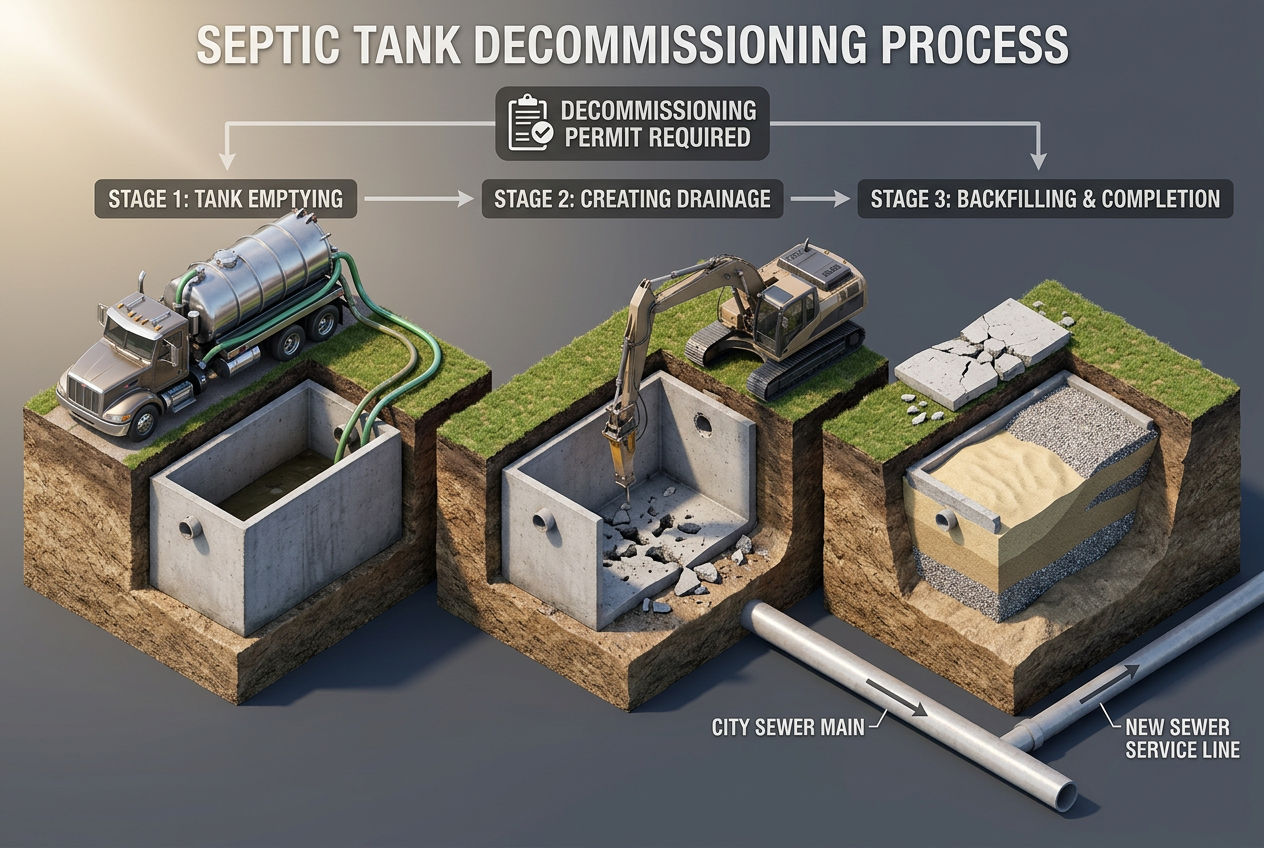
If you don't have an as-built diagram of your septic system, you'll need to find the tank first. Check with your county health department — many maintain records of permitted systems. If no records exist, a contractor can probe the soil or use a sewer camera to trace the pipe from your cleanout. Learn how to find your septic tank lid if you're starting from scratch.
Contact your local health department or environmental agency. Explain you're abandoning an existing tank due to sewer connection (or other reason). They'll issue the permit and tell you what fill materials are approved in your county.
Before anything else, the tank must be completely pumped out by a licensed pumper. Residual sludge and effluent left inside can create contamination and gas hazards during the fill process. This is not optional and not a DIY step.
The contractor removes or opens the septic tank lid (typically a 24-inch concrete or poly lid) and inspects the interior. The baffle walls are broken through or perforated to prevent sealed air pockets. In some jurisdictions, the inlet and outlet pipes must also be plugged or capped.
Approved fill materials include:
⚠️ Warning: Dirt, topsoil, and construction debris are not approved in most jurisdictions. They compact unevenly and can create settling voids over time.
Material volume requirements:
Your contractor will calculate fill material quantities based on the measured tank dimensions.
Once the tank cavity is filled, the contractor backfills the excavation, compacts the soil, and restores the surface grade. In most cases, the area can be reseeded with grass.
Your county health department will schedule a final inspection — typically within a few days of the fill. Once approved, you'll receive a signed closeout permit. Keep this document permanently. You'll need it when you sell the property.
📊 Quick Fact: The entire active work process takes 1–3 days. With permitting, expect 2–6 weeks start to finish.
Technically, some jurisdictions allow homeowner-performed abandonment with a permit. Practically, most don't — and the ones that do still require licensed pumpers for the initial pump-out.
Here's the real problem with DIY: the permitting process, proper perforation of baffle walls, selecting approved fill materials, and meeting the final inspection standard all require working knowledge of local code. A failed inspection means re-excavating and redoing the work. That scenario routinely costs more than hiring a licensed contractor from the start.
⚠️ Warning: Opening a septic tank without proper ventilation is genuinely dangerous. Hydrogen sulfide doesn't smell at lethal concentrations — your nose stops detecting it before your body does.
For most homeowners, the right call is to find a licensed septic professional who knows your county's specific requirements. The cost difference between DIY and professional rarely justifies the risk.
Bought an older home and suspect there's an unknown tank buried somewhere on the lot? You're not imagining things — rural and suburban properties built before 1970 sometimes have multiple tanks, including old cesspools that were abandoned without documentation.
Your county health department may have historical permit records going back decades. A septic system inspection using a sewer camera trace and soil probe is the most reliable detection method. In some cases, a ground-penetrating radar (GPR) survey is used on large or complex properties.
✅ Pro Tip: If you're buying a home and want to know what's underground before you close, the septic inspection guide for home buyers walks through exactly what to request.
An abandoned tank on a property is not automatically a dealbreaker — but it has to be properly documented. Most states require disclosure of any known buried tank, active or decommissioned. Buyers have the right to request proof that abandonment was performed with a permit and passed final inspection.
If you're selling a home with an old tank that was never formally abandoned, you have two options:
💡 Key Takeaway: Option one is almost always cleaner. A flagged tank can
Compare top-rated companies in your area. Get free, no-obligation quotes from verified providers.
Was this article helpful?
Connect with licensed, verified septic companies in your area.
Get estimates from licensed, verified companies in your area. No obligation.
⚡ Average response time: under 2 hours