
Septic effluent filter guide — learn what it does, top brands, cleaning schedule, and why a $30–$150 filter prevents $5,000+ drainfield repairs.
Quick Answer
Meta description: A septic effluent filter is a mesh screen that catches solids before they reach your drainfield. Learn what it costs, how to clean it, and which brands work best.
A septic effluent filter is a mesh screen cartridge that installs in your tank's outlet baffle and catches suspended solids before they flow into your drainfield. Systems built after 2000 often include one as standard equipment. If your system is older, you probably don't have one — but adding a filter for $30–$150 could prevent a drainfield failure that costs $5,000–$25,000 to fix.
💡 Key Takeaways:
- Effluent filters sit in your tank's outlet tee and block solids from reaching your drainfield
- They reduce suspended solids entering the drainfield by roughly 70–80%, according to University of Minnesota Extension research
- Filters need cleaning every 1–3 years — typically during a routine pump-out
- A clogged filter causes slow drains and backups; an unclogged filter quietly saves your drainfield
- Top brands include Zabel A1800, Polylok PL-122, Sim/Tech STF-110, and Tuf-Tite
A septic effluent filter catches the suspended solids that escape your tank's scum and sludge layers before that liquid — called effluent — exits into your drainfield. The filter cartridge slides into the outlet baffle, the pipe fitting that controls where clarified wastewater leaves the tank. Slot openings typically measure 1/16" to 1/8" (1.6–3.2mm), small enough to snag particles that would otherwise clog the soil around your leach laterals.
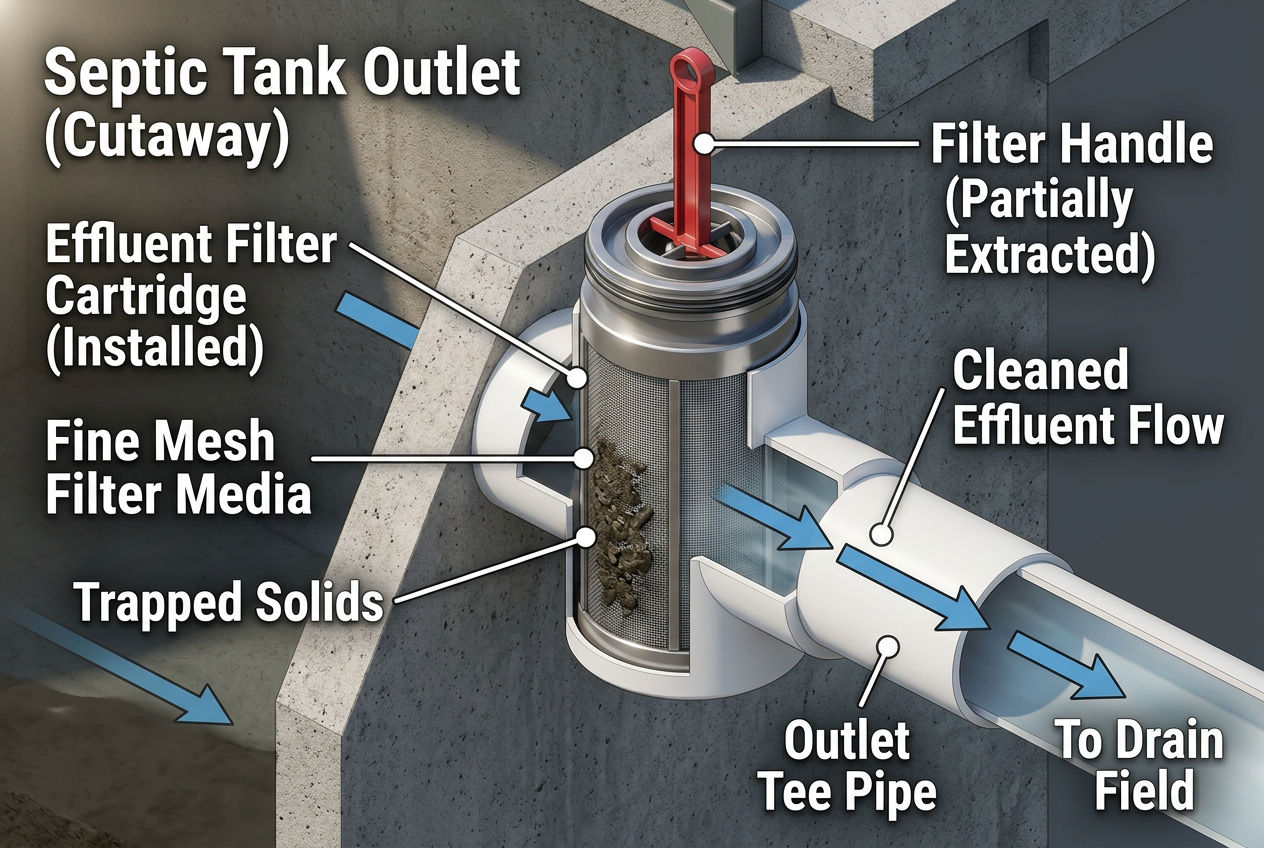
Wastewater enters your tank, anaerobic bacteria break down solids, and the heaviest material settles as sludge on the bottom while grease and lightweight waste form a scum layer on top. The relatively clarified liquid in the middle — effluent — is what should flow out to your drainfield. "Relatively clarified" still means there are fine particles in suspension that your drainfield soil would rather not receive.
Even healthy effluent carries fine particles that accumulate in drainfield soil over years and eventually reduce drainage capacity. The filter is the last line of defense against that buildup.
📊 Quick Fact: University of Minnesota Extension research found that properly maintained effluent filters reduce suspended solids reaching the drainfield by 70–80% — significantly extending drainfield life over a 20–30 year system lifespan.
University of Minnesota Extension research shows properly maintained effluent filters reduce suspended solids reaching the drainfield by 70–80%. Over a 20–30 year system lifespan, that difference is significant. Several state studies suggest filters can measurably extend drainfield life, though actual results depend on household loading, soil type, and how consistently the filter gets cleaned.
No — the outlet baffle and the effluent filter are two different things, though they occupy the same location. Many homeowners conflate them, and some inspectors do too, which creates real confusion during pump-outs.
The outlet baffle (or outlet tee) is a structural component — usually a sanitary tee fitting made of PVC or, in older concrete tanks, a concrete projection — that extends down into the tank's liquid zone. Its job is to prevent the scum layer from flowing directly out with the effluent. It's been a required component of septic tank design for decades.
The effluent filter is an add-on cartridge that slides inside that outlet tee. It adds mechanical filtration on top of what the baffle already does. If your pumper tells you your outlet baffle is fine, that's good — but it doesn't mean you have a filter.
No. Most septic tanks built or replaced after approximately 2000 include effluent filters, because many states began requiring them for new construction around that time. Tanks installed before then almost certainly don't have one.
Regulatory adoption has been uneven. Minnesota and Wisconsin essentially require filters on all new and replacement systems. Washington, Oregon, and North Carolina have strong adoption requirements. Parts of Florida mandate them, though requirements vary by county. In many rural Midwest and Plains states, filters remain optional even today.
If your home was built before 2000 and you've never had a septic inspection that specifically confirmed an effluent filter, assume you don't have one. A septic inspection will confirm either way.
💡 Key Takeaway: If your home was built before 2000, there's a strong chance your tank has no effluent filter at all. Many homeowners discover this for the first time during their first professional inspection.
Almost certainly yes. A Zabel A1800 filter — one of the most widely recommended units in the industry — retails for around $50–$75. A Polylok PL-122 or Sim/Tech STF-110 runs $30–$100 depending on the supplier. If your pumper adds one during a scheduled pump-out, installation typically runs $150–$250 for labor, or it may be included as a low-cost add-on. Some contractors do it for free to build goodwill with a long-term customer.
Compare that to drainfield replacement, which runs $5,000–$25,000 depending on your region, soil conditions, and system type. In the rocky clay soils of New England or the shallow water table zones of coastal Florida, you're looking at the higher end of that range — or more.
📊 Quick Fact: A filter costs $50–$75 on average, while drainfield replacement runs $5,000–$25,000 — that's a 100:1 to 300:1 ratio of potential savings to investment.
Most 4-inch outlet tees accept standard filter cartridges directly. Some pre-1980 concrete tanks have non-standard configurations that require an adapter or a different filter model. Your pumper can assess compatibility in about 30 seconds when they're already standing at the open tank.
⚠️ Important: A filter won't fix an already-failing drainfield. If your soil is biomat-clogged from years of solids loading, adding a filter now protects what's left but doesn't reverse existing damage. Think of it like changing your oil after the engine already seized — better late than never, but manage expectations.
Clean your septic effluent filter every 1–3 years. For most households, that aligns with your regular pump-out schedule — every 3–5 years for a typical 3-4 person household with a 1,000–1,500 gallon tank.
High-use households — large families, frequent guests, heavy laundry loads, homes with garbage disposals — may need filter cleaning every 6–12 months. Summer months when water use spikes, and periods after hosting events, can push more fine solids toward the filter than usual.
✅ Pro Tip: Schedule your filter cleaning to coincide with your regular pump-out. Your pumper already has the tank open and can clean or replace the filter in minutes — saving you a separate service call.
The cleaning process takes 5–15 minutes and costs nothing if you're doing it yourself:
The EPA recommends having a licensed professional inspect your entire system every 1–3 years. Pairing filter cleaning with those visits is the most efficient approach. If your pumper offers a maintenance plan, ask whether filter cleaning is included — many do.
A severely clogged septic filter behaves exactly like a blocked drain pipe — because that's effectively what it is.
⚠️ Warning: Don't ignore simultaneous slow drains in multiple fixtures. Unlike a single clogged sink, whole-house drainage problems often point to a clogged effluent filter or a full tank — both of which need prompt attention to avoid sewage backups.
Watch for these signs:
Slow drains throughout the house. Not one slow drain from a clog in a single fixture, but all drains moving sluggishly. Showers, sinks, and toilets all seem lazy.
Gurgling sounds. Air displacement in partially-blocked pipes creates that characteristic gurgle when water drains.
Sewage odors indoors or near the tank. Backed-up effluent can release gases into the home's drain venting system.
Septic alarm activation. Systems with a pump chamber and float switch may trigger a high-water alarm as effluent backs up.
Wet spots or soggy ground near the tank — not the drainfield. This is actually a sign your filter is doing its job. It's catching solids so aggressively that effluent is backing up toward the inlet side of the tank.
💡 Perspective: A clogged filter is an inconvenience. A failed drainfield caused by years of no filtration is a catastrophe. If you're seeing symptoms of a clogged filter, contact a septic professional — cleaning takes minutes but diagnosing the cause of a backup requires eyes in the tank.
Yes. Consider what's actually at stake over a 20-year window: a filter that costs $75 and gets cleaned at each pump-out, versus unrestricted fine solids entering drainfield soil every single day. The comparison isn't close.
| Factor | With Effluent Filter | Without Effluent Filter |
|---|---|---|
| Solids reaching drainfield | Reduced 70–80% | Unrestricted |
| Drainfield lifespan | Significantly extended | Baseline or reduced |
| Maintenance required | Clean every 1–3 years | Tank pumping only |
| Warning of system stress | Clogged filter = early warning | No warning until drainfield fails |
| Upfront cost | $30–$150 + installation | $0 |
| Risk cost (drainfield) | Reduced | $5,000–$25,000+ exposure |
Source: University of Minnesota Extension; EPA SepticSmart program; manufacturer specifications from Polylok, Zabel/Sim-Tech, Tuf-Tite
The "no filter" column doesn't mean your system will fail immediately. Millions of pre-filter systems have run for decades. But they're running without a safety net. Soil clogging from fine suspended solids is the leading cause of drainfield failure, and it happens gradually and invisibly until the day it doesn't drain anymore.
Four brands dominate the residential market. Your pumper will likely have a preference based on what they stock and install regularly, but knowing the options helps you ask informed questions.
Zabel A1800 — The most commonly recommended filter for standard residential systems. Fits most 4-inch outlet tees, uses a dual-barrier mesh design, and includes an alarm port for high-water float switches. Retail price: $50–$75. The Zabel line was developed specifically for retrofit installations, which is why pumpers recommend it so often for older tanks.
Polylok PL-122 — Aggressive slot sizing (1/16") makes it one of the most effective solids-blockers on the market. Slightly higher price point ($60–$100) but well-regarded for high-use households. The PL-122 model fits 4-inch tees; Polylok also makes models for 6-inch configurations in larger commercial tanks.
Sim/Tech STF-110 — Budget-friendly option ($30–$60) that performs well in normal-use households. The mesh is slightly coarser than the Polylok, which means it clogs less quickly but allows marginally more fine solids through. Good choice if your household loading is low and you're primarily looking for basic protection.
Tuf-Tite — Known more for risers and lids than filters, but their effluent filter line is well-regarded for compatibility with Tuf-Tite outlet tee assemblies. If your tank was fitted with Tuf-Tite components during installation, matching their filter cartridge avoids compatibility headaches.
✅ Pro Tip: Before ordering a filter online, ask your pumper what brand and size they recommend. They know your outlet tee configuration and can confirm compatibility — saving you a return trip if the wrong model shows up.
What actually matters most in filter selection: whether it fits your outlet tee diameter (4-inch is standard; confirm before ordering), whether your pumper can service it without special tools, and whether it includes an alarm port if your system has a pump chamber.
A septic outlet filter removes suspended solids. That's its job, and it does it well. It does not filter pathogens, dissolved nutrients, pharmaceuticals, or microplastics. Effluent leaving a filtered tank is cleaner than unfiltered effluent, but it's not treated water.
This matters if you're relying on filtration alone for a system near a well, a stream, or a property boundary. For those situations, engineered septic systems — constructed wetlands, drip irrigation systems, aerobic treatment units — provide additional treatment that a passive effluent filter cannot.
⚠️ Warning: An effluent filter is not a treatment system. It won't remove bacteria, viruses, nitrates, or chemicals from wastewater. If your system is near a well or waterway, you need additional treatment — not just filtration.
A filter also won't compensate for a failing drainfield, hydraulic overloading, or garbage disposal use that exceeds your tank's processing capacity. If you're dumping significant food waste into the system, the filter will clog faster and the underlying loading problem remains.
For comprehensive guidance on keeping your entire system healthy, see our septic tank maintenance guide.
The cost of a septic pump-out typically runs $300–$600 depending on your region and tank size. Adding a filter installation to that visit adds $150–$250 in most markets — or less if your pumper includes it as a package item.
Ongoing maintenance cost is essentially zero if you clean it yourself during pump-outs. If you pay your pumper to clean it during a service visit, expect $50–$100 added to the pump-out invoice.
Compare those numbers to septic repair costs — drainfield replacement ranges from $5,000 to $25,000+, and partial repairs to lateral lines or distribution boxes run $1,500–$5,000. Over a 20-year period, a homeowner who spends $75 on a filter and $50 per pump-out on cleaning spends roughly $350–$500 total. That's a reasonable insurance premium against a five-figure repair.
💡 Key Takeaway: Total 20-year filter cost (purchase + cleaning): $350–$500. One drainfield replacement: $5,000–$25,000+. The math makes the filter one of the cheapest forms of septic system insurance available.
Compare top-rated companies in your area. Get free, no-obligation quotes from verified providers.
Was this article helpful?
Connect with licensed, verified septic companies in your area.
Get estimates from licensed, verified companies in your area. No obligation.
⚡ Average response time: under 2 hours