
Bought a house with an illegal septic system? Learn what it means, what fines you face, who's liable, and exactly what to do next. Real costs included.
Quick Answer
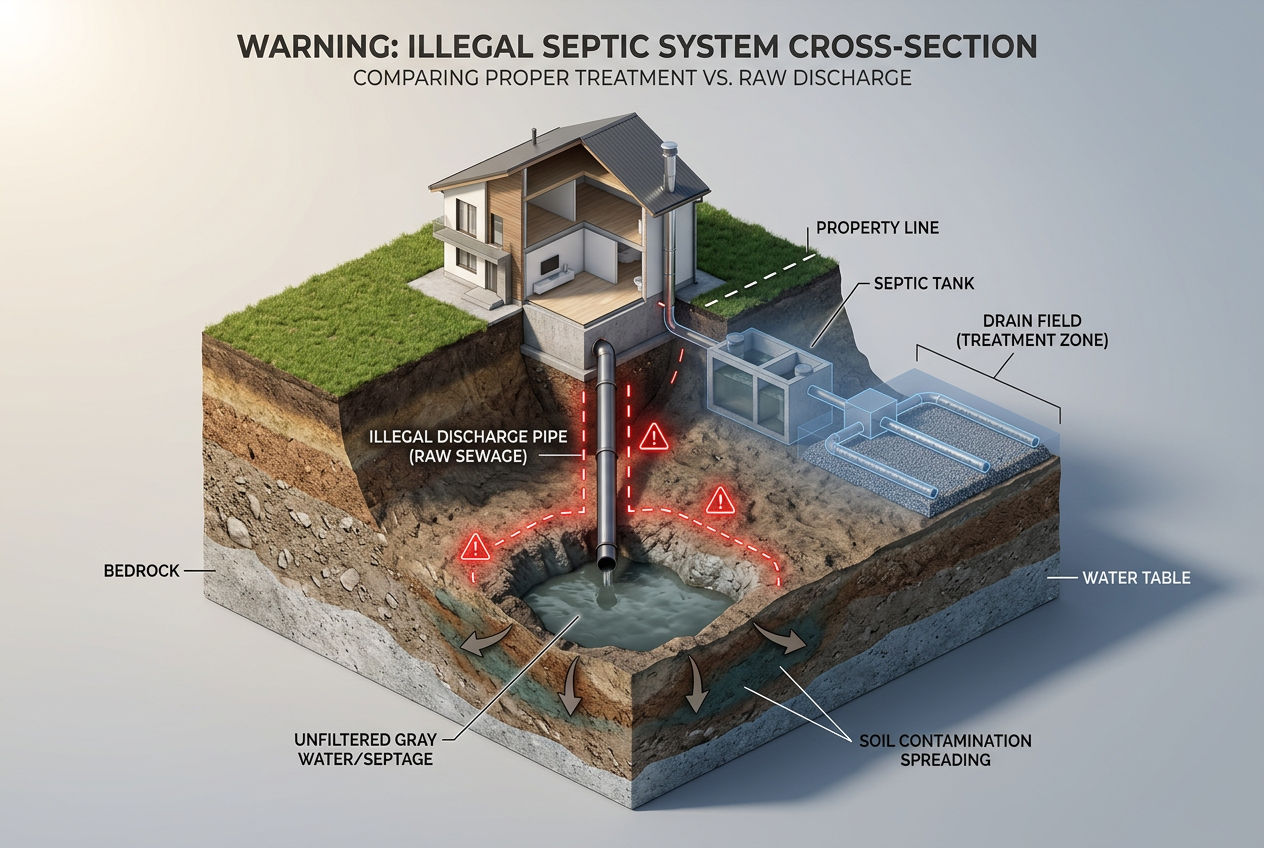
An illegal septic system is any onsite wastewater treatment system that was installed without required permits, operates below current health and safety standards, or uses a method that's outright prohibited — such as discharging raw sewage through a straight pipe or relying on an unlined cesspool. Discovering one after closing is stressful, but you have real options.
Key Takeaways
- "Illegal" covers several situations: no permit, non-compliant design, prohibited system type, or active environmental violation
- Daily fines from local health departments range from $50 to $500; EPA Clean Water Act civil penalties can reach $56,460/day in straight-pipe discharge cases
- Replacing a non-compliant system typically costs $5,000–$30,000 for conventional systems, and $15,000–$50,000+ for engineered alternatives
- Sellers in 30+ states have mandatory disclosure obligations — you may have legal recourse
- Your first call should be to your county health department, not a lawyer or a contractor
The phrase gets used loosely, so it helps to pin down exactly what you're dealing with. There are four distinct situations that all get called an "illegal" or unpermitted septic system, and they carry very different consequences.
No permit on record. The system may function perfectly well, but nobody pulled a permit before installing it. This is the most common situation and often the most fixable. Your county health department keeps septic system permit records — including as-built drawings showing tank location, drain field layout, and system type. If there's no record, the system's compliance is unknown until a licensed inspector evaluates it.
Non-compliant design. The system has a permit, but it was installed to older standards that no longer meet current code — or it was installed incorrectly even by the standards of its time. A tank with missing inlet and outlet baffles, a drain field sized for a two-bedroom house now serving a four-bedroom addition, or a distribution box that's collapsed and hydraulically bypassing half the leach laterals all fall here.
Prohibited system type. In most states, cesspools — unlined pits that receive raw sewage — have been banned for new construction since the 1970s or 1980s. If you bought a house with an active cesspool, you own a prohibited system regardless of whether anyone ever issued a permit. Hawaii is the extreme example: Act 125 requires 90,000+ cesspools to convert to compliant onsite wastewater treatment systems (OWTS) by 2050, with penalties for noncompliance already in effect in sensitive watershed areas.
Active environmental violation. A straight pipe — literally a pipe from the house that discharges raw or minimally treated sewage to a ditch, stream, or the ground surface — is an active pollution event. This is the most serious category. The EPA estimates 500,000 to 1 million+ homes in rural Appalachia, the Deep South, and other underserved regions still use straight-pipe sewage systems. This isn't a paperwork problem; it's a public health and criminal liability problem.
⚠️ Warning: A straight-pipe discharge is not just a code violation — it can trigger federal Clean Water Act enforcement with civil penalties up to $56,460 per day and potential criminal charges. If you suspect your property has one, treat it as an emergency.
Understanding which category applies to your situation determines everything that follows.
Start with your county health department or environmental health office — not the state, not the city. Septic regulations in the United States are governed almost entirely at the county level. Call and ask for the permit history on your address. Many counties now have searchable online databases.
Ask specifically for:
If records show a permit was issued but no final inspection was completed, that alone can put the system in a gray zone. If the permit is 40 years old and the house has had a bedroom addition since, the original permit doesn't cover the current load.
No records at all? That means a licensed septic inspector needs to do a full septic system inspection to establish what's actually in the ground. Plan to spend $300–$600 for a standard inspection. In Massachusetts, Title V requires a specific inspection protocol that involves pumping the tank, checking the distribution box, and load-testing the drain field — costs run $400–$1,200 depending on the county. New Jersey requires inspections at point of sale under NJ Admin Code 7:9A, so if your transaction happened in New Jersey without one, that's a potential disclosure violation.
✅ Pro Tip: When you call the county health department, ask for records by property address, not by your name. Permit records are tied to the parcel, so you'll get the full history — including any violations or complaints filed by previous owners or neighbors.
Local health departments have broad enforcement authority over septic code violations. Here's the realistic range of consequences, from mildest to most severe.
Notice of violation / compliance order. Most counties start here. You receive written notice that the system is non-compliant and a deadline to submit a remediation plan — typically 30 to 180 days. No fines yet, but the clock is running.
Daily fines. If you miss the compliance deadline or the violation is serious, fines start accruing. Most jurisdictions assess $50–$500 per day. At $200/day, a 90-day delay costs $18,000 before you've done a single thing to fix the system.
📊 Quick Fact: A 90-day delay at the average fine rate of $200/day costs $18,000 in penalties alone — often more than the targeted repairs that would have resolved the violation. Acting quickly on compliance notices is almost always cheaper than waiting.
Stop-use order / condemnation. In cases of active sewage surfacing on the ground or discharging to waterways, a health department can condemn the system and prohibit the property from being occupied until it's remediated. This is rare but real — particularly in coastal states and watershed protection zones.
Federal Clean Water Act exposure. If the system is discharging to a navigable waterway, wetland, or storm drain, you're potentially in EPA jurisdiction. Civil penalties under the Clean Water Act max out at $56,460 per day (2024 inflation-adjusted figure). Criminal penalties, including felony charges, are possible in cases of knowing or willful discharge. Most residential cases never reach this level, but a straight-pipe system draining to a creek puts you in that territory.
⚠️ Warning: Ignoring a compliance notice does not make it go away. Fines accrue daily whether or not you've opened the letter, and a health department can escalate to condemnation or federal referral if the violation is left unaddressed.
The good news: health departments generally want voluntary compliance, not litigation. If you approach them proactively, you'll almost always get a reasonable compliance timeline and avoid the worst penalties.
Pro Tip: When you contact your county health department, ask specifically whether they have a voluntary compliance program for non-compliant systems. Many counties offer extended timelines and waived fines for homeowners who self-report and submit a remediation plan within 30–60 days.
Once you close on a house, you own its problems. That's the hard truth. But "you own it now" doesn't mean the seller is off the hook.
Seller disclosure laws exist in more than 30 states and require sellers to disclose known material defects — and septic system status almost always qualifies as a material defect. If the seller knew the system was unpermitted, non-compliant, or failing, and failed to disclose it, you may have a legal claim for fraud, misrepresentation, or breach of contract.
Statutes of limitation for failure-to-disclose claims typically run 2–6 years from the date of discovery, depending on the state. This means even if you're a year post-closing, you may still have time to act. An attorney familiar with real estate disclosure law in your state can assess the strength of your claim. If you're still in due diligence, a septic inspection before closing is your best protection — and your leverage for negotiating repairs.
Real estate agents and inspectors can also carry liability if they knew about issues and stayed silent, or if an inspection report glossed over obvious red flags.
The practical reality: Legal action takes time and money. For a $5,000 problem, small claims court might be the right move. For a $40,000 system replacement, an attorney consultation is worth the $300–$500 it costs. See our detailed breakdown of what to do when a seller didn't disclose septic problems for specifics on building that case.
💡 Key Takeaway: As the current property owner, you are legally responsible for the septic system regardless of who installed it. But that responsibility doesn't erase the seller's disclosure obligations — pursue compliance and legal recourse simultaneously.
This is one of the most misunderstood concepts in residential real estate. Grandfathering is real — but it's narrower than most people think.
A system that was legally installed under the code in effect at the time of installation can often continue operating even if current code would require a different design. But grandfathering has firm limits:
Florida is instructive here: many older systems in nitrogen-sensitive spring protection zones — regardless of when they were installed — are subject to mandatory upgrade requirements under nutrient management rules. "It's always been here" is not a defense.
💡 Key Takeaway: Don't assume your system is grandfathered without verifying it with your county health department. Grandfathering protections are lost upon property transfer in many jurisdictions, and prohibited system types like cesspools are never grandfathered regardless of age.
Yes, everywhere in the United States. A straight pipe — sometimes called a "gray water pit" or just "a pipe out the back" — that discharges untreated sewage to the ground surface, a drainage ditch, or any waterway violates state and federal law without exception.
In practice, enforcement in rural areas has historically been spotty. But that's changing. Baylor College of Medicine researchers documented active hookworm infections in Lowndes County, Alabama — a consequence of widespread straight-pipe sewage — and the resulting attention accelerated state and federal enforcement actions in the region. If you've bought a rural property in Appalachia or the rural Southeast and suspect this situation, treat it as urgent.
What to do immediately: Don't use the system any more than necessary. Contact your county health department to self-report and ask about a voluntary compliance program — many counties have them specifically for households converting from illegal discharge systems. Self-reporting typically gets you a compliance timeline rather than immediate fines, and federal assistance programs through USDA Rural Development may cover part of the installation cost for qualifying households.
Here's where most articles stop at vague advice. Let's walk through actual paths with real numbers.
If your system works but doesn't meet current setback requirements or sizing standards, a variance may be available. A variance is a formal request to the health department to allow your specific situation to deviate from the standard rule. Common grounds: property too small for a standard drain field, pre-existing structures limiting setback compliance, or a system that functions correctly despite minor dimensional non-compliance.
Getting a variance usually requires a septic system engineering report — budget $500–$1,500 — and may require a new percolation test ($250–$1,000). Permit fees vary: $200–$2,500 depending on the county. Total cost for a successful variance: $1,000–$5,000. Timeline: 60–180 days.
This option only works if the system is actually functional. A variance approves an existing installation; it doesn't fix a failing one.
If the tank is sound but the drain field is undersized or the inlet baffle is missing, targeted repairs may bring the system into compliance at far less cost than a full replacement. A new concrete or plastic inlet baffle runs $150–$400 installed. Extending a drain field by adding leach laterals might cost $3,000–$8,000. Adding an effluent filter (a Polylok PL-122 or Zabel A1800 are common choices) at the tank outlet costs $200–$500 installed and can extend system life significantly.
Repair works when the core infrastructure is sound. If the tank is a 750-gallon steel unit that's corroding through, or the drain field soil has completely biomat-sealed from decades of overloading, repair is throwing money at a problem that needs replacement.
Sometimes this is the only path. A conventional gravity-fed septic system — concrete or fiberglass tank, distribution box, and standard absorption field — costs $5,000–$15,000 installed in most regions. Add engineering, permitting, and landscaping restoration and the real number is $8,000–$20,000.
If your soil fails a perc test — common in clay-heavy soils, high-water-table lots, and rocky terrain — you'll need an engineered alternative system: a mound system, drip irrigation system, or aerobic treatment unit (ATU). These run $15,000–$50,000+. Mound septic systems are common in the upper Midwest and Pacific Northwest where shallow soils or high water tables make conventional drain fields impossible. Aerobic septic systems are the standard alternative in Texas, where TCEQ Chapter 285 governs on-site sewage facilities (OSSFs) and requires licensed maintenance providers.
See our full breakdown of septic installation costs and drain field replacement costs for current regional pricing.
Financing Note: Don't assume you have to pay the full cost upfront. USDA Rural Development offers grants and low-interest loans for septic system replacement in qualifying rural areas. Some states — including North Carolina, Alabama, and West Virginia — have dedicated straight-pipe elimination programs that cover 50–100% of installation costs for income-qualifying households.
| Remediation Path | Typical Cost Range | Timeline | Best For |
|---|---|---|---|
| Variance application | $1,000–$5,000 | 60–180 days | Functional system, minor non-compliance |
| Targeted repairs | $1,500–$10,000 | 2–8 weeks | Specific component failure |
| Conventional replacement | $8,000–$20,000 | 2–4 months | System at end of life, soil passes perc |
| Engineered/alternative system | $15,000–$50,000+ | 3–6 months | Difficult soils, restricted lots |
| Straight-pipe conversion | $8,000–$25,000 | 3–6 months | No system currently exists |
Sources: National averages from contractor surveys; EPA SepticSmart program; USDA Rural Development grant data. Costs vary significantly by region and site conditions.
Technically, yes — but with serious conditions. Most states require disclosure of known defects, and in states like Massachusetts, New Jersey, and Washington, a failed or non-compliant septic system must be remediated before closing or the buyer must acknowledge the condition in writing and accept an appropriately adjusted price.
If you're now the owner of a non-compliant system and you're thinking about selling later, document everything. Keep copies of every permit application, inspection report, contractor invoice, and health department correspondence. If you remediate the system before selling, the paper trail proves compliance and protects you from future liability claims.
If you decide to sell before remediation is complete, full disclosure is non-negotiable. Disclose the system status, any active compliance orders, and the estimated cost of remediation. Price the property accordingly. An honest listing that says "septic system needs replacement, priced $20,000 below comparable sales" sells far faster than a house where a buyer discovers the problem during inspection and walks away.
In states with mandatory point-of-sale septic inspections — Massachusetts, New Jersey, and several others — you may not have the option to sell without addressing the system first. Check your state and county requirements early so you aren't blindsided at closing.
📊 Quick Fact: A variance for minor non-compliance costs $1,000–$5,000, while a full conventional system replacement runs $8,000–$20,000. Knowing which remediation path fits your situation can save tens of thousands of dollars — get a professional assessment before committing to full replacement.
If you've confirmed your septic system is illegal or non-compliant, here's your action plan in order:
Discovering an illegal septic system after buying a house is a serious problem, but it's a solvable one. The worst thing you can do is ignore it — fines accrue daily, environmental liability compounds, and the problem only gets more expensive. The best thing you can do is act quickly: contact your county health department, get a professional inspection, understand your options, and make a plan.
Most homeowners who approach this proactively end up with a compliant system, a clear property record, and — in many cases — financial assistance that offsets a significant portion of the cost. Start with that first phone call to your county health department. Everything else follows from there.
Compare top-rated companies in your area. Get free, no-obligation quotes from verified providers.
Was this article helpful?
Connect with licensed, verified septic companies in your area.
Get estimates from licensed, verified companies in your area. No obligation.
⚡ Average response time: under 2 hours