
Bleach, antibacterial soap, and paint thinner can wipe out the beneficial bacteria your septic tank depends on. Here are 14 things to avoid — and what to do instead.
Quick Answer
What kills septic tank bacteria ranges from the obvious (paint thinner poured down a drain) to the surprising (the antibacterial hand soap sitting next to your kitchen sink). When these beneficial bacteria die off, solid waste stops breaking down — and the consequences move fast, from slow drains to a waterlogged drain field to a full system replacement that runs $15,000–$30,000.
About 21 million U.S. households depend on septic systems, according to the EPA. Every single one of them depends on a thriving microbial ecosystem inside the tank to function.
This guide covers exactly what kills that ecosystem — with specific thresholds, not vague warnings — so you can share it with everyone in your household and stop the damage before it starts.
💡 Key Takeaways
- A healthy 1,000-gallon septic tank hosts billions of anaerobic bacteria; certain household chemicals can wipe out colonies within hours
- Bacterial recovery takes 48 hours to 2+ weeks after a chemical event, depending on severity
- Bleach, antibacterial products, disinfectants, paint products, and some medications are the most common offenders
- Most damage is cumulative — small amounts used daily eventually cross a threshold
- You can help bacteria recover with biological additives, but they won't reverse drain field damage already done
Your septic tank isn't just a holding tank. It's a living bioreactor. A functioning 1,000-gallon tank contains roughly 1 billion bacteria per milliliter of septic effluent — a dense population of anaerobic and facultative microbes that digest solid waste, break down grease, and produce clarified liquid effluent that can safely disperse through your drain field.
Kill those bacteria, and solids stop breaking down. The scum layer thickens. The sludge layer climbs. Partially digested waste starts moving into the distribution box and out into your leach laterals. Once biomat clogs those laterals, you're looking at drain field replacement — not a cheap fix.
📊 Quick Fact: These bacteria thrive in a narrow pH window of 6.5–7.5. They're sensitive to temperature, oxygen, and especially chemicals. Most of the 14 things below don't just slow bacterial activity — they actively destroy colonies.
To understand how the full system works before we get into what breaks it, see our beginner's guide to septic systems.
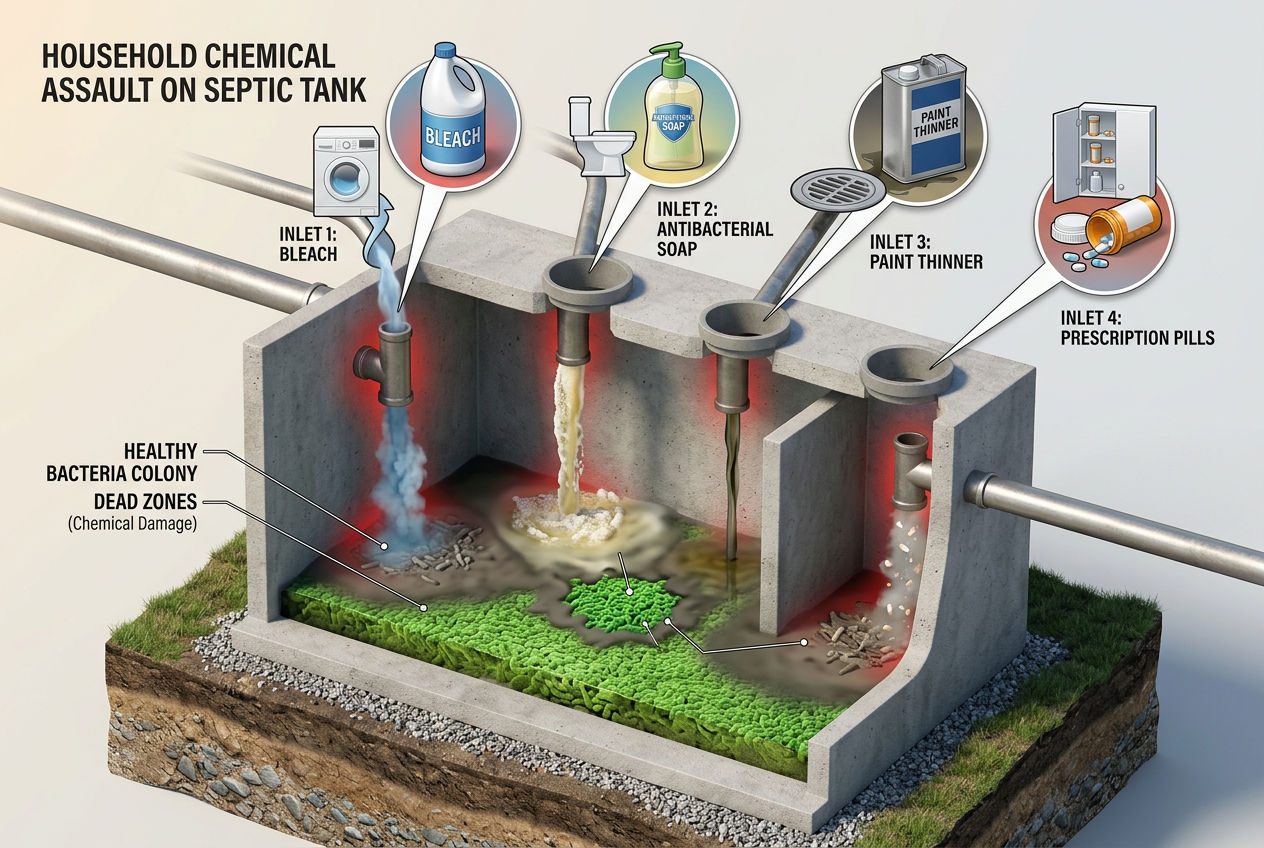
Bleach is the most common bacterial killer in a residential septic system. It's also misunderstood. The question isn't whether bleach kills septic bacteria — it does — but how much crosses the danger line.
A standard household laundry load uses roughly ¾ cup of bleach. For a 1,000-gallon tank, occasional loads at that dose are generally tolerable if they're spaced out. But 1–2 gallons of bleach entering the tank in a short window can significantly disrupt bacterial activity. Think:
⚠️ Warning: The damage isn't always catastrophic after one event. But regular use chips away at the colony until the system stops functioning efficiently.
Switch to hydrogen peroxide-based cleaners for toilet cleaning and oxygen bleach for laundry when possible.
This one surprises homeowners. The same thing that makes antibacterial soap effective — its ability to kill microorganisms — applies equally to the bacteria in your tank.
Products containing triclosan (banned from over-the-counter consumer hand soaps by the FDA in 2016, but still found in some specialty products) and benzalkonium chloride (still widely used) reduce septic bacteria populations with repeated exposure. You're washing your hands dozens of times a day. Multiply that by everyone in your household, and you're sending a steady chemical stream into your tank.
✅ Pro Tip: Look for soap labeled "septic-safe" or use plain castile soap. The antibacterial products and septic harm question comes up constantly from homeowners who are doing everything else right.
Disinfecting wipes are loaded with "quats" — quaternary ammonium compounds. These include:
Quats are designed to kill a broad spectrum of bacteria. They're extremely effective. That's also why even small routine amounts flushed or rinsed into your system accumulate and harm bacterial populations over time.
⚠️ Warning: A single wipe won't destroy your tank. Using them daily on every surface in your house, then rinsing the residue off sinks and counters? That adds up.
Products like Drano and Liquid-Plumr use sodium hydroxide (lye) or sulfuric acid to dissolve clogs. These are powerful bases and acids — both extremes on the pH scale.
Septic bacteria function between pH 6.5 and 7.5. Sodium hydroxide has a pH near 14. Even diluted after traveling through pipes, a significant dose will crash the pH in your tank, wiping out colonies in the affected zone. The bacteria on surviving surfaces will repopulate, but recovery takes 48 hours to two weeks depending on how severe the exposure was.
For septic-safe clog removal, enzymatic drain treatments are a better option. We cover this in detail at can you use Drano with a septic system.
Those automatic in-tank toilet bowl cleaner tablets are releasing a steady low dose of chlorine into every flush, day after day.
A single toilet flush introduces roughly 1.5–2 gallons of water to your tank. With a bleach tab dissolving continuously, every flush carries a small chemical load. That's not a crisis per flush — but it's a chronic, low-grade assault on your bacterial colony. Over months, you'll notice the difference in how your system performs.
✅ Pro Tip: Use citric acid-based toilet bowl tablets instead. Many are labeled septic-safe and are far gentler on your tank biology.
⚠️ Warning: Never pour paint or paint-related products down any drain connected to your septic system. This isn't a "use sparingly" situation — it's a hard no.
Even 1 gallon of paint thinner can effectively sterilize a 1,000-gallon tank. The solvents (mineral spirits, acetone, xylene) are acutely toxic to bacteria at very low concentrations. Latex paint in large amounts causes similar problems and introduces solids that don't break down biologically.
Dispose of paint products at a hazardous waste facility. Your county likely has a free drop-off program — check your local waste management authority's website.
Your body doesn't absorb 100% of any medication. What passes through ends up in your toilet — and then in your tank.
Standard antibiotics like amoxicillin and ciprofloxacin are excreted at therapeutically significant concentrations. Research has documented measurable reductions in microbial efficiency in septic tanks during and after antibiotic courses.
| Medication Type | Impact Level | Duration of Concern |
|---|---|---|
| Short-term antibiotics | Low | 1–2 weeks |
| Long-term antibiotic therapy | Moderate–High | Ongoing |
| Chemotherapy drugs | High | Treatment duration + 2 weeks |
Chemotherapy drugs present an even more acute risk. Many are designed to interrupt cellular processes in ways that affect all bacteria, not just pathogens. If you or a household member is undergoing chemotherapy, talking to your prescribing physician about septic impact is worth the conversation.
✅ Pro Tip: Don't flush unused medications, either. That's a direct, concentrated dose going straight into the tank.
Some homeowners use floor drains in garages connected to the home's plumbing — and that plumbing connects to the septic system. Never drain these substances into any fixture:
⚠️ Warning: Even a quart of motor oil can disrupt bacterial activity significantly. These substances also create a hydrocarbon layer in the tank that coats everything and smothers the biological process.
This one gets overlooked constantly. During each regeneration cycle, a water softener discharges 50–100+ gallons of salt brine backwash. That brine heads into your septic tank.
High sodium concentrations alter the osmotic environment inside the tank, stressing bacterial cells. It also introduces chloride ions that can disrupt bacterial membrane function over time. If you're on a softener that regenerates every day or two, the cumulative sodium load is significant.
The water softener and septic system dynamic is one of the most underserved topics in home maintenance.
✅ Pro Tip: Some septic professionals recommend discharging water softener backwash to a separate dry well to avoid this entirely.
Laundry detergent itself isn't necessarily lethal to septic bacteria in moderate amounts — but quantity and type matter. Powdered detergents sometimes contain phosphates (though many have been reformulated), and surfactants in high concentrations alter the surface tension of the liquid in your tank in ways that disrupt bacterial function.
More practically: doing 10 loads of laundry on Saturday sends a large volume of detergent-laden, hot water surging through your tank in a single day. That hydraulic overload combined with the chemical load is a one-two punch.
Best practices for septic-safe laundry:
Our guide on doing laundry with a septic system covers this in detail, including how many loads per day are safe.
Spring cleaning season is one of the worst periods for septic bacteria. Homeowners scrub bathrooms with bleach, mop floors with ammonia-based cleaners, sanitize counters with disinfectant sprays — and rinse all of it down drains over a single weekend.
Each product on its own might be manageable. All of them concentrated in a 48-hour period creates a chemical overload that can crash bacterial populations noticeably.
📊 Quick Fact: You may not see the consequences immediately, but slow drains and odors showing up a few weeks later often trace back to a cleaning blitz.
Standard window cleaners contain diluted ammonia and are unlikely to cause major problems at typical usage levels. But pouring concentrated ammonia — the kind sold as a heavy-duty cleaner — directly down a drain is a real risk.
Ammonia is toxic to many bacterial species at high concentrations. It also raises the pH of your tank, pushing it outside that 6.5–7.5 sweet spot where bacteria thrive. The good news is ammonia volatilizes quickly, so the impact is usually more acute than chronic. Still, it's not something to make a habit of.
This doesn't kill bacteria the way a chemical does — but it accomplishes the same outcome through a different mechanism. Grease poured down the kitchen drain coats the interior of your tank, smothers bacterial colonies, and creates a thick scum layer that reduces the effective working volume of the tank.
Bacteria can't digest large grease loads fast enough to keep up. Over time, a grease-heavy tank needs pumping far more often and performs far less efficiently between pump-outs.
⚠️ Warning: If you have a garbage disposal, you're already adding extra organic load — see how that affects septic maintenance schedules.
Here's the uncomfortable truth: even "septic-safe" products can damage your system if you use them in volume. A single dose of most cleaning products isn't the problem. Daily use of multiple products, combined with heavy water usage, heavy laundry loads, and a smaller tank size, creates an environment where bacteria simply can't keep up.
Consider these risk factors:
| Substance | Risk Level | Danger Threshold | Safer Alternative |
|---|---|---|---|
| Chlorine Bleach | High | 1–2 gallons/event | Oxygen bleach, H₂O₂ cleaners |
| Antibacterial Soap | Moderate–High | Daily routine use | Plain castile soap |
| Chemical Drain Cleaners | High | Any significant dose | Enzymatic drain treatments |
| Disinfecting Wipes (quats) | Moderate | Daily use, multiple surfaces | Vinegar-based wipes |
| Paint Thinner/Solvents | Critical | As little as 1 gallon | Hazardous waste disposal |
| Prescription Antibiotics | Low–Moderate | Long-term courses | No alternative; monitor system |
| Water Softener Brine | Moderate | Daily regeneration cycles | Discharge to separate dry well |
Data informed by EPA Septic Systems guidelines and University of Minnesota Extension septic research.
If you've already put your system through a chemical event — a heavy bleach cleaning, a paint spill, a round of antibiotics — bacterial colonies can recover, but they need time and the right conditions.
| Event Type | Recovery Time | Action Required |
|---|---|---|
| Minor chemical event (single bleach load) | 48–72 hours | Normal use only |
| Moderate event (cleaning blitz) | 1–2 weeks | Stop source, monitor drains |
| Major event (solvent spill, paint dump) | 2–4+ weeks | Stop source, consider additives |
Stop the source first. No recovery happens if the chemical insult continues.
Give it 2–4 weeks of normal use. Natural bacterial repopulation happens as long as you stop introducing harmful substances. For minor chemical events, 48–72 hours of normal use often restores function. Major events — a large bleach dump, solvent exposure — can require 2+ weeks.
Consider biological additives. Products like RidX and other septic tank treatments introduce concentrated bacterial cultures. These won't reverse drain field damage already done, but they can accelerate recovery inside the tank itself.
💡 Key Takeaway: Natural recovery is always preferable to additives. If your system recovers on its own within a week, additives aren't necessary. They're most useful after acute chemical events or during the recovery period following medical antibiotic treatments.
Compare top-rated companies in your area. Get free, no-obligation quotes from verified providers.
Was this article helpful?
Connect with licensed, verified septic companies in your area.
Get estimates from licensed, verified companies in your area. No obligation.
⚡ Average response time: under 2 hours