
Learn which trees damage septic systems, exact planting distances by component, and the worst species to avoid. Protect your drain field from costly root intrusion.
Quick Answer
Trees near a septic system pose a serious risk when planted too close. Most experts recommend planting trees at a distance at least equal to their mature height from any drain field component — a minimum of 20 feet for small trees and 50+ feet for large ones. Willows, silver maples, and poplars are the most dangerous species.
Key Takeaways
- The #1 planting rule: distance from drain field = tree's mature height (minimum). Aggressive species need 1.5×.
- Weeping willows, silver maples, and poplars are the three most destructive species for septic systems.
- 80–90% of a tree's feeder roots sit in the top 12–24 inches of soil — exactly where your drain field pipes run.
- Drain field repair from root damage costs $2,000–$10,000. Full replacement runs $5,000–$20,000+.
- Japanese maple, dogwood, and eastern redbud are among the safest ornamental trees to plant near a system.
Your septic system leaks — on purpose. The drain field (also called the leach field or absorption field) is designed to slowly release treated wastewater, called effluent, into the surrounding soil. That effluent is warm, oxygen-rich, and loaded with nutrients. To a tree's root system, it's a five-star buffet that never closes.
Tree roots don't randomly wander. They follow gradients — moisture, oxygen, and nutrients. Your drain field hits all three. The perforated distribution pipes buried 18–36 inches below grade release moisture into the soil continuously. Even minor cracks in pipe joints or concrete septic tank walls emit water vapor that roots can detect and track from surprising distances.
📊 Quick Fact: A mature weeping willow's root system can extend more than 100 feet from the trunk. Poplar and cottonwood aren't far behind. Even species considered "moderate" can push feeder roots 40–60 feet in search of water — especially during summer drought, when your drain field becomes the only reliable moisture source in the yard.
This is why the trees you planted a decade ago, 30 feet from your system, might be quietly destroying it right now.
Root intrusion isn't a single event. It's a slow process that usually goes unnoticed until you've got sewage backing up into your basement or a soggy, foul-smelling patch of lawn over the drain field.
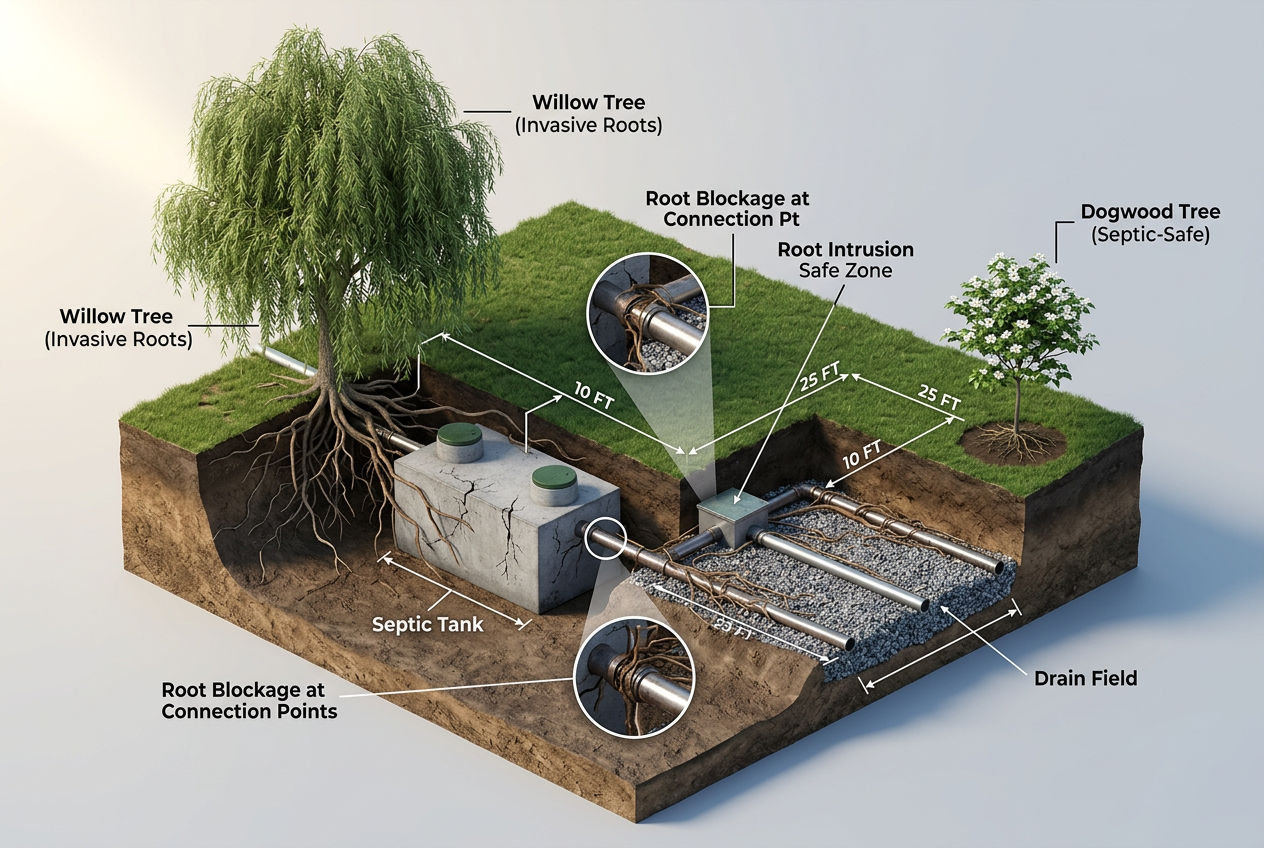
Here's what actually happens:
Initial penetration: Fine feeder roots — hair-thin strands — enter through the smallest gaps: hairline cracks in concrete septic tank walls, deteriorated rubber pipe gaskets, improperly sealed distribution box joints, even the perforations in the leach lines themselves.
Interior growth: Once inside, those roots find everything they need to thrive. They grow. They branch. They expand.
Structural damage: Tree roots can exert pressures exceeding 150 PSI. That's enough to crack a concrete tank wall, displace PVC pipe joints, and collapse corrugated plastic leach laterals entirely. What starts as a tiny root tip becomes a mass of fibrous material that blocks flow, traps solids, and eventually causes complete pipe failure.
⚠️ Warning: The septic tank itself isn't immune. Older precast concrete tanks — especially those installed before 1980 — develop shrinkage cracks at the inlet and outlet baffle walls over time. Root systems exploit those openings.
Once roots reach the tank's interior, they can damage the baffles that regulate solids separation. A damaged inlet or outlet baffle accelerates drain field failure dramatically. You can learn more about how septic tank baffles work and fail if you suspect yours has been compromised.
📊 Quick Fact: The EPA estimates that approximately 21 million U.S. households depend on septic systems. Industry data suggests roughly 60% of septic system failures involve some degree of root intrusion or drain field compromise.
The honest answer is: it depends on the tree and which part of your system you're protecting. Most generic advice online gives you one number — "50 feet" — and calls it done. That's not enough information to actually protect your system.
The drain field is your most vulnerable component. It covers a large area (often 1,000–2,500 square feet for a typical 3-bedroom home) and contains perforated pipes just 18–36 inches below the surface. The septic tank itself is a single buried vessel that's somewhat less vulnerable — but still at risk from aggressive root systems.
Use this table as your baseline. If you're planting an aggressive species like a willow or silver maple, add 50% to these distances or simply don't plant them at all.
| Septic Component | Small Trees (under 30 ft) | Large Trees (over 30 ft) |
|---|---|---|
| Septic tank | 10 ft | 20–30 ft |
| Distribution box | 10 ft | 20–25 ft |
| Drain field / leach lines | 20 ft | 50+ ft |
| Septic pump / lift station | 10 ft | 20 ft |
Source: Distance guidelines synthesized from EPA septic system guidance (epa.gov/septic), NOWRA best practices, and university extension recommendations from Clemson Cooperative Extension and Penn State Extension.
💡 Key Takeaway: The underlying rule is simple: plant trees at a distance from your drain field at least equal to the tree's expected mature height. A dogwood that tops out at 25 feet? Plant it 25 feet from the nearest leach line. A silver maple that will eventually reach 70 feet? You'd need 70–105 feet of clearance. In most residential lots, that means silver maples simply don't belong anywhere near a septic system.
If you're not sure where your drain field is, check your property's as-built plans (usually filed with the county health department) or read our guide on how to find your drain field before planting anything.
These eight species consistently cause the most root damage to septic systems across the country. If you already have them on your property, the question isn't if they'll reach your system — it's when.
| Species | Aggressiveness | Typical Root Spread | Why It's Risky |
|---|---|---|---|
| Weeping Willow | 5/5 | 100+ ft | Most water-seeking tree in North America |
| Silver Maple | 5/5 | 60–80 ft | Aggressive shallow roots |
| Poplar / Cottonwood | 5/5 | 80–100 ft | Fast-growing, invasive root systems |
| American Elm | 4/5 | 60–80 ft | Spreading, moisture-seeking roots |
| Red Maple | 4/5 | 50–70 ft | Less aggressive than silver maple, still high risk |
| River Birch | 4/5 | 40–60 ft | Naturally grows near streams, seeks moisture |
| Sweetgum | 4/5 | 40–60 ft | Aggressive shallow root system |
| Box Elder | 4/5 | 50–70 ft | Fast-growing opportunistic roots |
⚠️ Warning: The willow tree and septic system combination is the single worst pairing in residential landscaping. Willow roots follow water vapor through soil, through concrete, through pipe walls. A weeping willow planted 60 feet from a drain field is not safe. It's just not there yet.
Safe trees near a septic system share a few traits: compact root systems, moderate mature height, and non-aggressive water-seeking behavior. Ornamental trees in the 15–30-foot range are generally your best options.
| Species | Root Type | Mature Height | Safe Distance from Drain Field |
|---|---|---|---|
| Japanese Maple | Shallow, compact | 15–25 ft | 15–20 ft |
| Dogwood | Fibrous, shallow | 15–30 ft | 20 ft |
| Eastern Redbud | Compact | 20–30 ft | 20–25 ft |
| Crabapple | Moderate | 15–25 ft | 20 ft |
| Ornamental Cherry | Moderate | 20–30 ft | 25 ft |
| Holly | Compact, non-aggressive | 15–30 ft | 15–20 ft |
| Amur Maple | Compact | 15–20 ft | 15 ft |
✅ Pro Tip: Japanese maples and dogwoods are particularly popular choices because they're attractive, widely available, and their root architecture stays shallow and tight.
None of these are zero-risk. All trees grow roots toward moisture. But the species above have compact, predictable root systems that are far less likely to reach a properly distanced septic component.
⚠️ Warning: Even "safe" trees planted directly over a failing or oversaturated drain field can accelerate problems. If your drain field is already showing signs of stress — soggy ground, slow drains, odor — fix the system before worrying about landscaping. No tree is harmless above a compromised drain field.
Root intrusion doesn't announce itself. Most homeowners get their first warning when a problem is already well advanced. Here's what to watch for:
Slow drains throughout the house: One slow drain usually means a clog in a single line. All drains running slow — toilets, sinks, showers — points to a blockage in the main sewer line between the house and the tank, or in the tank outlet itself. Root masses are a common culprit.
Gurgling sounds in toilets and drains: That gurgle is trapped air being displaced as water forces past a partial blockage. Root infiltration in distribution pipes or the outlet baffle creates exactly that kind of partial restriction.
Sewage odors inside or outside: A functioning septic system shouldn't smell. If you're catching odors near floor drains or outside over the drain field, something is backing up or escaping where it shouldn't.
Wet or unusually green patches over the drain field: Effluent surfacing above ground means your leach lines aren't absorbing properly. Root damage — crushed pipes, blocked trenches — is one cause. So is soil saturation from heavy rain, but if you're seeing this during dry weather, roots are high on the suspect list. Compare what you're seeing to the signs of a failing drain field to get a clearer picture.
Sewage backup into the house: This is the emergency version. If you're seeing sewage in floor drains or tub drains, stop using water and call a septic professional immediately. You're past the inspection stage.
💡 Key Takeaway: If you suspect root intrusion, schedule a professional septic inspection before the problem compounds. A camera inspection of your sewer line and distribution pipes can confirm root intrusion without excavation. Inspection costs typically run $200–$500 — a much better investment than the $2,000–$10,000 drain field repair that follows untreated root damage.
Professional root removal from septic pipes costs $200–$600 for most residential systems. There are three main approaches, and the right one depends on how advanced the intrusion is.
Mechanical root cutting (rooter service): A rotating blade on a flexible cable is run through the pipe to cut root masses. This clears the blockage quickly but doesn't kill the roots — they regrow, often within 6–12 months. Best for mild-to-moderate intrusion as a temporary fix.
Hydro jetting: High-pressure water (typically 3,000–4,000 PSI) scours pipe walls clean. More effective than mechanical cutting for heavy root masses. Also clears grease, scale, and solids. Most septic service companies offer this as part of drain line cleaning.
Copper sulfate treatment: Copper sulfate crystals flushed through the toilet kill root tissue on contact inside the pipes. Annual applications cost $10–$30 and can slow regrowth.
⚠️ Warning: Copper sulfate comes with two honest limitations: it can kill the beneficial bacteria in your septic tank if overused, and it's not effective once roots have caused structural pipe damage. Some states restrict copper sulfate use due to environmental concerns about copper accumulation in soil and groundwater. Check with your state's environmental agency before using it.
Here's where a lot of homeowners get burned: Removing the tree does not immediately stop root activity. Dead roots can persist and continue blocking pipes for years. Some species — particularly poplars and willows — send up new sprouts from the root system even after the trunk is removed.
✅ Pro Tip: Cutting the tree is a necessary first step, but it must be followed by pipe inspection, root removal, and monitoring.
If pipes have been crushed or joints displaced, no amount of root treatment fixes that. You need drain field repair or replacement, which runs $2,000–$10,000 for partial repairs and $5,000–$20,000+ for full replacement. See our drain field replacement cost guide for a full breakdown by region and system type.
Prevention is dramatically cheaper than repair. Here's what actually works.
Install a root barrier: A root barrier — also called a root deflector — is a vertical sheet of dense HDPE plastic or metal installed in the soil between a tree and the septic system. It physically redirects root growth downward and away.
Keep the system well-maintained: A healthy, properly functioning septic system is less attractive to roots because effluent moves through the drain field efficiently rather than pooling. A system with a failing Polylok PL-122 effluent filter leaking solids into the drain field, or a distribution box channeling uneven flow to saturated trenches, creates wet spots that roots target aggressively.
💡 Key Takeaway: Staying current on regular pumping — every 3–5 years for a 1,000-gallon tank per EPA guidelines — is genuinely part of root damage prevention.
Map your system before landscaping: Most homeowners don't know exactly where their drain field runs. Before planting anything larger than a shrub in your backyard, get your as-built plans from the county or have a technician locate your system. Planting a "safe" tree directly over a leach line because you didn't know it was there defeats the whole strategy.
Choose the right plants for the field itself: Shallow-rooted grasses — tall fescue, Kentucky bluegrass — are the ideal drain field cover. They hold soil, allow evaporation, and pose no root risk. Avoid vegetable gardens over the drain field (contamination risk) and never plant shrubs or trees in the drain field zone itself. See our article on whether you can drive over a drain field for more on what does and doesn't belong over your leach field.
For a broader look at keeping your system healthy long-term, the septic tank maintenance guide covers pumping schedules, additives, and what to avoid flushing.
It absolutely does. Soil type, climate, and local species all affect how aggressively roots pursue your septic system.
Southeast (Florida, Georgia, the Carolinas):
Northeast (New York, Pennsylvania, New England):
Midwest (Ohio through Minnesota and Iowa):
Pacific Northwest (Washington, Oregon):
Compare top-rated companies in your area. Get free, no-obligation quotes from verified providers.
Was this article helpful?
Connect with licensed, verified septic companies in your area.
Get estimates from licensed, verified companies in your area. No obligation.
⚡ Average response time: under 2 hours