
Learn how to prevent septic pipes from freezing in winter. Covers signs of frozen lines, emergency thawing steps, heat tape installation, and winterization for vacant homes.
Quick Answer
Septic pipes freeze — and when they do, you're not looking at a $40 plumber visit. You're looking at $200–$600 for professional thawing, and potentially $2,000–$10,000+ if drain field lines crack and need replacement. A frozen septic line can happen fast: ice expansion can crack PVC pipe within 24–72 hours of a complete freeze. The good thing is that knowing how to prevent septic freeze puts almost all of that risk in your control.
⚠️ Frozen right now? Skip to the emergency thawing steps →
💡 Key Takeaways:
- Septic pipes freeze most often when temps stay below 20°F for 2+ weeks without snow cover insulating the ground
- The inlet pipe and effluent line carry the highest freeze risk — both run shallow and handle low flow
- Vacant and seasonal homes are the highest-risk category because there's no warm water flow to keep pipes from freezing
- Heat tape (aka heat cable) installed on vulnerable pipe sections costs $50–$300 DIY and is one of the most reliable prevention tools
- Professional thawing with a pipe steamer typically costs $200–$600 and takes 1–3 hours
Yes — septic pipes freeze regularly in cold climates, and occasionally in places you wouldn't expect. The pipes carrying wastewater from your house to the tank, and from the tank to the drain field, are the most vulnerable parts of the system.
Bacterial activity inside an active septic tank generates measurable heat. A working 1,000-gallon concrete tank serving a 4-person household stays surprisingly warm through its own biological process. The tank itself rarely freezes when the home is in regular use. But the pipes connecting to it are a different story.
The inlet pipe from your house typically runs just a few feet below grade near the foundation — often above the local frost line. Same with the effluent pipe heading toward the drain field. Those pipes carry relatively low-volume, intermittent flow. On a still, sub-zero night with no snow cover, that's enough for frozen effluent to block the line completely.
The EPA notes that proper burial depth — at least 12 inches below the local frost line — is the first line of defense for any buried pipe. But plenty of older systems weren't installed that way, and even properly buried pipes can freeze if a cold snap is severe enough or lasts long enough.
Critical threshold: Sustained ambient temperatures below 20°F (−6°C) for two or more weeks, combined with bare (uninsulated) ground, significantly raise freeze risk. Add an empty house with no warm water flowing, and you've got a near-certain freeze scenario.
📊 Quick Fact: Frost line depths vary dramatically by region — from 0 inches in southern Florida to 72+ inches in northern Minnesota. If your septic pipes sit above your local frost line, they are at elevated freeze risk every winter regardless of other factors.
Not all components freeze equally. A frozen septic tank is a different repair situation than a frozen inlet line — and your drain field distribution pipes occupy yet another risk category entirely. The table below breaks down where your system is most exposed:
| Component | Freeze Risk | Primary Reason |
|---|---|---|
| Inlet pipe (house to tank) | High | Shallow depth, low continuous flow |
| Effluent pipe (tank to field) | High | Small diameter, intermittent flow |
| Pump chamber / dosing tank | High | Standing water, exposed electrical parts |
| Drain field distribution lines | Moderate–High | Shallow, wide-spread, low flow volume |
| Septic tank (vacant home) | Moderate–High | No warm inflow, bacterial activity slows |
| Septic tank (active use) | Low | Bacterial heat, buried thermal mass |
Source: NAWT (National Association of Wastewater Technicians) field guidance and EPA septic system installation standards.
Aerobic treatment units (ATUs) warrant close attention. If you have an aerobic septic system — common in Texas, Oklahoma, and parts of the South — your system is more freeze-prone than a conventional tank. The above-ground spray heads, aeration compressors (like a Hiblow HP-80), and control panels all have surface exposure. The aeration process itself pulls cold winter air directly into the treatment chamber. See our guide to aerobic vs. anaerobic septic systems for a full breakdown of how these systems differ.
Concrete tanks are slightly more vulnerable to cracking than poly or fiberglass tanks if water freezes inside — concrete cracks along existing stress fractures under ice expansion pressure. An actively used concrete tank almost never freezes solid. Vacant homes are the real danger zone.
A frozen septic line mimics other system failures, which makes diagnosis tricky. Watch for:
These symptoms also appear during septic system backups caused by a full tank or a failing drain field. The seasonal timing is your biggest clue — if the slowdown started during or after a hard freeze, ice is the likely culprit.
⚠️ Warning: If multiple drains stop working at the same time during freezing weather, do not continue running water. Every additional flush adds wastewater to a line that cannot move it — increasing the risk of sewage backing up into your home and adding pressure to already-stressed pipes.
One quick field test: locate your cleanout cap (the 4-inch white PVC cap near your foundation or in the yard). Open it carefully. If the pipe is empty and there's no flow, your blockage may be frozen solid. If it's full and backing up, the freeze may be further down the line or at the tank inlet.
If your septic line is frozen right now, stop running water. Every flush adds more wastewater to a line that can't move it — which increases indoor backup risk and puts pressure on blocked pipes.
Open your nearest cleanout access point. If you see ice or no flow at all, you've confirmed a freeze. If water is backed up, the blockage is likely between your house and the tank.
This is the safest DIY approach for PVC lines. Do NOT use boiling water — thermal shock can warp or crack PVC pipe. Use water in the 110–120°F range (hot tap water is typically fine). Slowly pour warm water into the cleanout or the drain closest to the suspected freeze point. This works best on a partial freeze near an access point. Allow 30–60 minutes between attempts. Thawing time via this method runs 4–12+ hours, and it doesn't always reach a deep freeze.
If you have access to the pipe section (exposed in a crawl space, for example), a self-regulating heat cable wrapped around the pipe and plugged into an outdoor-rated outlet can start thawing within a few hours. Products like Easy Heat AHB-116 or similar self-regulating cables are designed for this purpose.
⚠️ Important: Never use a propane torch, automotive antifreeze, or chemical de-icers on frozen septic pipes. All three can cause serious damage — to you, your pipes, or the bacterial ecosystem your tank needs to function.
If warm water hasn't cleared the line in 2–3 hours, stop and call a licensed septic contractor. Professional thawing typically uses a high-pressure hydrojet or pipe steamer that can clear a residential line in 1–3 hours. The cost runs $200–$600 for a standard service call.
⚠️ Warning: Do not wait overnight to see if a frozen pipe thaws on its own. Ice expansion can crack PVC pipe within 24–72 hours of a complete freeze. The longer you wait, the higher the chance of permanent pipe damage that turns a $300 thawing call into a multi-thousand-dollar replacement job.
Find emergency septic service near you →
Three professional methods are worth knowing, so you can have an informed conversation with your contractor:
1. Pipe steamer (thermal thawing) A contractor inserts a flexible steam hose into the frozen pipe and slowly advances it as ice melts. This is the most common and safest method for PVC lines. Job time: 1–3 hours. Cost: typically included in the $200–$600 service call.
2. High-pressure hydro-jetter A high-pressure water jetter can break through ice blockages and flush debris at the same time. Best for lines where partial flow already exists. Cost is similar to steaming — sometimes bundled, sometimes billed by the foot.
3. Ground thawing equipment For frozen drain field lines or deeply buried sections, contractors sometimes use electric ground thawing blankets or resistive heating equipment. This is less common and typically reserved for severe cases where multiple lines are blocked.
For a full breakdown of what professional service covers and what it costs, see our septic system repair cost guide — it walks through exactly what contractors check during a freeze-related service call.
Prevention is dramatically cheaper than repair. Want to prevent septic freeze before the season hits? These seven methods cover every risk category from shallow inlet pipes to vacant-home scenarios.
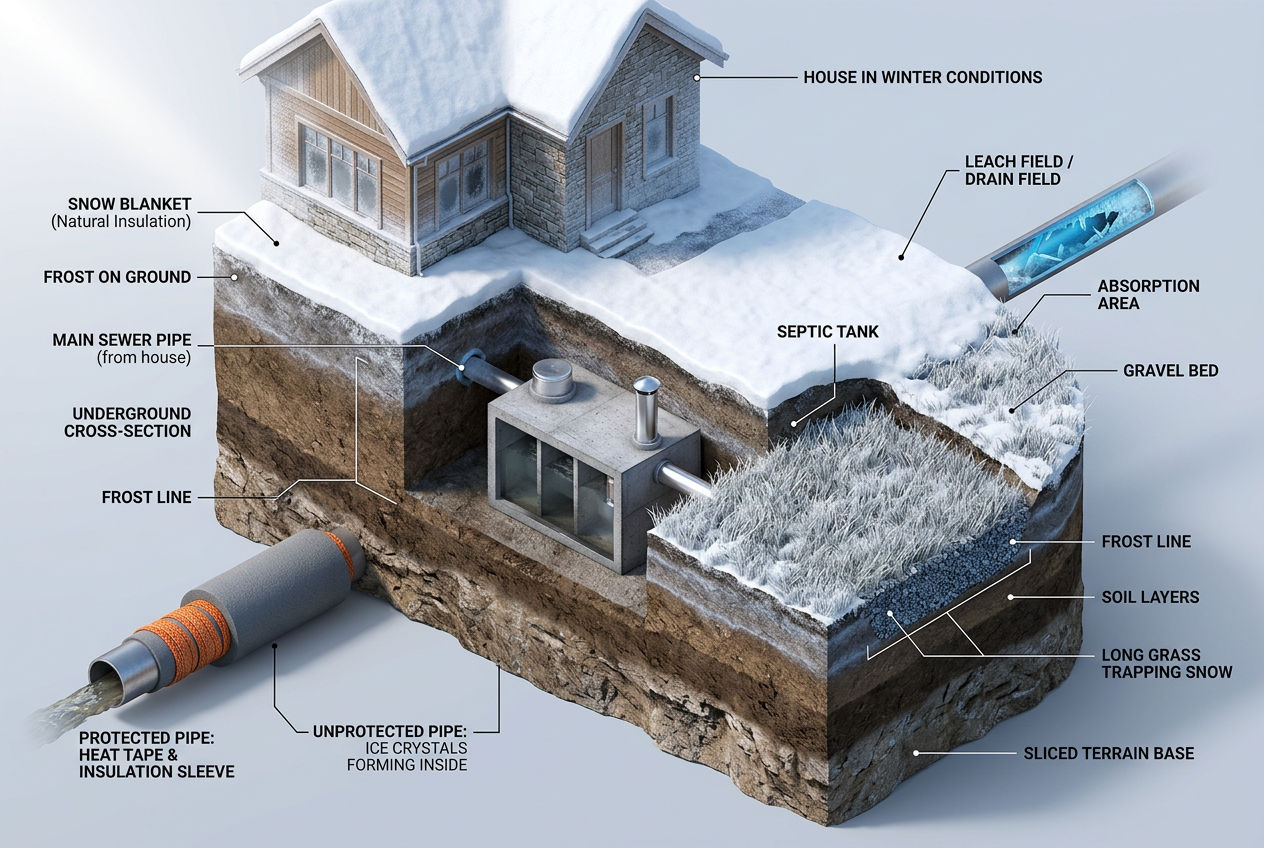
1. Insulate exposed and shallow pipes Rigid foam board (R-10 or higher) or pipe insulation foam sleeves ($0.50–$3.00 per linear foot) over any exposed or shallow-buried sections. Pay particular attention to the run from your foundation to the tank — this stretch is almost always the shallowest and most vulnerable.
✅ Pro Tip: When insulating pipes, use closed-cell foam sleeves rather than fiberglass wrap. Closed-cell foam resists moisture absorption, maintains its R-value when wet, and won't compress under soil pressure — fiberglass loses nearly all insulating ability once it gets damp.
2. Install self-regulating heat tape Heat tape (also called heat cable) is the most reliable freeze-prevention tool for pipes you can't bury deeper. Self-regulating varieties like the Easy Heat AHB series or Frost King HC6 automatically increase output when temps drop and reduce it when temps rise — cutting power consumption and eliminating the overheating risk associated with fixed-wattage cables. Installation runs $50–$300 DIY depending on pipe length. Hire an electrician for longer runs or if your outdoor outlet lacks GFCI protection.
3. Keep warm water flowing in vacant homes If your property sits empty during winter, the absence of warm water flow through the inlet pipe is the single biggest freeze risk factor. Options:
4. Leave snow cover undisturbed over the system Snow is a remarkably effective insulator. A 4-inch snowpack over your drain field and tank can keep ground temperature 10–15°F warmer than bare, frozen ground. Avoid plowing, blowing, or compacting snow over your septic system footprint. This is one of the few completely free preventative steps — it just requires not doing something.
💡 Tip: If you're in a climate that gets consistent snowfall, resist the urge to clear snow from your yard over the septic system. That snow cover is free insulation worth more than products costing hundreds of dollars.
5. Pump your tank before winter A full septic tank in November is a freeze risk in December. When the tank is near capacity, effluent has less thermal mass and moves more slowly through the system. Schedule a pump-out in October or early November. Check our guide on how often to pump a septic tank for timing guidance by household size.
✅ Pro Tip: Build a fall winterization routine: pump the tank in October, inspect and insulate pipes in early November, and verify heat tape operation before the first hard freeze. Scheduling all three tasks together often qualifies for a bundled service discount from septic contractors.
6. Insulate the tank lid for vacant or seasonal properties Septic tank insulation blankets — rigid foam board cut to fit over the tank lid, or commercial blanket products — cost $100–$400 and can maintain tank temperature several degrees above freezing even with no warm water inflow. This is standard practice for seasonal cabins and vacation homes in Minnesota, Wisconsin, and similar climates.
7. Add an inspection riser and insulated lid Older systems with concrete lids buried under 12 or more inches of soil are harder to insulate and access. Installing a septic system riser and lid brings the access point to grade level and allows you to add a foam-insulated lid cover — a genuine upgrade that also simplifies future maintenance.
For a comprehensive maintenance calendar covering all seasons, the septic tank maintenance guide has a detailed pre-winter checklist worth bookmarking.
This question matters a lot when you're facing a $3,000 drain field repair in February.
Standard homeowners insurance policies typically cover sudden and accidental damage. A pipe that freezes and bursts may qualify — but the key word is "sudden." If an adjuster determines the freeze resulted from inadequate insulation, a known vulnerable installation, or deferred maintenance, the claim may be denied under the "neglect" exclusion.
What most standard policies do not cover:
What may be covered:
Practical advice: Call your insurer before the repair, not after. Get the adjuster's assessment in writing. Some insurers offer septic-specific riders that cover repair and replacement — worth asking about if you're in a cold climate with an older system. See our breakdown of drain field replacement costs to understand what you might be dealing with financially.
If you're closing a cabin, vacation home, or rental property for the winter, the winterization process is different from a year-round occupied home. You can't rely on daily water use to keep pipes active.
Complete winterization checklist:
Pump the tank — Start with a clean tank. A full or near-full tank left to freeze is a cracking risk and a spring nightmare.
Blow out the lines — A contractor can use an air compressor to push residual water out of vulnerable pipe sections. This is especially important for the inlet pipe near the foundation.
Add RV-grade propylene glycol antifreeze to traps — Pour non-toxic RV antifreeze (propylene glycol based, not ethylene glycol) into every drain trap in the house: toilets, floor drains, sink P-traps. This prevents the water in traps from freezing and cracking. Use approximately 1 cup per trap.
Shut off and drain the water supply — Standard winterization step, but relevant because even a slow drip from a failed supply shutoff can introduce water into a frozen drain line.
Insulate exposed pipe sections — Add pipe foam sleeves to any exposed runs in the crawl space, basement, or near the foundation.
Install tank insulation blankets — Particularly important if your tank is a concrete tank in a climate that sees sustained sub-zero temperatures.
Arrange for periodic warm-water flow — If possible, have a neighbor or caretaker run warm water through the system every 2–3 weeks. Even a single toilet flush and a few minutes of hot tap water through the kitchen sink can keep the inlet pipe from freezing solid.
Not every frozen septic situation is a DIY fix. Call a licensed septic contractor immediately if:
A professional can camera-inspect the line to pinpoint the exact freeze location, use commercial steamers to clear it safely, and assess whether any pipe damage occurred. Early intervention prevents a $300 thawing call from becoming a $5,000+ drain field replacement.
📊 Quick Fact: Professional thawing at $200–$600 costs a fraction of what frozen pipe damage can run. A cracked drain field line from ice expansion averages $2,000–$10,000+ to repair — meaning every dollar spent on prevention or early thawing can save $10–$50 in emergency repairs.
Compare top-rated companies in your area. Get free, no-obligation quotes from verified providers.
Was this article helpful?
Connect with licensed, verified septic companies in your area.
Get estimates from licensed, verified companies in your area. No obligation.
⚡ Average response time: under 2 hours