
Is Rid-X good for your septic tank? We break down the science, expert opinions, real costs, and what actually keeps your system healthy. Get the honest answer.
Quick Answer
Rid-X septic treatment is one of the most recognized products in the septic care aisle, but the science behind it tells a more complicated story than the packaging suggests. Studies from the University of Minnesota Extension, the Washington State Department of Health, and EPA guidance all point in the same direction: biological additives like Rid-X provide no proven benefit to a properly functioning septic system and are not a substitute for pumping.
💡 Key Takeaway: Rid-X contains four natural enzymes (cellulase, lipase, protease, amylase) plus bacterial strains, but peer-reviewed research finds no significant benefit for healthy systems.
📊 Quick Facts:
- A healthy 1,000-gallon tank already contains billions of anaerobic bacteria — far more than a single Rid-X dose adds
- Rid-X costs $96–$180 per year. Amortized pumping runs $75–$150 per year — and pumping is the only proven maintenance method
- Rid-X will not reverse drain field clogging or save a failing system
- The EPA recommends regular pumping and water conservation — not septic additives
Rid-X is a biological septic tank treatment made by Reckitt Benckiser, a multinational consumer goods company best known for household cleaning products. It comes in four forms: powder, liquid, gel pacs, and Septi-Pacs. The powder and liquid versions are the most widely sold, and aside from concentration differences, all four deliver essentially the same active ingredients.
The product's core claim is straightforward: flush it once a month, and its enzymes and bacteria help break down the waste accumulating in your tank.
Rid-X contains two categories of active ingredients: natural enzymes and bacterial cultures.
The four enzymes are:
These enzymes work fast but are not living organisms. They speed up initial breakdown but don't sustain themselves. The bacterial component — naturally occurring strains of Bacillus species — is supposed to colonize the tank and continue the digestion process after the enzymes have done their initial work.
Per manufacturer instructions, one 9.8 oz dose treats tanks up to 1,500 gallons, used once monthly.
The theory is sound on the surface. More bacteria and enzymes in the tank should mean faster waste breakdown, smaller sludge and scum layers, and less strain on the drain field. If you flushed antibacterial soap yesterday, or ran a heavy bleach load through the washing machine, maybe a bacterial boost helps replenish what was lost.
That's the pitch. The problem is what the research actually shows.
Independent research does not support the manufacturer's claims for normally functioning systems. Multiple university extension programs and state health agencies have reviewed biological septic additives — not just Rid-X, but the entire category — and the findings are consistent.
| Institution | Finding |
|---|---|
| University of Minnesota Extension | No scientific evidence that microbial additives improve system performance or reduce pumping frequency |
| Washington State Department of Health | Biological additives showed no measurable improvement in effluent quality, sludge reduction, or drain field performance |
| EPA | Does not recommend or endorse septic additives; emphasizes regular pumping every 3–5 years and water conservation |
⚠️ Warning: Several states have gone further. Washington, Wisconsin, and others have additive registration or approval processes, and a number have issued advisories cautioning against relying on additives as a maintenance strategy.
This article is part of our broader look at whether septic additives work — worth reading if you're evaluating more than just Rid-X.
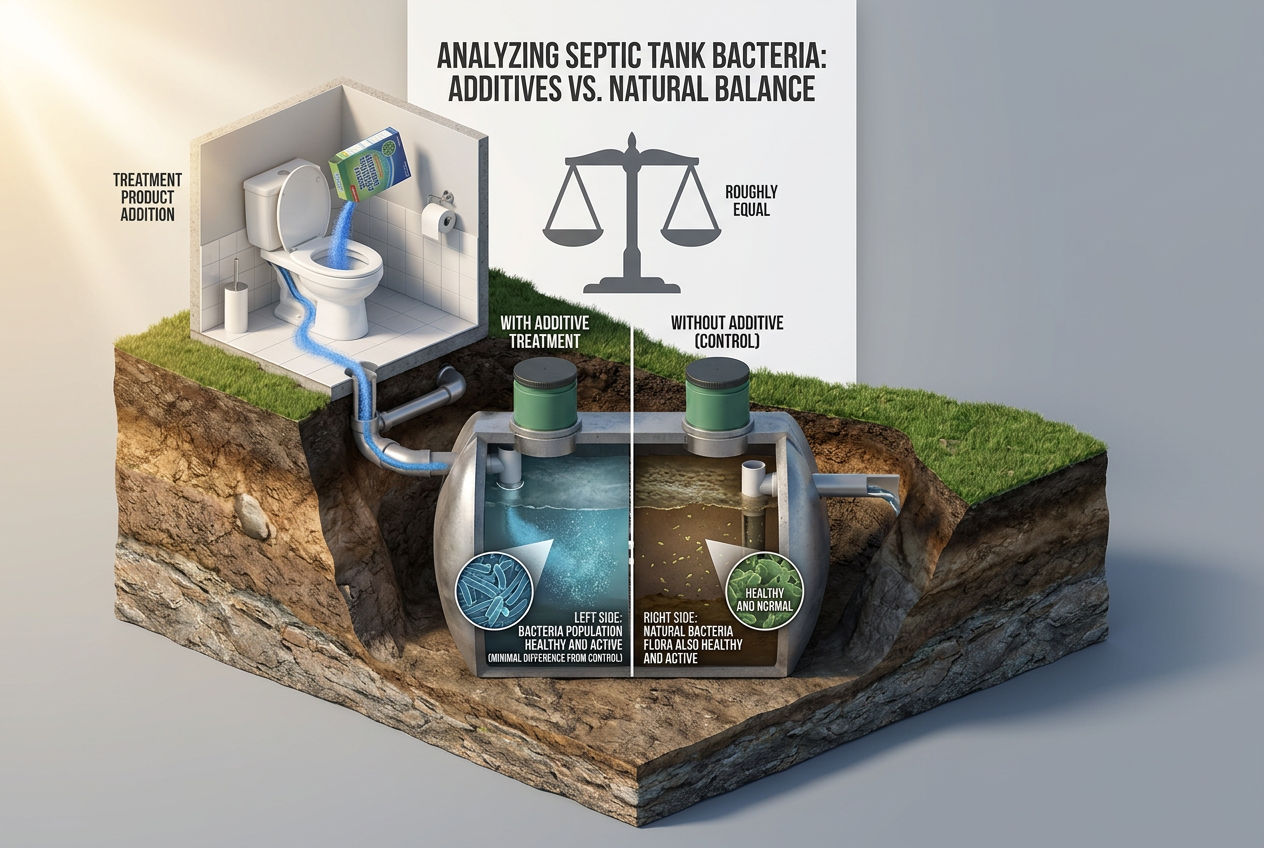
Here's the part the Rid-X marketing doesn't mention: your septic tank is already a thriving bacterial ecosystem.
A healthy tank contains billions of anaerobic bacteria per milliliter of liquid — microbes that have been adapting to your specific waste stream, water chemistry, and tank environment for years. A single Rid-X dose introduces a comparatively small number of Bacillus bacteria that, frankly, have to compete with an established colony that already owns the tank.
💡 Key Takeaway: Think of it like seeding a grass lawn with a handful of wildflower seeds. The lawn isn't going to transform. The existing ecosystem is too established.
The bacteria in your tank — primarily anaerobic species that thrive without oxygen — are already doing exactly what Rid-X claims to do. They're breaking down the sludge layer at the bottom of your tank, digesting the scum layer at the top, and processing the effluent that flows out toward your drain field. They don't need reinforcements. They need the right conditions to do their job. For more on how to support those conditions, see our septic tank bacteria guide.
For most conventional concrete or fiberglass tanks with healthy bacterial populations, Rid-X is unlikely to cause direct harm. The ingredients are biodegradable, and the bacterial strains used are not pathogenic.
That said, there are real risks — they're just not the ones most people ask about.
Picture this: a homeowner in rural North Carolina has been faithfully flushing Rid-X every month for six years. They figure they're covered. They've skipped two pumping cycles. Meanwhile, the sludge layer in their 1,000-gallon tank has crept past the 12-inch safe threshold. Solids start pushing into the distribution box. The leach laterals in the drain field begin to clog with a biomat — a dense biological layer that restricts effluent flow. By the time there's sewage backing up in the yard, the drain field is failing.
⚠️ Warning: Drain field replacement in North Carolina runs $8,000–$20,000 depending on soil type and system design. All those monthly Rid-X purchases didn't prevent it. Two pump-outs — at roughly $350 each in that region — likely would have.
You can check the warning signs your tank needs pumping if you're unsure where your system stands.
There's one additional concern worth flagging: some older studies raised questions about whether certain enzymatic additives could loosen accumulated solids and push them toward the drain field faster than a tank without additives. The evidence is not definitive, but it's a reason to avoid aggressive "septic cleaner" products that claim to dissolve sludge rapidly. Rid-X's formula is mild enough that this risk is considered low by most professionals, but it's not zero.
| Factor | Rid-X | Notes |
|---|---|---|
| Scientifically proven to work | No | Multiple independent studies find no benefit |
| Safe for most systems | Yes | Won't harm a healthy conventional tank |
| Replaces pumping | No | Sludge still accumulates regardless |
| Helps after antibiotics/harsh chemicals | Possibly | Anecdotal; not peer-reviewed |
| Annual cost | $96–$180/yr | Based on $8–$15/box, used monthly |
| Risk of false security | High | Main documented risk |
| Endorsed by EPA | No | EPA recommends pumping, not additives |
Sources: EPA Septic guidance; University of Minnesota Extension; Washington State DOH
Most licensed septic professionals don't recommend Rid-X — and many actively discourage it. Not because they want to sell you pumping services (though pumping is genuinely what your system needs), but because they've seen what happens when homeowners use Rid-X as a substitute for real maintenance.
✅ Pro Tip: A common sentiment among NAWT-certified pumpers and NOWRA members: "If you're using Rid-X and pumping on schedule, it's not hurting anything. If you're using Rid-X instead of pumping, you're heading for a problem."
It's worth noting that Reckitt Benckiser — Rid-X's manufacturer — is not a septic industry company. They make:
Their expertise is consumer goods marketing, not wastewater engineering. That's not a disqualifier, but it does mean their product claims aren't backed by the same institutional accountability you'd expect from, say, an Orenco Systems engineered treatment specification or an EPA regulatory threshold.
If you want advice specific to your system — tank age, soil type, household load, and local water table — a local licensed septic professional is the right call. Find septic service companies near you through our directory.
So what actually happens if you skip Rid-X entirely?
For most properly maintained systems, nothing. Nothing bad, anyway.
Your tank's natural bacterial community handles the workload it was engineered to handle. A conventional 1,000-gallon concrete tank serving a four-person household has been digesting waste since the day it was installed. It doesn't need a monthly enzyme supplement any more than a healthy gut needs a daily industrial probiotic dose.
💡 Key Takeaway: Rid-X probably won't hurt a healthy system. But it almost certainly isn't helping it either. The money is better spent on your actual septic pumping schedule.
The one scenario where a biological additive makes marginal sense: after a significant disruption to the bacterial population. Examples include:
Even then, the evidence is anecdotal, and your tank will re-populate naturally within a few weeks regardless. For a full picture of what actually threatens your tank's bacterial balance, see our guide on what kills septic bacteria.
If you've read this far and still want to use Rid-X, the manufacturer recommends one 9.8 oz dose per month for tanks up to 1,500 gallons. Larger systems would require proportionally more product.
The method: flush it down the toilet before bed, when the household isn't using water. This gives the bacteria maximum contact time with the tank contents before the next flush cycle dilutes them. Don't use it right after running a heavy bleach cycle through the laundry or disinfecting drains.
If you want to support your septic system's bacterial health without Rid-X, your options fall into three categories:
Products like Bio-Tab, Septic Drainer, and Green Gobbler Septic Saver make similar claims with similarly mixed evidence. Our best septic tank treatment roundup evaluates the strongest options side by side if you want a deeper comparison.
Some old-school septic owners swear by flushing a packet of active dry yeast every few months. Yeast produces enzymes similar to Rid-X's amylase and cellulase. It's cheap (under $1 per packet), completely biodegradable, and carries no risk. The evidence it helps is equally thin, but at least the cost is negligible.
Seriously. A properly maintained system — pumped every 3–5 years, fed a reasonable diet of toilet paper and human waste, protected from harsh chemical overload — doesn't need supplementation. Avoiding things that kill septic bacteria matters far more than adding anything.
If you're curious what products are genuinely safe versus harmful, our septic-safe products guide is worth bookmarking.
This is where the honest answer lands: the maintenance practices with decades of proven results cost less than a Rid-X subscription and actually work.
A 1,000-gallon tank serving four people needs pumping every 3–4 years. Add a garbage disposal and that compresses to every 2–3 years. A 1,500-gallon tank with two people can sometimes go 5–6 years. The EPA's 3–5 year guideline is a reasonable starting point, but your pumper can measure your sludge and scum layers with a sludge judge and tell you exactly where you stand. See our septic pumping cost guide for current regional pricing.
Don't park vehicles over the leach field. Don't plant trees within 30 feet — root intrusion is one of the leading causes of drain field failure. Keep surface water diverted away from the absorption area. Our guide to signs of drain field failure covers the early warning signals worth knowing.
⚠️ Warning: Flushable wipes (they're not), grease, harsh chemical drain cleaners, and excessive antibacterial products are the real enemies of your septic system. No additive offsets the damage from chronic chemical abuse.
A household that does six loads of laundry in a single day sends a surge of water through the tank that can push unsettled solids toward the drain field. Spacing laundry across the week is one of the simplest and most effective things you can do for your system's longevity.
Compare top-rated companies in your area. Get free, no-obligation quotes from verified providers.
Was this article helpful?
Connect with licensed, verified septic companies in your area.
Get estimates from licensed, verified companies in your area. No obligation.
⚡ Average response time: under 2 hours