
Learn how laundry affects your septic system. Tips on detergent choice, load limits, lint filters, and washer types to prevent drain field failure.
Quick Answer
Washing machines send 30–45 gallons of water into your septic tank per cycle — and the detergents, lint, and water volume from laundry are among the most controllable risk factors for drain field failure. Limiting laundry to 1–2 loads per day, using phosphate-free liquid detergent at half the recommended dose, and switching to a high-efficiency washer are the three changes that protect a laundry septic system from the most common failure patterns.
Your washing machine is one of the biggest water consumers in your home — and every drop of that water flows straight into your septic system. A standard top-load washer sends 30–45 gallons into your tank per cycle. Run four or five loads back-to-back on a Saturday morning and you've just dumped 150–200 gallons into a system that may only be designed to absorb a fraction of that at once.
Septic damage from laundry builds up slowly — months or years of small habits that chip away at bacterial populations or push your drain field past its absorption limit. A few targeted changes protect your system without making laundry day miserable.
💡 Key Takeaways
- Top-load washers use 30–45 gallons per load; high-efficiency models use just 12–17 gallons — a meaningful difference for your drain field.
- Limit laundry to 1–2 loads per day and spread them across the week to prevent hydraulic overload.
- Use phosphate-free, low-surfactant detergent and stick to ½ to ⅓ of the recommended amount.
- Up to ¾ cup of standard chlorine bleach per load is generally safe; more than that disrupts your tank's bacterial balance.
- Liquid fabric softeners and conventional dryer sheets can harm septic bacteria — there are safer alternatives.
Every load of laundry sends a mix of water, detergent chemicals, lint, and soil particles into your septic tank. The tank separates solids from liquid. The liquid — called effluent — then flows out to your drain field (also called a leach field), where it percolates through the soil and gets naturally filtered before reaching groundwater.
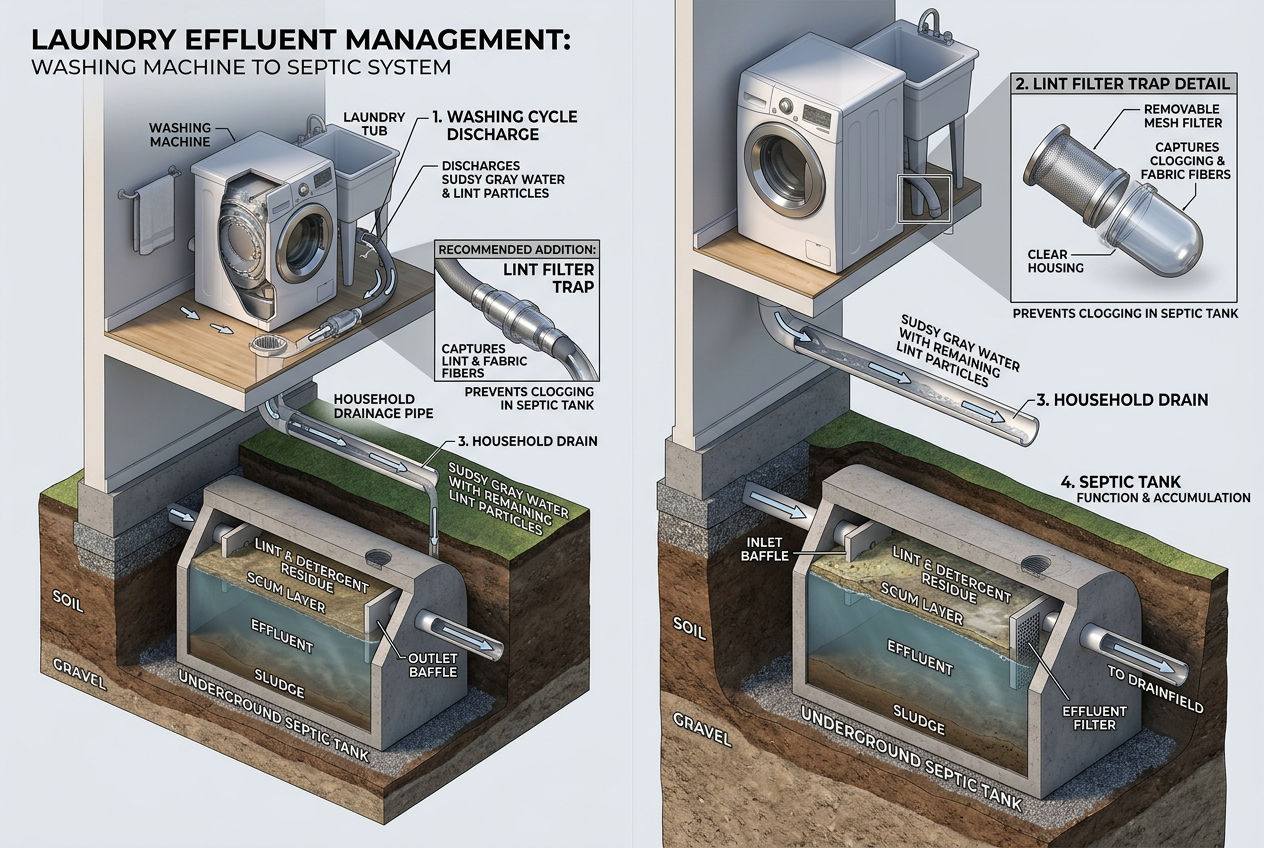
That process relies on two things working together: a healthy bacterial colony in your tank that breaks down organic material, and a drain field soil layer that isn't oversaturated. Laundry threatens both.
Harsh detergent surfactants can reduce your tank's beneficial bacteria population by up to 50% with heavy use, according to research cited by University of Minnesota Extension. Once that bacterial colony is compromised, solids accumulate faster, your tank fills sooner, and unprocessed waste starts pushing into the drain field.
⚠️ Warning: Surfactants in conventional detergents can reduce your tank's beneficial bacteria by up to 50%. Once compromised, solids accumulate faster and unprocessed waste starts pushing into the drain field.
Picture this: you switch to a "fresh scent" powder detergent because it was on sale. Three months later, your yard smells faintly of sulfur near the drain field. The detergent didn't cause an overnight failure — it slowly degraded the bacterial layer that keeps your system working. That's how most laundry-related septic problems start.
Drain field failure is how that chain ends — and replacing a drain field runs $3,500–$20,000 depending on your region and system type. Understanding how your septic system processes wastewater is the foundation for every laundry decision you'll make as a homeowner.
Yes — hydraulic overload from too much laundry is one of the most common and preventable causes of drain field failure. Sending too much water through your system in a short window doesn't give your drain field time to absorb and treat the effluent. The soil becomes saturated, and the biomat layer — the biological treatment layer in the leach field — can't do its job.
Most residential septic systems are designed to handle roughly 120 gallons per bedroom per day, per standard state health codes. A 3-bedroom home with a 1,000-gallon tank is engineered around that assumption. If you're running 5 loads of laundry in addition to normal household water use, you can blow past that limit before dinner.
Here's a real scenario: A family of four does all their laundry on Sunday. Five loads in a top-loader at 40 gallons each = 200 gallons from laundry alone. Add showers, dishes, and toilet flushes — you're easily pushing 400–500 gallons into a system designed for around 360 gallons per day. That single day of overuse stresses the drain field. Do it every week for a year and you're looking at signs of drain field failure by year two or three.
Spread your loads: No more than 1–2 full loads per day. Distribute laundry across Monday, Wednesday, and Friday instead of one marathon session. Your drain field needs 24–48 hours between heavy-use periods to properly drain and recover.
✅ Pro Tip: Set a reminder on your phone for laundry days — spreading loads across Monday, Wednesday, and Friday is the single most effective habit change for protecting your drain field from hydraulic overload.
For a standard residential system, 1–2 loads per day is the recommended maximum, and only if those loads are spaced out. A family of four generates roughly 50 gallons per day of laundry wastewater on average — that's manageable. Five loads in one day is not.
The math gets even more favorable if you own a high-efficiency (HE) front-load washer. At 12–17 gallons per load versus 30–45 gallons for a conventional top-loader, you're sending 60–70% less water into your tank per cycle. That margin adds up fast.
If you have an older, smaller system — say, a 750-gallon tank on a 2-bedroom property — be even more conservative. Check your system's design specs or ask a licensed septic technician about your daily hydraulic capacity. You can find a licensed septic professional in your area to review your system's documentation.
For a deeper breakdown of load frequency and system sizing, see our dedicated guide on how many loads of laundry are safe with a septic system.
The best laundry detergent for a septic system is liquid, phosphate-free, low in surfactants, and biodegradable. A few brands consistently earn recommendations from septic professionals and university extension programs:
Here's something most product labels won't tell you: "septic safe" is not a regulated label claim. Any manufacturer can print those words on a bottle without independent verification. What you're actually looking for is the EPA Safer Choice certification, a phosphate-free formula, and a short, biodegradable ingredient list. If you can't pronounce half the ingredients, that's a warning sign.
Regardless of which brand you choose, use ½ to ⅓ of the manufacturer-recommended amount. Detergent is formulated for municipal sewer systems, which can handle much higher chemical loads than a biological septic system. More detergent does not mean cleaner clothes — it means more surfactants killing your tank bacteria.
Browse our complete list of septic-safe household products for recommendations beyond laundry detergent.
| Detergent | Form | Phosphate-Free | EPA Safer Choice | Septic Risk Level |
|---|---|---|---|---|
| Seventh Generation Free & Clear | Liquid | Yes | Yes | Low |
| ECOS Laundry Detergent | Liquid | Yes | Yes | Low |
| Charlie's Soap | Powder | Yes | No | Low–Moderate |
| Arm & Hammer Essentials | Liquid | Yes | No | Low–Moderate |
| Conventional powder detergent | Powder | Often no | No | High |
Sources: EPA Safer Choice Program (epa.gov/saferchoice); manufacturer ingredient disclosures. Risk level reflects surfactant load, sodium content, and phosphate presence — not brand testing by SepticTankHub.
Liquid detergent is generally the safer choice for septic systems. Many conventional powder detergents contain sodium-based fillers and carriers — compounds that don't break down easily and can cause soil compaction in your drain field over time. In the Southwest, where soils are already alkaline and sandy, this sodium buildup can measurably reduce percolation rates, effectively choking the drain field's ability to treat effluent.
Liquid detergents tend to dissolve more completely in the wash cycle, meaning less undissolved chemical residue reaches your tank. They also tend to have lower sodium content overall.
⚠️ Warning: Sodium-based fillers in powder detergents can cause soil compaction in your drain field over time. In alkaline or sandy soils — common in the Southwest — this buildup can measurably reduce percolation rates, effectively choking your drain field.
Powders aren't automatically off the table, though. Charlie's Soap — a powder — is well-regarded in the septic community because it's highly concentrated (so you use very little), low-sudsing, and sodium-free. The key is reading the ingredient list, not just the form factor.
If you're in a coastal community or a state with strict groundwater protection rules — think Massachusetts Title 5, Florida's Department of Health septic regulations, or California's Regional Water Quality Control Board guidelines — the sodium question matters even more. Detergent chemistry reaching your groundwater via a drain field is a drinking water safety issue, especially for households on private wells.
Front-load and high-efficiency top-load washers are meaningfully better for your septic system — not because of any special technology, but because they use dramatically less water. A conventional top-loader moves clothes through a full tub of water; an HE washer tumbles clothes through a small amount of water repeatedly, achieving the same clean with 60–70% less water per cycle.
That water savings translates directly to less hydraulic stress on your drain field. If your system is already borderline — older tank, smaller drain field, high household usage — upgrading to an HE washer can genuinely extend the life of your system.
Penn State Extension notes that high-efficiency washers also use less detergent per load, which compounds the benefit: lower water volume and lower chemical load reaching your septic tank. If you're shopping for a new machine, look for the Energy Star certification, which correlates with lower water consumption.
The upfront cost difference is real — HE washers typically run $200–$400 more than comparable conventional models. But weigh that against the cost of a drain field repair. Even at the low end, a failing leach field costs more than a decade of appliance upgrades.
Yes — and this is one of the most overlooked laundry-related septic issues. Modern synthetic fabrics shed microfibers that are too small for your washing machine's lint trap to catch. Those fibers flow directly into your septic tank, where they don't biodegrade. Over time, they accumulate in the biomat layer of your drain field and reduce its permeability.
A standard load of synthetic laundry can release hundreds of thousands of microfibers. Multiply that by 200+ loads per year and you're adding a measurable volume of non-degradable material to your system annually.
The practical fix is an inline lint filter installed on the washing machine discharge hose. Two models with good track records in the septic industry:
These filters run $30–$80 and install in about 20 minutes. This is one of those low-cost, high-impact upgrades that most laundry guides skip entirely. If you have a high-efficiency washer and wash a lot of synthetic athletic wear, an inline lint filter is worth prioritizing.
📊 Did You Know? A single load of synthetic laundry can release hundreds of thousands of microfibers — and unlike organic lint, synthetic fibers never biodegrade in your septic system. An inline lint filter is one of the cheapest ways to extend your drain field's lifespan.
For broader guidance on what household waste does and doesn't belong in your system, see our guide on what you can flush with a septic system.
Bleach is safe in moderate amounts — the operative word being moderate. Up to ¾ cup of standard household chlorine bleach (5.25–6% concentration) per wash load is generally considered acceptable for a functioning septic system. That amount dilutes significantly by the time it reaches your tank and doesn't kill off your bacterial colony in one shot.
The problem is cumulative and dose-dependent. Running bleach in every load, using the full cap (often 1–1.5 cups), and combining it with bleach-based cleaners elsewhere in your home adds up. Chlorine is an antimicrobial — that's why it works as a disinfectant and why it can disrupt the biological balance your tank depends on.
A few practical guidelines:
⚠️ Warning: Never pour undiluted bleach directly down any drain connected to a septic system. Concentrated chlorine can wipe out the bacterial colony your tank depends on in a single dose.
If you've recently had a septic service or your system is recovering from a backup, skip bleach entirely for 2–4 weeks while the bacterial colony re-establishes.
Liquid fabric softeners are a legitimate concern. Most conventional formulas contain quaternary ammonium compounds (quats) — the same class of antimicrobial chemicals used in disinfectant wipes. These compounds are designed to stay on fabric fibers after rinsing, which means a significant portion washes out with the rinse water and flows into your tank.
Quats are effective at killing bacteria. That's the problem when those bacteria are the ones processing waste in your septic tank.
The safest swap is ½ cup of white distilled vinegar added to the rinse cycle. It softens fabric by neutralizing detergent residue, it's completely biodegradable, and it won't affect your bacterial population. Wool dryer balls are the other solid alternative — they soften fabric mechanically in the dryer with zero chemical contact with your water system.
✅ Pro Tip: Add ½ cup of white distilled vinegar to your rinse cycle as a fabric softener replacement. It softens clothes by neutralizing detergent residue, is completely biodegradable, and won't harm your septic bacteria.
Conventional dryer sheets don't go through your plumbing, so they're less of a direct concern. The bigger issue is that some people dissolve dryer sheet "pods" or liquid softener in the wash cycle — that's where the septic risk enters.
If you use a water softener alongside your laundry setup, the salt and brine discharge raises a separate set of septic considerations. See our guide on water softeners and septic systems for a full breakdown.
Protecting your septic system from laundry-related damage comes down to controlling three variables: water volume, chemical load, and non-degradable solids. Here's a condensed checklist:
📊 Quick Fact: The difference between a septic system that lasts 25 years and one that fails at 12 is often just a handful of small, consistent habits in the laundry room — controlling water volume, chemical load, and non-degradable solids.
None of these changes require a major lifestyle adjustment. The difference between a septic system that lasts 25 years and one that fails at 12 is often just a handful of small, consistent habits in the laundry room.
Compare top-rated companies in your area. Get free, no-obligation quotes from verified providers.
Was this article helpful?
Connect with licensed, verified septic companies in your area.
Get estimates from licensed, verified companies in your area. No obligation.
⚡ Average response time: under 2 hours