
A septic tank pump-out costs $400–$750 and takes an afternoon. Replacing the drain field it protects costs $5,000–$20,000. So every time a homeowner skips the cheap job, they're gambling a few hundred dollars against a five-figure repair — a 7× to 50× bet. And the trigger is preventable: skipped pumping is a leading cause of the failure that forces the replacement.
The multiplier
Replacing a failed drain field ($5,000–$20,000) costs roughly 7 to 50 times a single routine pump-out ($400–$750) — about 23× at typical mid-range figures ($550 vs $12,500).
The math: Low = $5,000 / $750 ≈ 7×. High = $20,000 / $400 = 50×. Representative = $12,500 / $550 ≈ 23×.
A routine septic pump-out costs $400–$750 and is needed every 3–5 years.
Replacing a failed drain field costs $5,000–$20,000 — the bill routine pumping is meant to prevent.
Why skipping the cheap job triggers the expensive one
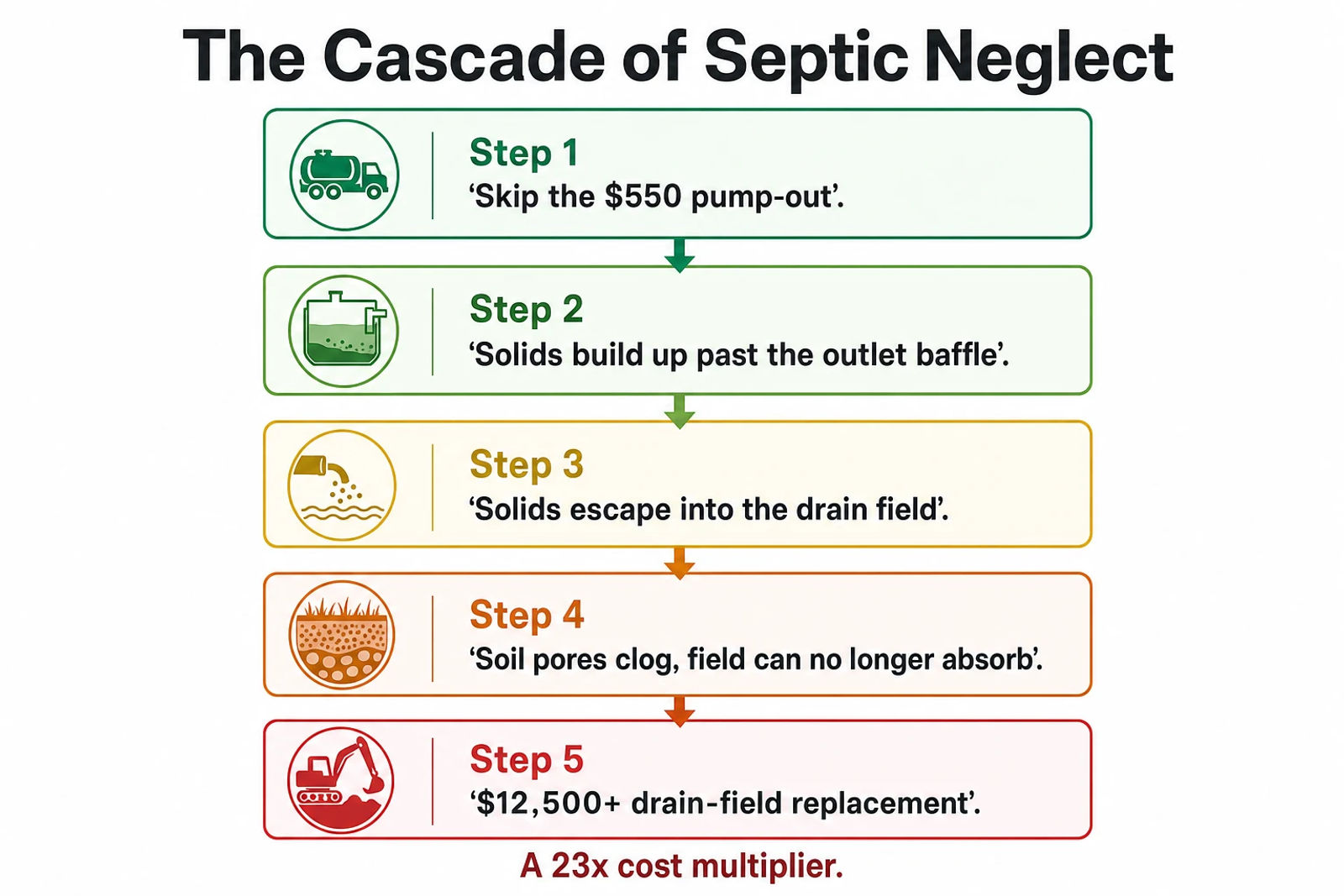
Skipped pumping is a leading, preventable cause of drain-field failure: when a tank isn't pumped, solids build up, escape into the drain field, clog the soil, and shorten its life from 25+ years to as little as 8–12.
A septic tank works by letting solids settle and holding them until they're pumped out. Skip the pumping and the solids layer grows until it reaches the outlet — then it escapes into the drain field, clogs the soil pores, and the field can no longer absorb water. That's the failure that turns a $550 pump-out into a $12,500+ replacement. Per U.S. EPA guidance, regular pumping is the single most effective way to prevent it.
Even the lifetime math favors maintenance
Over 30 years, pumping every 4 years at ~$550 totals about $4,100 — still far less than a single drain-field replacement.
Some owners rationalize skipping pumping as saving money. It doesn't. Thirty years of on-schedule pumping costs less than one replacement — and that's before counting the emergency call-outs, yard excavation, and permit fees a failure adds. To find your own schedule, use our pumping schedule calculator or read how often to pump a septic tank.
SepticTankHub Research. “The Cost of Septic Neglect: The Maintenance Multiplier” (Report #1), 2026. https://www.septictankhub.com/blog/cost-of-septic-neglect/. Free to republish with attribution and a link.
Methodology & sources
Methodology & Sources — data as of 2026-07-07
Cost figures are national ranges from our cost guides; actual prices vary by region, system type, soil, and access.
The multiplier is a ratio of published cost ranges (drain-field replacement ÷ routine pump-out), presented as a range with a representative midpoint — not a single false-precision number.
'Neglect causes failure' reflects EPA and extension maintenance guidance, not a proprietary survey.
- Cost figures are national ranges from our cost guides; regional prices, system type, soil, and access all move them.
- The multiplier is a ratio of published cost ranges, shown as a range with a representative midpoint — not a single false-precision number.
- The link between neglect and failure reflects EPA/extension maintenance guidance, not a proprietary survey.
- SepticTankHub Cost Guides (pumping, drain-field replacement, system replacement) — Researched cost ranges. (accessed 2026-07-07)
- U.S. EPA — How to Care for Your Septic System — Maintenance guidance; neglect as failure driver. (accessed 2026-07-07)
Frequently asked questions
This is Report #1, published 2026. Media & data inquiries: [email protected] · see our press page. Related: Septic Cost Index · Septic Statistics.
