
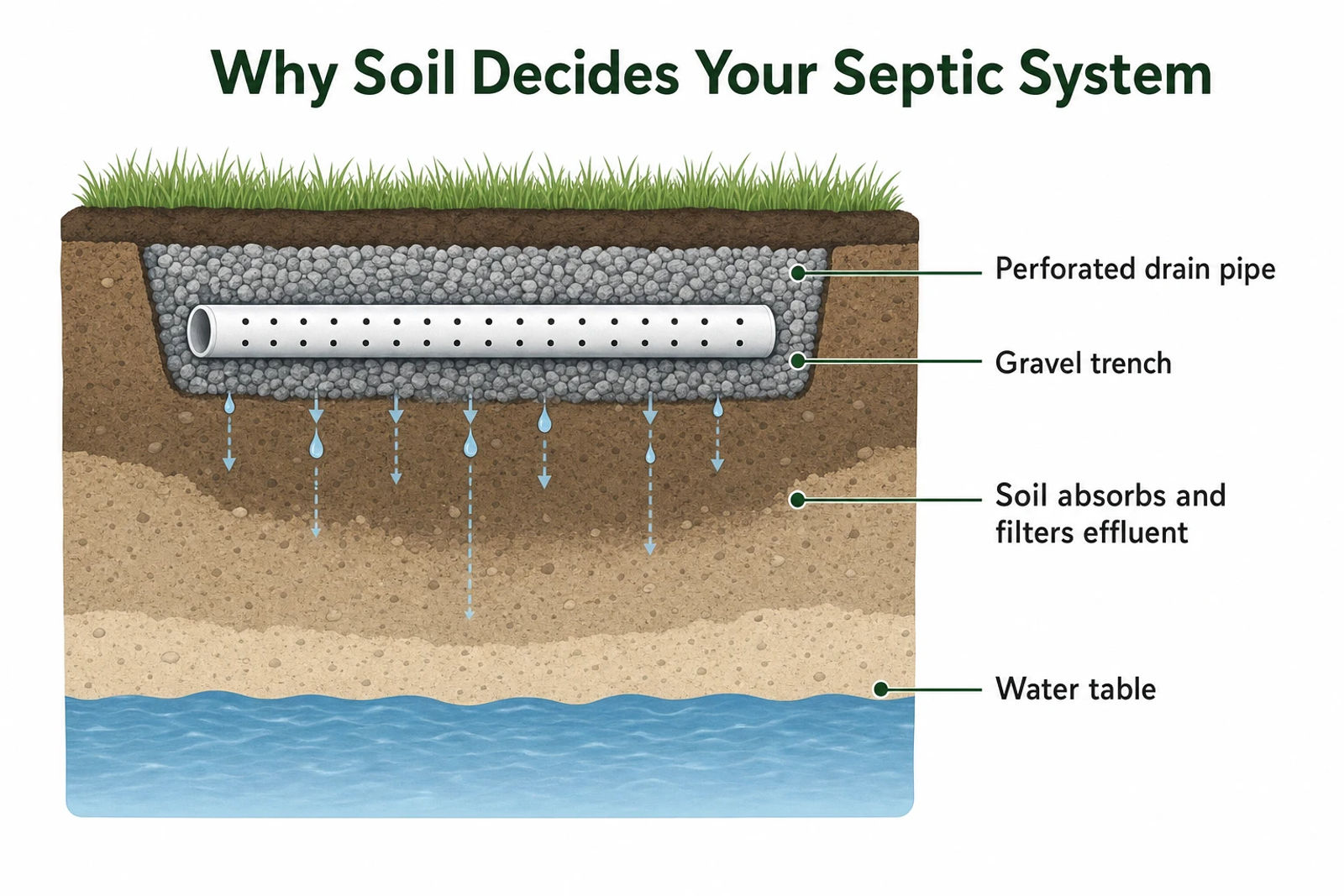
Most of America's soil is a bad place to put a septic system. According to USDA soil data, about 72.8% of rated U.S. soils are “Very Limited” for a conventional septic drain field — the properties that let a drain field work (steady permeability, a deep water table, no bedrock or flooding) are the exception, not the rule. It's worst in Maine (95.8%) and best in Texas (34.1%). Here's every state, mapped.
The headline numbers
About 72.8% of rated U.S. soils are "Very Limited" for a conventional septic drain field, according to USDA data.
Maine has the worst soil for septic in the nation — about 95.8% of its rated soils are "Very Limited" for conventional drain fields.
Texas has the most septic-friendly soil of the 50 states, at about 34.1% "Very Limited" — still high, but the lowest in the country.
In 30 states, at least three-quarters of rated soils are poorly suited for a conventional septic system.
Septic soil suitability, mapped
Darker = a larger share of soils poorly suited for a conventional drain field.
Every state, ranked
Ranked worst-to-best. Search for your state.
| # | State | % Soils 'Very Limited' ▼ |
|---|---|---|
| 1 | Maine | 95.8% |
| 2 | Michigan | 94.5% |
| 3 | Vermont | 90.5% |
| 4 | Oregon | 90.4% |
| 5 | Missouri | 90.3% |
| 6 | Alaska | 89.8% |
| 7 | Hawaii | 89.1% |
| 8 | New Jersey | 88.8% |
| 9 | Mississippi | 88.8% |
| 10 | Florida | 88% |
| 11 | Iowa | 87.9% |
| 12 | Pennsylvania | 87.5% |
| 13 | West Virginia | 87.2% |
| 14 | New Hampshire | 86.5% |
| 15 | South Dakota | 82.6% |
| 16 | Kansas | 81.8% |
| 17 | Alabama | 80.9% |
| 18 | Nebraska | 80.6% |
| 19 | Indiana | 80.2% |
| 20 | Virginia | 79.3% |
| 21 | Connecticut | 78.5% |
| 22 | North Carolina | 78.4% |
| 23 | Massachusetts | 78.4% |
| 24 | Illinois | 78.3% |
| 25 | Idaho | 78.2% |
| 26 | Wisconsin | 77.8% |
| 27 | North Dakota | 77.6% |
| 28 | Nevada | 77% |
| 29 | Minnesota | 76% |
| 30 | Rhode Island | 75.6% |
| 31 | Maryland | 74% |
| 32 | Montana | 73.8% |
| 33 | South Carolina | 72.4% |
| 34 | Tennessee | 71.1% |
| 35 | Delaware | 69.1% |
| 36 | Georgia | 66% |
| 37 | New Mexico | 64.2% |
| 38 | Washington | 63.6% |
| 39 | Oklahoma | 58.1% |
| 40 | Wyoming | 57.3% |
| 41 | Arkansas | 56.6% |
| 42 | Ohio | 51.2% |
| 43 | Colorado | 49% |
| 44 | Arizona | 46.6% |
| 45 | California | 44.5% |
| 46 | Kentucky | 43.9% |
| 47 | New York | 43.4% |
| 48 | Louisiana | 42% |
| 49 | Utah | 41% |
| 50 | Texas | 34.1% |
50 of 50 rows · click a column to sort · click a row name to link it
What poor soil means for your wallet
“Very Limited” rarely means you can't build — it means a standard gravity drain field won't work, so you need an alternative or engineered system (a mound, an aerobic treatment unit, drip dispersal). Those cost more to permit and install, which is exactly why some states charge higher permit fees for alternative systems (see our Cost Index). Poor soil is also a leading driver of the drain-field failures behind our cost-of-neglect analysis. Your specific site is decided by a perc test, not a statewide average — this map shows the landscape, not your lot.
SepticTankHub Research. “The Best & Worst States for Septic Soil”, 2026, from USDA SSURGO data. https://www.septictankhub.com/blog/septic-soil-suitability-by-state/. Free to republish with attribution and a link.
Methodology & sources
Methodology & Sources — data as of 2026-07-08
Source: USDA NRCS SSURGO via Soil Data Access, national interpretation 'ENG - Septic Tank Absorption Fields' (ruledepth 0).
Metric = the share of a state's rated soil map-unit COMPONENTS rated 'Very limited' for conventional septic drain fields. This is a component-count proxy, not an area-weighted average — a defensible state-level indicator, but not a parcel-level rating.
'Very limited' means the soil has properties (high water table, slow permeability, shallow bedrock, flooding, etc.) that make a conventional drain field difficult; alternative systems are often required, raising cost.
This is the soil layer of a forthcoming county-level septic risk map, which will add housing age and system density.
- This is a component-count proxy at the state level — not an area-weighted average and not a rating of your individual parcel.
- 'Very Limited' reflects difficulty for a CONVENTIONAL drain field; alternative systems are usually still possible.
- This is the soil layer of a forthcoming county-level septic risk map (which will add housing age and system density).
- USDA NRCS — SSURGO / Soil Data Access, 'ENG - Septic Tank Absorption Fields' interpretation — Share of rated soil map-unit components rated 'Very limited' for septic absorption fields, by state. (accessed 2026-07-08)
Frequently asked questions
The soil layer of our forthcoming county-level septic risk map. Media & data inquiries: [email protected] · see our press page.
