
A septic biomat is a natural bacterial layer in your drain field — but when it thickens, it causes backups and soggy yards. Learn what to do about it.
Quick Answer
A septic biomat is a dark, slimy biological layer that forms at the soil interface inside your drain field as anaerobic bacteria process septic effluent. A thin biomat — around 1–2 mm — is completely normal. In fact, it helps filter pathogens. A thick biomat of 2 inches or more reduces soil permeability so dramatically that your drain field stops draining.
💡 Key Takeaways
- Every functioning drain field develops a biomat. That's normal biology, not a defect.
- Problems start when the biomat grows thick enough to cut off soil absorption — sometimes reducing infiltration rates by a factor of 100 to 1,000.
- The most common cause of excessive biomat is hydraulic overloading: too much water entering the system too fast.
- Remediation options exist — but they work best early. Waiting until sewage surfaces in your yard narrows your choices fast.
- Aerobic treatment units (ATUs) produce cleaner effluent that dramatically slows biomat growth over time.
Biomat is a dense mat of anaerobic bacteria, their extracellular byproducts (polysaccharides and extracellular polymeric substances, or EPS), and trapped suspended solids. It forms at the interface between the gravel trench of your drain field and the native soil below.
Here's the basic sequence:
Penn State Extension describes this layer as forming within weeks to months of a new system going into service. In a properly loaded system, it reaches an equilibrium thickness and stays manageable. That's the healthy scenario. The biology of a septic system is a balance between input and processing capacity — and biomat is a natural part of that balance.
Yes — a thin biomat is not just normal, it's actually useful. A 1–2 mm biomat acts as a biological filter. It removes residual pathogens, fine particles, and some dissolved organics from the effluent before it reaches groundwater. University of Minnesota Extension research confirms that a healthy biomat provides meaningful secondary treatment, complementing what the septic tank does upstream.
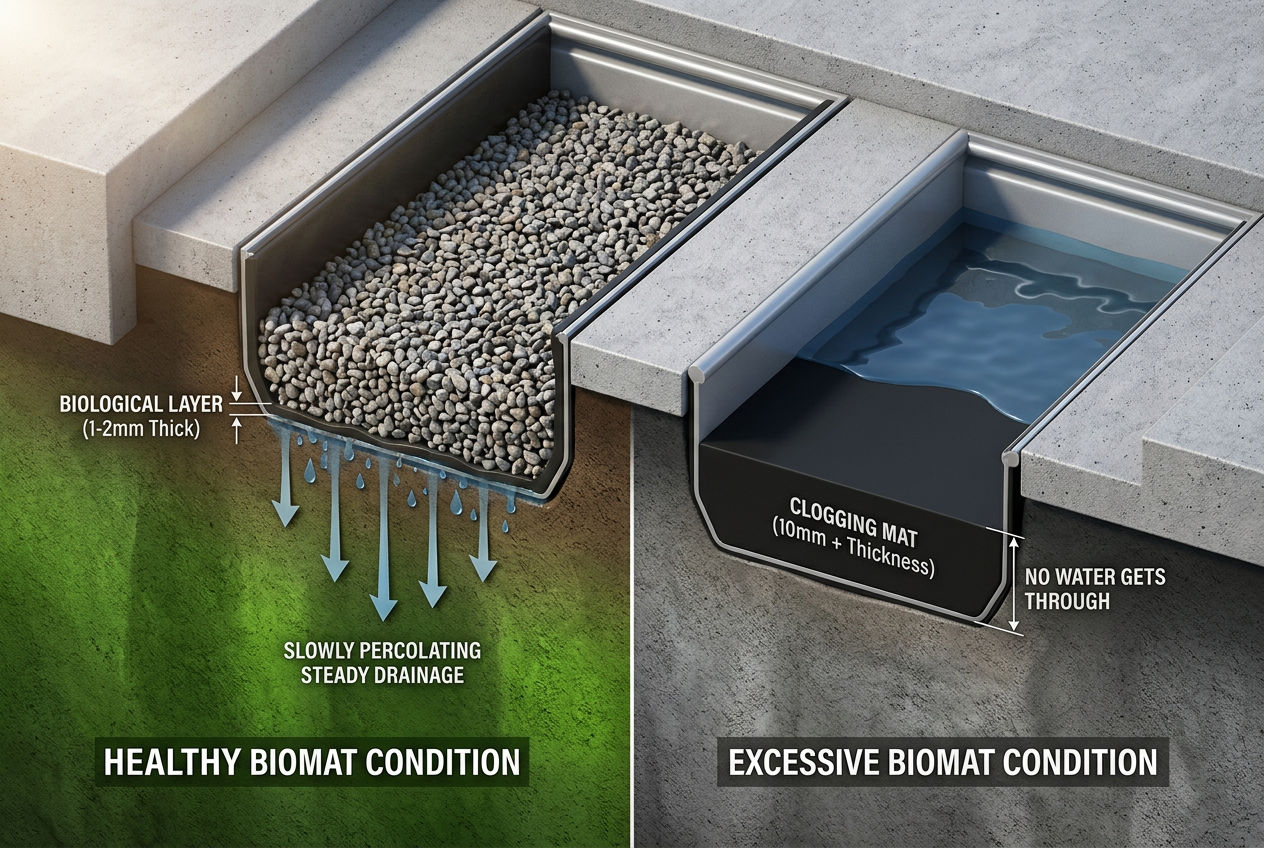
The problem is what happens next. As effluent loading continues, the biomat thickens. Once it reaches 1–2 inches, it starts reducing the soil's percolation rate significantly. At 2–4 inches or more — which happens in overloaded or neglected systems — the biomat can reduce native soil infiltration rates by a factor of 10 to 1,000 compared to unaffected soil. At that point, the soil absorption field can't accept water fast enough, and the system backs up.
📊 Quick Fact: Think of it like a coffee filter. A little bit of grounds on the filter actually improves filtration. Pack the filter six layers deep and coffee stops flowing through entirely.
The single biggest driver of accelerated biomat growth is hydraulic overloading — pushing more water through the system than it was designed to handle.
The average person uses about 70 gallons of water per day. A drain field sized for a 4-person household is engineered around roughly 280 gallons per day. Add a leaking toilet (which can waste 200+ gallons daily without anyone noticing), a teenager home for the summer, or houseguests for a week-long holiday, and you've blown past that design capacity. When excess water hits the drain field, the biomat never gets a rest period to partially oxidize and thin out.
High TSS effluent — If your septic tank baffles are broken or your tank hasn't been pumped in 10+ years, solids escape into the drain field. More suspended solids mean faster biomat growth. This is one reason regular septic tank pumping isn't optional maintenance — it protects the drain field.
Clay soils — In Southeast states like Georgia, Alabama, and the Carolinas, naturally slow-percolating clay soils create faster biomat problems than sandy soils do. The soil was already limiting drainage; the biomat pushes it over the edge.
Cold weather — In northern climates, biological activity slows in winter. A Minnesota drain field in January isn't breaking down organics at the same rate it does in July. Biomat can thicken during cold months, then partially recover in warmer weather — or not, if loading stays high.
Garbage disposals — Using a garbage disposal dramatically increases the TSS load entering your tank. What you put down your drains has a direct impact on how quickly your biomat thickens.
A thin, healthy biomat is invisible from the surface. A problematic one gives you clear warning signs — though they can develop gradually enough that homeowners miss them until things get bad.
Slow drains throughout the house — Not just one sink or toilet. If everything drains sluggishly, the drain field may be saturated.
Gurgling sounds — Gurgling in multiple fixtures points to a drainage backup, not a simple clog. Gurgling from your septic system is worth investigating immediately.
Wet, soggy areas over the drain field — Especially in spring when the water table is already high. If that wet patch smells like sewage, you're past early warning.
Bright green grass over leach laterals — Effluent acts as fertilizer. A suspiciously lush stripe across your yard in a dry summer is a flag.
Sewage odors outdoors — A properly functioning system shouldn't smell. Odors near the drain field often mean effluent is surfacing.
✅ Pro Tip: A septic system inspection is the definitive way to confirm biomat clogging. A qualified inspector will probe the drain field, check the distribution box for backflow (a reliable indicator of failed absorption), and may assess the effluent filter for excessive solids buildup. Early detection matters — a lot.
This question comes up constantly in inspection reports, and the distinction matters financially.
Biomat clogging is a condition where the drain field trench is physically blocked by a thick biological layer. The pipes, distribution box, and soil structure are largely intact. Given the right intervention, some or all of the absorption capacity can be recovered.
Full drain field failure means the soil absorption capacity is permanently compromised — either from irreversible biomat that has sealed the soil matrix, root intrusion, physical damage, or soil saturation from a high water table that never recedes. At that point, drain field replacement is typically required.
⚠️ Warning: The tricky part is that advanced biomat clogging often leads to drain field failure if ignored. Water that can't absorb into the soil finds another path — sometimes back up through the pipes, sometimes laterally into the yard. Over time, saturated soil conditions can permanently change the soil structure.
Picture this scenario: You're selling your home and the buyer's inspector flags a biomat problem in the drain field. If you catch it at early biomat clogging, you might spend $2,000–5,000 on remediation. Wait until it's full failure, and you're looking at $5,000–20,000 for drain field replacement. Same root cause, very different outcomes depending on timing.
| Biomat Stage | Thickness | Percolation Impact | Typical Symptoms | General Approach |
|---|---|---|---|---|
| Healthy / Normal | 1–2 mm | Minimal — beneficial filtration | None | No action needed |
| Early Clogging | ¼–½ inch | Moderate reduction | Slow drains, slight odor | Reduce water use; inspect |
| Significant Clogging | ½–2 inches | Severe reduction (10–100×) | Wet yard, backups | Professional assessment; remediation |
| Advanced / Critical | 2–4+ inches | Near-total blockage (up to 1,000×) | Surfacing sewage, system failure | Immediate service; possible replacement |
Data compiled from Penn State Extension, University of Minnesota Extension, and EPA septic system guidance (epa.gov/septic).
There's no single biomat cure. Options range from simple operational changes to complete system overhaul. Which one applies to your situation depends on how severe the biomat is, your soil type, and your system design.
This is always step one. Fix leaking toilets, spread laundry loads across the week rather than doing six loads on Saturday, and reduce discretionary water use. How many laundry loads your septic can handle matters more than most homeowners realize.
Giving the drain field a rest period — even a few weeks of reduced loading — allows some aerobic oxidation of the biomat surface. This works best with early-stage clogging.
Enzyme and bacterial additives marketed for drain field restoration exist. Some professionals use them as part of a broader treatment plan. However, peer-reviewed research — including studies cited by the University of Arkansas and the National Onsite Wastewater Recycling Association (NOWRA) — shows inconsistent results. These products don't reliably break through a mature, thick biomat. Our review of septic additives covers the evidence in detail.
⚠️ Warning: Hydrogen peroxide treatment is another option used by some licensed contractors. Applied at concentrations of 7–35%, it can oxidize biomat material in the trench. This is not a DIY approach — the chemical handling requirements are serious, and improper application can damage beneficial soil biology permanently.
This is the most evidence-supported remediation strategy for significant biomat clogging. Conventional septic tank effluent contains 150–250 mg/L BOD. An aerobic treatment unit (ATU) — systems like those made by Orenco Systems or using Hiblow HP-80 compressors — reduces BOD to under 30 mg/L and TSS to under 30 mg/L before effluent reaches the drain field.
Cleaner effluent means far less biological material feeding the biomat. Over 6–12 months, the existing biomat can partially oxidize and thin out as the soil's natural aerobic bacteria get back to work. ATU installation typically costs $5,000–10,000 depending on system size and region. That's real money — but compared to a full drain field replacement at $5,000–20,000, it's often worth exploring first.
This is also why ATUs are increasingly required by state health departments in coastal areas and regions with high water tables, where any reduction in effluent quality creates faster drain field problems. See our aerobic vs. anaerobic septic comparison for a deeper look.
Some older properties were built with dual drain fields designed to alternate. If you have this setup, switching to the dormant field while the clogged field rests can allow significant biomat recovery over 6–24 months. This option isn't available if you have a single-field system, which is most residential installations.
When biomat damage is irreversible — or when the soil structure itself is permanently altered — replacement is the only option. A new drain field installation runs $5,000–20,000+ nationally, with higher costs in the Northeast and Pacific Northwest where labor rates and permitting requirements drive up prices. The full cost breakdown for drain field replacement is worth reviewing before any contractor
Compare top-rated companies in your area. Get free, no-obligation quotes from verified providers.
Was this article helpful?
Connect with licensed, verified septic companies in your area.
Get estimates from licensed, verified companies in your area. No obligation.
⚡ Average response time: under 2 hours