
Learn how to negotiate septic repairs after a home inspection — seller credits, price reductions, escrow holdbacks, and step-by-step strategy with cost benchmarks.
Quick Answer
Meta Description: Learn how to negotiate septic repairs after a home inspection — including seller credits, price reductions, and escrow holdbacks. Step-by-step strategy with real cost benchmarks.
To negotiate septic repairs after a home inspection, use the findings in your septic inspection report to request that the seller repair the system, credit you money at closing, reduce the sale price, or fund an escrow holdback. Knowing how to negotiate septic repairs from a home inspection report — and which approach to use — depends on what was found, how much it costs, and whether your market favors buyers or sellers.
💡 Key Takeaways:
- Get 2–3 independent estimates from licensed septic contractors before making any repair request
- Seller credits typically cover 50%–100% of repair costs depending on market conditions
- FHA and VA loans require a functioning septic system — failed systems create mandatory negotiation leverage
- Escrow holdbacks require lenders to hold 1.5× the repair estimate until work is complete
- Full system replacement ($10,000–$30,000+) can justify a walk-away if the seller won't negotiate
Most home inspectors flag septic problems in one of four categories: minor maintenance issues, component failures, drain field problems, or outright system failure. Which category you're dealing with changes your entire negotiation position.
A septic inspection might reveal something as minor as a full tank needing pumping ($300–$600) or as serious as a saturated drain field requiring full replacement ($5,000–$20,000+). Common findings include failed outlet baffles or missing effluent filters, cracked tank walls, a flooded distribution box, surfacing effluent over the leach field, or a system that flat-out failed a septic dye test or septic load test.
Some inspectors only do a visual check. Others perform a hydraulic load test — running water continuously for 30–60 minutes while watching for backups or surface ponding. If the inspector only did a visual, you have the right to request a more thorough evaluation before your home inspection contingency deadline expires. Don't skip this step if the system is older than 20 years or if you see signs of drain field failure anywhere on the property.
Before you make any repair request, you need to know what things actually cost. Walking into a negotiation without numbers puts you at an immediate disadvantage — the seller's agent will quote the lowest possible figure, and you'll have nothing to counter with.
| Repair Type | Typical Cost Range | Negotiation Weight |
|---|---|---|
| Septic tank pumping | $300 – $600 | Low — minor ask |
| Baffle or effluent filter repair | $500 – $2,500 | Moderate |
| Full septic tank replacement | $3,000 – $8,000 | Significant |
| Drain field / leach field repair | $2,000 – $15,000 | Major |
| Full drain field replacement | $5,000 – $20,000+ | Deal-breaker territory |
| Complete system (tank + field) | $10,000 – $30,000+ | Strong leverage or walk |
| Engineered / alternative system | $15,000 – $50,000+ | Site-specific; consult local contractor |
Cost data based on 2024–2025 national averages. Regional labor rates and soil conditions significantly affect final pricing. See septic repair cost guide for detailed breakdowns.
📊 Quick Fact: The average septic repair negotiated during a home sale falls between $2,000 and $8,000. Drain field issues account for the majority of high-dollar negotiations — and buyers who present multiple contractor estimates recover 25%–40% more than those who submit a single quote.
A worked example: a buyer under contract on a 1970s farmhouse in central Ohio gets a dye test back showing the 1,000-gallon concrete tank is intact, but the distribution box is cracked and one of three leach laterals is saturated. Two local contractors quote $4,200 and $4,800 to replace the distribution box and reroute the failed lateral. That buyer reasonably asks for a $4,500 seller credit — the midpoint of both estimates — and has the documentation to back it up.
For full cost context, the drain field replacement cost guide breaks down pricing by system size, soil type, and region.
You have five levers to pull when negotiating septic repairs after a home inspection. Most buyers reach for one, but experienced negotiators sometimes combine two. Each one works differently depending on your loan type, market conditions, and the severity of the defect.
You request that the seller hire a licensed septic contractor, complete the repairs, and provide documentation before the closing date. This sounds clean, but it carries real downsides. Sellers often hire the cheapest contractor. Rushed repairs can be sloppy. You have no control over quality, and you inherit the system the day you get the keys.
This approach works best for clear, contained problems — a broken baffle wall, a missing Polylok effluent filter, a failed riser lid — where the scope of work is easy to define and verify.
The seller doesn't fix anything. Instead, they credit you money at closing — typically listed on the settlement statement as a seller concession — and you hire your own contractor after you move in. This gives you control over who does the work and when. Seller credits typically range from 50%–100% of the estimated repair cost depending on how competitive the market is. In a balanced market, asking for the full estimate is reasonable. In a hot seller's market with multiple offers, expect to negotiate down.
Instead of a formal credit at closing, the seller simply drops the sale price by the cost of repairs. This affects your loan amount and your property tax basis. For buyers paying cash, this is often the cleanest path. For financed buyers, a closing cost credit is usually more financially efficient since it directly offsets out-of-pocket costs.
Your lender will need to approve credits above certain thresholds. FHA loans cap seller concessions at 6% of the sale price; conventional loans cap them at 2%–9% depending on down payment size.
An escrow holdback is a specific sum of money — held by the title company or closing attorney — that gets released to pay for repairs after closing. This mechanism is common when repairs can't be completed before the closing date (frozen ground, contractor availability, permit delays).
Most buyers don't know this part: lenders typically require the escrow amount to equal 1.5× the estimated repair cost, not just the estimate itself. So if your contractor quotes $8,000 to replace a drain field, the lender may require $12,000 in escrow. The seller must agree to fund it, or the gap has to be negotiated. Not every lender offers holdbacks — confirm with your loan officer early.
📊 Quick Fact: The 1.5x escrow multiplier means an $8,000 repair requires $12,000 held in escrow — and the seller funds that entire amount. Factor this into your negotiation strategy early, because the seller's actual out-of-pocket obligation is 50% higher than the repair estimate alone.
Your home inspection contingency gives you the legal right to exit the contract and recover your earnest money if negotiations fail. This is the most underused lever because buyers get emotionally attached to properties before the inspection results are even in.
⚠️ Warning: Your inspection contingency has a hard deadline — typically 7–14 days from the contract date. If that deadline expires before you reach an agreement on repairs, you lose your right to walk away with your earnest money. Track this date from day one and work backward from it when scheduling contractor estimates.
But sometimes walking is the right call. If the inspection found complete septic system failure requiring $25,000+ to remediate, the seller refuses all concessions, and the property is priced at market value assuming a functioning system — that math doesn't work. Properties with known septic failures sell for roughly 10–20% below comparable properties with working systems, according to real estate valuation literature. If the seller won't adjust the price to reflect that reality, you're subsidizing their problem.
Follow this sequence. Each step builds the leverage for the next.
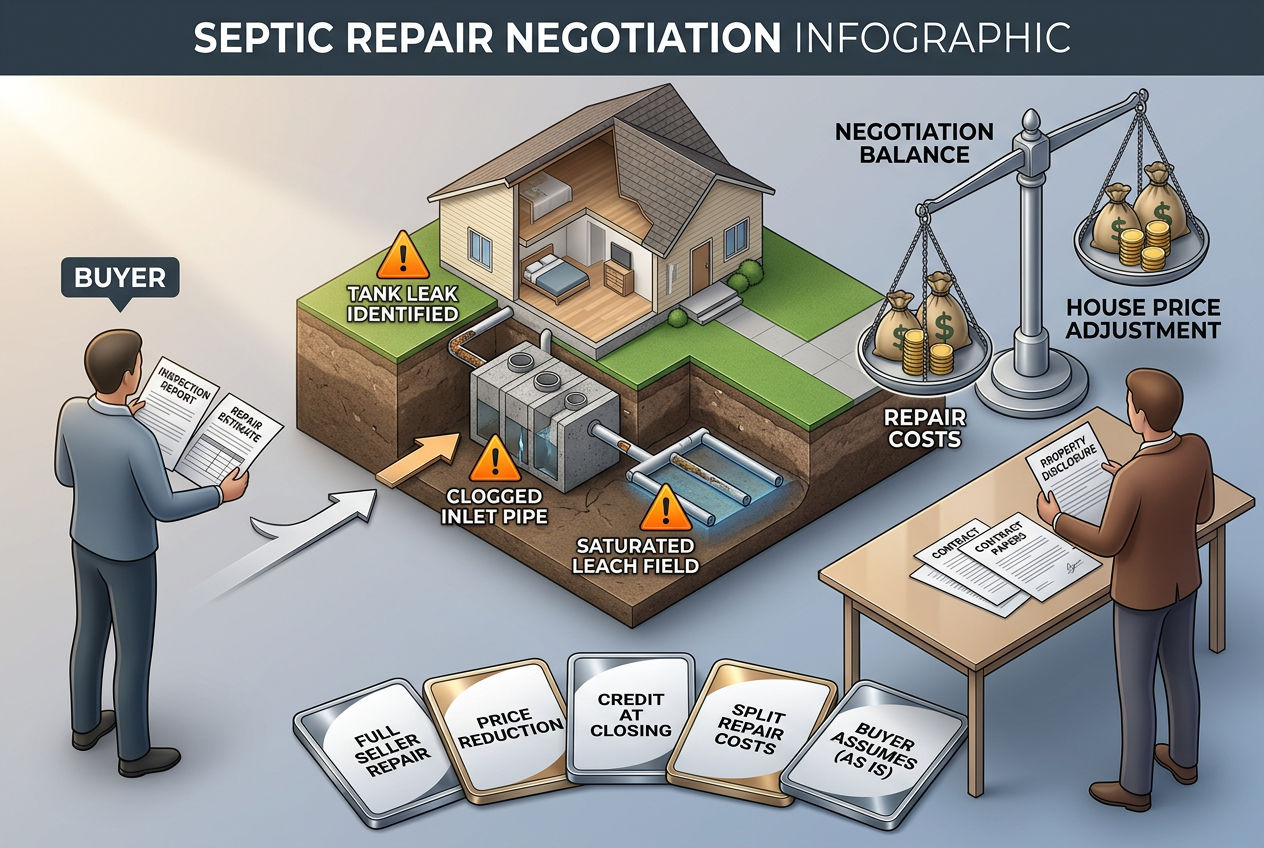
Step 1 — Read the inspection report carefully. Identify whether the inspector flagged a definitive failure, a potential problem, or a maintenance item. The distinction matters more than most buyers realize. "Active effluent surfacing over leach field" is a failure. "Tank requires pumping" is maintenance. Your ask should match the severity.
Step 2 — Get 2–3 estimates from licensed septic contractors. Do this fast. Most purchase agreements give you 7–14 days for the due diligence period. Call contractors immediately after receiving the inspection report. You need independent licensed professionals — not the seller's preferred vendor. Find licensed septic contractors in your area to get competing estimates quickly.
✅ Pro Tip: Call contractors for estimates the same day you receive the inspection report — not the next week. Septic contractors often book 3–5 days out for site visits, and your contingency clock is already ticking. Getting estimates on day 2–3 gives you time to negotiate before your deadline hits.
💡 Tip: Photograph the inspection findings (surfacing effluent, wet spots, cracked components) before the seller has a chance to address anything cosmetically. Timestamped photos strengthen your addendum and protect you if the seller disputes the severity.
Step 3 — Calculate your ask. Use the midpoint or average of your estimates, not the highest quote. Asking for the highest number invites a counter-offer anchored to the lowest. The midpoint is harder to argue with.
Step 4 — Submit a formal repair addendum. Work with your real estate agent to draft a repair addendum or repair request letter that references specific inspection findings, attaches the contractor estimates, and states exactly what you're requesting — credit amount, repair scope, or price reduction. Vague requests invite vague responses.
Step 5 — Set a response deadline. Give the seller 48–72 hours to respond. Longer windows let negotiations drag past your contingency deadline.
⚠️ Important: Track your inspection contingency deadline carefully. If it expires before you reach agreement, you lose your right to walk away with your earnest money. Ask your agent to calendar the deadline and set a reminder 48 hours before it hits.
Step 6 — Respond to the counter-offer strategically. If they offer 50% of your ask, come back at 85% with the explanation that your FHA lender requires a functional septic system for loan approval. That's not a negotiating tactic — it's a documented lender requirement that constrains your flexibility.
The right number depends on three factors: repair cost, market conditions, and your loan type.
In a buyer's market — defined as 6+ months of inventory — you have room to ask for 100% of the midpoint estimate. Sellers are motivated. Days on market are longer. The threat of you walking away carries real weight.
In a balanced market (3–6 months of inventory), expect to negotiate to 75%–90% of your ask. Come in at 100% and settle near the midpoint.
In a seller's market (under 3 months of inventory, like spring 2024 in most Sun Belt metros), you may only get 50%–60% of your ask — or nothing at all. In those conditions, a purchase price reduction is sometimes more palatable to sellers than a formal closing credit because it doesn't show up as a concession in MLS data.
Loan type also constrains your options:
💡 Key Takeaway: FHA and VA loan requirements are not negotiation tactics — they are mandatory lender conditions. If the septic system fails inspection, the lender will not fund the mortgage until repairs are made. This gives government-backed buyers documented leverage that conventional buyers simply do not have.
Sellers say no for three reasons: they don't believe your numbers, they can't afford the repair, or they've already priced the property to account for the system's condition. Knowing which one you're dealing with tells you how to respond.
If they dispute your numbers: Share your contractor estimates directly. Three licensed bids are hard to refute. If they still disagree, offer to bring in a neutral third-party septic engineer for a $200–$400 evaluation — and split the cost. Sellers who know the system is failing rarely agree to this. Sellers who believe it's fine often do.
If they can't afford repairs: A price reduction costs them the same as a credit in net proceeds, but it doesn't require them to write a check before closing. Reframe your ask as a price reduction rather than a repair demand.
If they've priced it accordingly: Pull comps. If neighboring properties with functional systems sold for $20,000 more, that's your argument. The seller non-disclosure guide covers your legal options if the seller knew about failures and didn't disclose them.
The hybrid approach: Some buyers split the difference by accepting a smaller credit in exchange for a seller-funded warranty or service agreement on the repaired system. This signals that you're serious about closing, not just hunting for concessions, and it gives you post-closing protection.
Government-backed loans don't give you a choice on septic system condition — and that's actually an advantage. If you're using an FHA or VA loan to purchase a home, the lender requires the septic system to be functional and meet local health standards before they'll fund the mortgage.
What does "functional" mean in practice? The system must not have active effluent surfacing, must not be backing up into the home, and must pass a basic operational evaluation. In many states, this means the system needs a passing result on a licensed inspector's evaluation — not just a visual check.
If the seller refuses to repair a failing system on an FHA or VA transaction, you have three options: walk away with your earnest money intact, ask for a price reduction large enough to cover repairs post-closing (subject to lender approval), or request a repair escrow. What you can't do is close on a loan where the appraiser has flagged an active septic failure. The lender simply won't fund it.
This is documented leverage, not negotiating tactics. Use it accordingly. Your agent can reference the lender's written conditions in the addendum.
You negotiated a credit or a repair. You closed. Now what?
Don't pocket the credit and ignore the system. The money exists for a reason — spend it on the repair within the first 60–90 days. Waiting creates two problems: you may discover the problem has progressed, and if you ever need to sell, you'll be the seller who has a known-defect history in the inspection report with no documentation of remediation.
✅ Pro Tip: Schedule your repair contractor before closing day if possible. Many septic contractors book 2–4 weeks out, and lining up the work in advance means repairs start within the first week of ownership — well within the 60–90 day window and before the system has time to deteriorate further.
After closing:
Compare top-rated companies in your area. Get free, no-obligation quotes from verified providers.
Was this article helpful?
Connect with licensed, verified septic companies in your area.
Get estimates from licensed, verified companies in your area. No obligation.
⚡ Average response time: under 2 hours