
Learn how many loads of laundry are safe for your septic system per day. Tips on spacing loads, choosing detergents, and protecting your drain field.
Quick Answer
Meta description: Wondering how many loads of laundry you can do with a septic system? Learn the safe daily limit, how to calculate your home's laundry capacity, and which habits protect your drain field.
Most septic systems can handle 1–2 full loads of laundry per day when loads are spaced several hours apart. Cramming 5 or 6 loads into a single Saturday morning can push 150–270 gallons of washing machine discharge into your tank in just a few hours — potentially exceeding your system's entire designed daily flow capacity and saturating your drain field before it has time to recover.
💡 Key Takeaways
- Limit laundry to 1–2 loads per day, spaced at least 2–3 hours apart, for a standard 1,000-gallon septic tank
- A single all-day laundry marathon (6+ loads) can send 180–270 gallons from laundry alone into your system
- A 3-bedroom home is typically designed for only ~360 gallons/day of total household water use
- High-efficiency front-load washers use 12–17 gallons per load vs. 30–45 gallons for older top-loaders — a massive difference for your tank
- Spreading loads across multiple days is the single most effective habit change you can make
For most households on a standard 1,000-gallon septic tank, 1 to 2 full loads per day is the practical safe limit. Space them at least 2–3 hours apart so your system has time to process the incoming water.
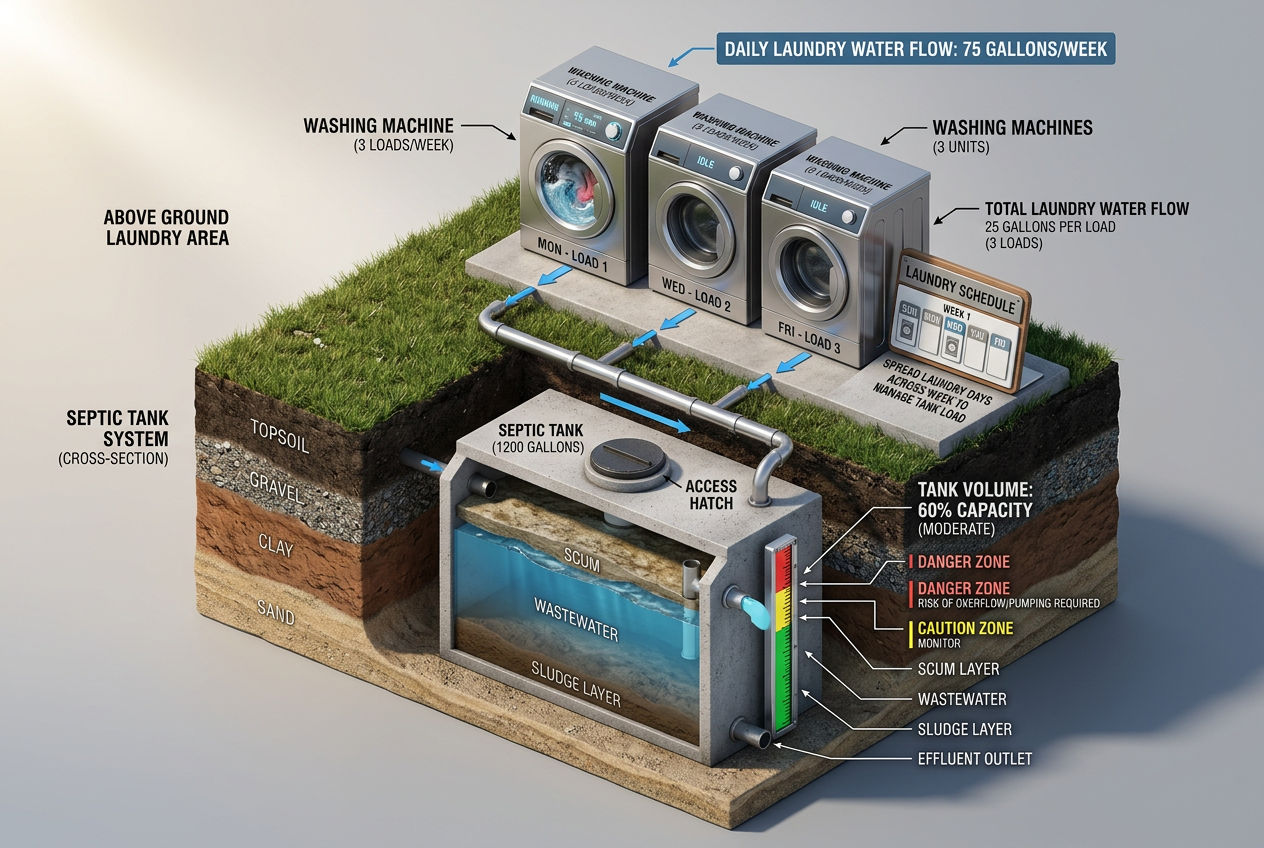
The EPA's residential wastewater guidelines estimate design flow rates at roughly 120 gallons per day per bedroom — meaning a 3-bedroom home is engineered to handle around 360 total gallons daily from all sources combined:
📊 Quick Fact: Laundry accounts for approximately 21–25% of indoor household water use, according to EPA WaterSense data. On a tight-capacity system, that percentage matters.
One load in the morning, one in the evening? You're almost certainly fine. Five loads before noon? That's where things can go wrong — fast.
Yes, and the mechanism is called hydraulic overload.
Your septic tank holds solids and allows clarified liquid effluent to flow out through the outlet baffle into the drain field, where it percolates through the soil. That soil — the leach field — is not a bottomless sponge. It can only absorb a certain volume per day based on its soil percolation rate (how fast water moves through the soil profile).
When you flood the system with water faster than the drain field can accept it, the effluent backs up. The soil becomes saturated. Sewage can surface as standing water or soggy ground near your leach laterals. In extreme cases, it backs up into your home through the lowest drain in the house — usually a basement floor drain or ground-level toilet.
⚠️ Warning: A single laundry marathon of 6 loads using an older standard top-loader can push 180–270 gallons into your tank from laundry alone. Add normal shower and toilet use and you could easily hit 450–550 gallons in a day — on a system designed for 360.
Chronic overloading doesn't just cause one bad day. Repeatedly saturating the drain field:
Drain field replacement can cost $3,000–$15,000 or more depending on your location, soil conditions, and system type. That's an expensive consequence of avoidable laundry habits.
The type of washer you have changes this calculation dramatically.
| Machine Type | Gallons Per Load | Loads/Day to Hit 100 Gal |
|---|---|---|
| Standard top-loader (older) | 30–45 gal | 2–3 loads |
| HE top-loader | 15–25 gal | 4–6 loads |
| Front-load HE washer | 12–17 gal | 6–8 loads |
| Compact / portable washer | 10–15 gal | 7–10 loads |
Source: U.S. Department of Energy / AHAM washing machine efficiency standards
✅ Pro Tip: If you have an older, pre-2005 standard top-loader, a single load dumps up to 45 gallons into your system. Three loads before lunch is 135 gallons — from laundry alone. Switch to a front-load HE washer and those same three loads use roughly 36–51 gallons total.
That's not a small gap. It's the difference between staying safely within your system's hydraulic budget and blowing past it.
You've probably heard this rule before: do only one load of laundry per day with a septic system. Is it valid?
The one-load-per-day rule is a genuine industry best practice, endorsed by state cooperative extension services including North Carolina State University and the University of Minnesota Extension. Spreading laundry loads throughout the week gives your drain field 24–48 hours between significant water surges to drain and recover properly.
But the rule isn't a universal magic number. A compact washer using 10 gallons per load is very different from a commercial-capacity top-loader using 40. The correct framing is: keep your total daily household water use well within your system's designed daily flow capacity.
For most 3–4 person households on a 1,000-gallon tank, 1–2 loads per day is the practical ceiling. Context matters:
If you're not sure what your system's daily capacity is, look at your original septic system permit — it will list the design flow rate. No paperwork? A licensed septic inspection can tell you exactly what you're working with.
Work through this step-by-step with real numbers from a typical household.
Scenario: 4-person household, 3-bedroom home, 1,000-gallon concrete septic tank, older standard top-loader.
💡 Key Takeaway: Industry best practice from the National Association of Wastewater Technicians (NAWT) recommends keeping total daily water use to no more than 50% of tank capacity, which means staying closer to 2 loads/day for comfortable margins.
Use that math as a guide, not a dare.
Swap that old top-loader for a front-load HE washer (15 gallons/load), and your laundry budget stretches to 10+ loads before you'd theoretically hit the limit — though spacing them out still matters for drain field recovery.
⚠️ Warning: These calculations assume average soil percolation and a drain field in good working condition. If your leach field is aging, has existing biomat buildup, or sits in clay-heavy soil, your real-world capacity may be 20–30% lower than the design figures suggest. When in doubt, err toward fewer loads — not more.
The best practice isn't just "one load per day." Distributing laundry across Monday through Friday gives the drain field rest time between surges. Think of it as a recovery window, not just a daily limit.
Half-empty machines waste water. A full load in a front-load HE washer uses 15 gallons. A half-load in the same machine still uses about 12–13 gallons. You're getting twice the laundry done for nearly the same water cost.
This is the single biggest mechanical change you can make. Going from a 40-gallon top-loader to a 15-gallon front-loader cuts your laundry water use by 60–65%. Your septic tank bacteria benefit too — less hydraulic flushing means more stable biological activity in the tank.
Powdered detergents often contain fillers — sodium sulfate, clay-based carriers — that don't dissolve completely and can accumulate in your tank. Look for septic-safe laundry detergent labeled biodegradable and phosphate-free. Products like Seventh Generation Free & Clear liquid detergent meet these criteria. Check our guide to septic-safe products for specific recommendations.
Standard washing machines release synthetic microfibers and lint particles directly into your septic tank with every cycle. These non-biodegradable fibers don't break down and can accumulate in sludge layers or pass through to clog soil pores in the drain field. An inline lint trap (about $20–$40) catches them before they become your problem.
When the water table rises or your yard is already saturated from rain, your drain field's absorption capacity drops significantly. During prolonged wet spells — or the spring thaw if you're in Minnesota, Michigan, or Wisconsin — treat laundry like a rationed resource. Even one extra load can push an already-stressed drain field over the edge. See our deep dive on how heavy rain affects your septic system for more detail.
Thanksgiving weekend, summer visitors, back-to-school laundry catch-up — these spike your total water use across the board. Before a high-use event, do laundry in the days before guests arrive so your drain field starts from a rested state, not a partially saturated one.
Most homeowners think about water volume when managing laundry and septic systems. Fewer think about what's actually in that water — and it matters more than most people realize.
Every washing machine cycle sheds synthetic microfibers and fabric particles that flow directly into your septic tank. Unlike toilet paper or food waste, these fibers are non-biodegradable. They don't break down. Over time, they accumulate in the sludge layer and can pass through the tank into the drain field, where they physically clog soil pores.
📊 Quick Fact: A study from the Rozalia Project found that a single synthetic garment can shed more than 1,900 microfibers per wash.
An inline lint filter — installed directly on the washer's discharge hose — is a $20–$40 fix that prevents years of gradual clogging.
Conventional powder detergents contain sodium sulfate and clay-based fillers that don't fully dissolve in water. These settle in your tank and add to sludge volume, accelerating the need for septic pumping.
Liquid detergents dissolve completely and are far less likely to leave residue. Look for products labeled:
Phosphates disrupt the bacterial balance your tank depends on to break down waste.
Cold-water wash cycles aren't just energy-efficient — they're actually gentler on your septic system's bacterial ecosystem. Hot water washes that discharge into the tank can temporarily reduce bacterial activity, slowing the breakdown of solids. Where your detergent allows it, cold-water washing is the better choice for septic health.
Most household drains — toilets, sinks, showers — discharge water in relatively small, intermittent amounts. A toilet flush is 1.28–1.6 gallons. A 10-minute shower is 20–25 gallons spread over time.
A washing machine is different. It discharges in concentrated surges. A standard top-loader empties its drum in one or two rapid drain cycles, sending 20–30 gallons of water into your septic system in a matter of minutes. This sudden volume spike can temporarily overwhelm the tank's ability to separate solids from liquids, stirring up settled sludge and potentially pushing partially treated effluent into the drain field.
✅ Pro Tip: This is exactly why spacing loads 2–3 hours apart matters — you're giving the tank time to settle between surges, not just limiting daily volume.
Compare top-rated companies in your area. Get free, no-obligation quotes from verified providers.
Was this article helpful?
Connect with licensed, verified septic companies in your area.
Get estimates from licensed, verified companies in your area. No obligation.
⚡ Average response time: under 2 hours