
The EPA, University of Minnesota, and Washington State DOH all say the same thing about septic additives. Here's what the science actually shows before you buy.
Quick Answer
Septic tank additives are not necessary for a healthy septic system, and most offer no measurable benefit. The EPA, University of Minnesota Extension, and Washington State Department of Health have all reviewed the evidence and reached the same conclusion: the bacteria your tank needs already arrive with every flush, and no commercial product has been shown to eliminate the need for regular pumping.
💡 Key Takeaways
- Human waste contains 10⁸ to 10¹¹ bacteria per gram — your tank's bacterial ecosystem is self-sustaining from day one.
- The EPA explicitly states there is "no scientific evidence" that additives extend the life of a properly maintained system.
- Biological additives (bacteria and enzymes) are largely redundant. Chemical additives can actively harm your system.
- No commercial septic additive has been proven to reduce sludge accumulation enough to replace pumping.
- A standard pump-out every 3–5 years ($300–$600) remains the only evidence-backed maintenance strategy.
Walk into any hardware store and you'll find a wall of products promising to "restore" your septic system, "eliminate odors," and "reduce the need for pumping." RID-X, Rid-X Advanced, Green Gobbler, Bio-Clean — the claims are bold and the packaging is convincing.
The numbers tell the story. The US septic additive market generates an estimated $400–$500 million per year. That's a lot of marketing muscle aimed at roughly 21 million American households — about one in five — that rely on private septic systems. If you've ever felt like you should be doing something beyond just pumping the tank every few years, these products are designed to scratch that itch.
The problem? The itch is mostly manufactured. Understanding how your septic system actually works makes that clear fast.
A healthy septic tank is a self-regulating biological system. Wastewater flows in from the house and separates into three distinct layers inside the tank:
The real work happens in the middle. Anaerobic bacteria — organisms that thrive without oxygen — break down organic waste continuously. These bacteria didn't come from a packet you dropped in the toilet. They came from you.
📊 Quick Fact: Human feces contains between 100 million and 100 billion bacteria per gram (10⁸ to 10¹¹ CFU/g). A standard household delivers more than enough microbial activity to keep the digestion process running from the moment the system is first used.
The sludge layer grows regardless. Anaerobic digestion doesn't eliminate solids — it reduces them slowly. That's why pumping exists. That's why it's non-negotiable.
Not all additives are the same. They fall into three categories, and the science on each is different — though not dramatically so.
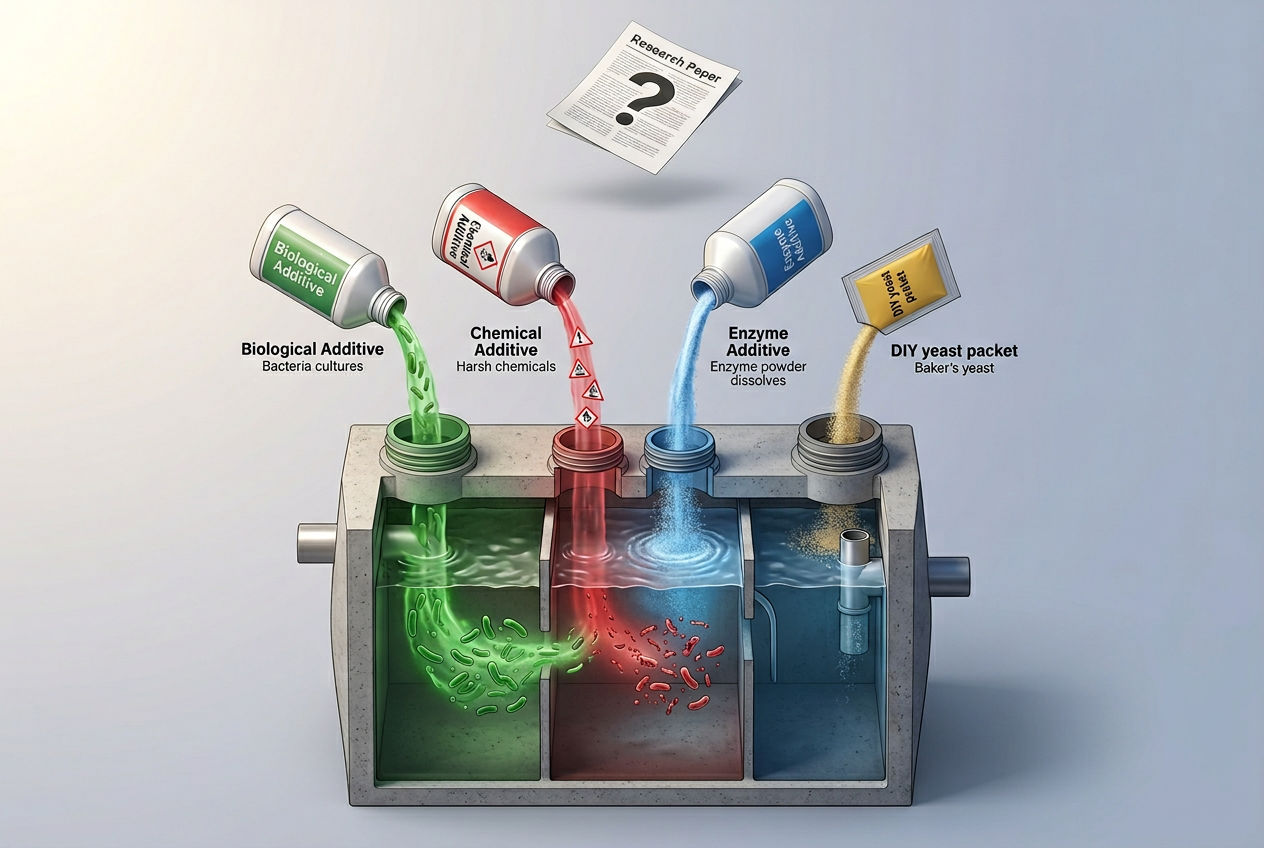
These are the most common and widely marketed. Products like RID-X contain strains of Bacillus bacteria and enzymes (amylase, protease, lipase, cellulase) intended to "boost" the tank's bacterial population.
The core problem: your tank already has those bacteria in vastly greater quantities than any packet provides. Adding a few billion bacteria to a tank that already contains trillions is like pouring a cup of water into a swimming pool to raise the level.
✅ Pro Tip: The Washington State Department of Health put it plainly — biological additives are unnecessary because human waste already introduces sufficient bacteria to maintain system function.
Do septic enzymes work? Enzymes are catalysts, not living organisms. They can help break down specific compounds temporarily, but they don't reproduce, they don't persist, and they don't change the fundamental rate at which sludge accumulates in your tank.
This category is where things go from "ineffective" to "actively dangerous." Chemical additives — including organic solvents like methylene chloride and trichloroethylene, strong acids, and high-concentration hydrogen peroxide — have been used to "unclog" sluggish systems.
Here's what actually happens: Solvents emulsify the sludge layer, breaking solids into tiny particles that can then travel with the effluent into your drain field. Your drain field isn't designed to handle solids. The biomat — the biological filter layer in your leach laterals — gets overwhelmed. The result is drain field failure, which can cost $5,000–$20,000 to repair or replace.
⚠️ Warning: The University of Arkansas Cooperative Extension published findings showing that certain chemical additives not only destroy beneficial bacteria but can leach volatile organic compounds into groundwater.
Regulatory action has followed the science. Several states have taken specific measures:
You'll see recommendations online to flush a packet of baker's yeast, toss in baking soda, or add buttermilk to "help" your septic system. These are harmless but ineffective.
Why they don't work:
They won't hurt anything. But they won't help anything either.
This is where most articles hedge. They say "studies suggest" without naming a single study. Here's what the named research actually found:
The federal standard is clear. The EPA's guidance document (EPA 832-F-00-040) and the Onsite Wastewater Treatment Systems Manual both state that septic additives are not recommended and that there is "no scientific evidence" they extend the life of a properly maintained system. The EPA's position has been consistent across multiple administrations. You can review their current guidance at EPA.gov.
One of the most rigorous field studies on this topic, the University of Minnesota Extension program monitored septic systems with and without additives over multi-year periods.
The results: Systems using additives showed no significant improvement in effluent quality compared to control systems that received no additives. Their Extension program explicitly states that additives are "not recommended."
📊 Quick Fact: The University of Minnesota is also the source of much of the EPA's cold-climate septic research — their conclusions carry significant weight in the Upper Midwest, where cold winters are sometimes cited as a reason to use biological additives.
Washington conducted one of the most comprehensive regulatory reviews of septic additives in the US.
Their findings: Biological additives are unnecessary, and some additives can cause measurable harm. Washington's registration requirement for septic additives exists precisely because the state found that manufacturers' claims frequently exceeded what evidence could support.
Kansas State researchers tested multiple commercial additives in the 1990s — research that has been cited consistently in the decades since.
The finding: No tested additive reduced sludge accumulation enough to extend pumping intervals or eliminate the need for regular pump-outs.
The NSFC, now part of WVU's research infrastructure, compiled research across multiple institutions and concluded that additives are "not necessary for the proper functioning of a septic system." Their work represents a synthesis of findings rather than a single study, which gives it broad applicability.
| Additive Type | Common Claim | What Evidence Shows | Risk Level |
|---|---|---|---|
| Biological (bacteria) | Boosts bacterial population | Redundant — tank already has sufficient bacteria | Low |
| Enzyme-based | Breaks down waste faster | Temporary effect; doesn't reduce sludge accumulation | Low |
| Chemical solvents | Clears clogs, reduces solids | Can push solids into drain field; groundwater risk | High |
| Yeast/baking soda | Supports bacterial health | No measurable benefit; harmless | Low |
| Hydrogen peroxide | Oxidizes waste, reduces odor | Can kill beneficial bacteria at high concentrations | Moderate |
Source: EPA Onsite Wastewater Treatment Systems Manual; University of Arkansas Cooperative Extension; Washington State Department of Health
Yes — specifically, chemical additives can. And the damage isn't minor.
Picture this scenario: Your system is sluggish. Drains are slow. You're worried about a backup. Someone at the hardware store recommends a chemical "super cleaner" for septic tanks. You pour it in. The solvents break up the sludge layer and it disperses into the effluent. That effluent flows out to your leach field, carrying fine particulate matter that clogs the soil pores and the biomat layer in your leach laterals.
Six months later, you're getting quotes for drain field repair or full drain field replacement, which runs $8,000–$25,000 depending on your region and soil conditions.
Chemical additives cause immediate harm:
Biological additives create delayed problems:
⚠️ Warning: If you're noticing signs your septic tank needs attention, no additive will reverse what's already happening.
One, with significant caveats.
In extreme cold-weather conditions — think Upper Midwest and northern New England, where soil temperatures drop below 40°F for extended periods — anaerobic bacterial activity genuinely slows. Research from Minnesota and Wisconsin suggests that in these conditions, a biological additive may provide a marginal short-term benefit by introducing cold-tolerant bacterial strains.
The emphasis is on "marginal" and "short-term." No study has shown this translates into:
✅ Pro Tip: In Minnesota specifically, where septic pipes freeze prevention is a real concern for homeowners, insulating your inlet pipe and maintaining regular water use does far more to protect your system than any biological additive. Physical insulation beats biological supplements every time.
One genuinely reasonable use case: if you accidentally poured bleach, used a chemical drain cleaner, or flushed a large volume of antibiotics, a one-time biological additive dose may help recolonize the bacterial population faster than natural recovery alone. This is remediation, not maintenance — and it doesn't justify ongoing additive use.
💡 Key Takeaway: Before spending money on any additive, talk to a licensed septic professional. A professional inspection will tell you more about your system's health in 30 minutes than a year of additive use ever could.
The science here is clear and unambiguous. Skip the additives aisle entirely — these three practices are the only ones backed by research.
A 1,000-gallon tank serving a 4-person household needs pumping every 3–4 years. Add a garbage disposal and that drops to every 2 years. A 1,500-gallon tank serving two people can stretch to 5–7 years. The full pumping schedule guidance depends on tank size and household size.
| Household Size | Tank Size | Pumping Frequency | Estimated Annual Cost |
|---|---|---|---|
| 1–2 people | 1,000 gal | Every 4–5 years | $60–$150/yr |
| 3–4 people | 1,000 gal | Every 3–4 years | $75–$200/yr |
| 3–4 people | 1,500 gal | Every 4–5 years | $75–$150/yr |
| 5+ people | 1,500 gal | Every 2–3 years | $100–$300/yr |
Costs based on a national average pump-out of $300–$600. See septic pumping costs by region for local pricing.
📊 Quick Fact: Even at the high end, regular pumping costs $150–$300 per year. That's less than most households spend on lawn care — and it's the single most effective thing you can do for your septic system.
The bacteria in your tank are self-sustaining — but they're not indestructible. Your tank's anaerobic bacteria digest organic waste 24/7 without any help from you. The only thing you need to do is avoid killing them.
Products that disrupt the bacterial balance:
💡 Key Takeaway: The fix isn't additives — it's avoiding products that harm your tank's natural bacteria in the first place. Your tank doesn't need more bacteria added. It needs you to stop killing the ones it already has.
Your drain field is the most expensive component of your septic system to replace — $5,000–$25,000 depending on soil type, region, and system design. Protecting it is simple but non-negotiable.
Rules that prevent expensive failures:
⚠️ Warning: By the time you see wet spots, soggy ground, or lush green strips over your leach laterals, the damage is already advanced. Drain field failure is gradual and invisible until it isn't. Annual inspections catch problems while they're still fixable.
Get professional guidance. A professional septic inspection — typically $100–$300 — will identify problems before they become failures. A septic inspector uses a sludge judge (a clear calibrated tube) to measure actual sludge depth and tell you whether you need pumping now or have another year or two. No additive packaging can tell you that.
Here's where the additive industry's math falls apart completely.
| Maintenance Strategy | Annual Cost | 10-Year Total | Actual Benefit |
|---|---|---|---|
| Monthly additives (RID-X, etc.) | $50–$150 | $500–$1,500 | None proven |
| Regular pumping (every 4 years) | $75–$150 | $600–$1,800 | System longevity maintained |
| Additives INSTEAD of pumping | $50–$150 | $500–$1,500 + $8,000–$25,000 drain field failure | System destroyed |
⚠️ Warning: The most expensive row in that table isn't the additives themselves — it's the false confidence they create. Homeowners who believe additives replace pumping are the ones who end up with catastrophic drain field failures costing 10–40x more than a single pump-out.
📊 Quick Fact: The costs of additives and pumping are nearly identical on an annual basis. The difference is that pumping actually works. Every dollar spent on additives instead of pumping is a dollar that delivers zero return and may actively accelerate system failure.
This is why the consensus exists. The EPA, every major university extension program that has studied the question, and the National Association of Wastewater Technicians (NAWT) all point homeowners toward the same answer: pump regularly, watch what goes into your tank, and skip the additives.
Compare top-rated companies in your area. Get free, no-obligation quotes from verified providers.
Was this article helpful?
Connect with licensed, verified septic companies in your area.
Get estimates from licensed, verified companies in your area. No obligation.
⚡ Average response time: under 2 hours