
Bought a home with undisclosed septic problems? Learn your legal options, how to prove the seller knew, state disclosure laws, and steps to recover repair costs.
Quick Answer
If a seller didn't disclose septic problems, you likely have legal recourse — including a demand for repair costs, a negotiated settlement, or a lawsuit for fraudulent concealment. Your specific options depend on your state's real estate disclosure laws, what the seller knew, and how much time has passed since closing.
💡 Key Takeaways:
- All 50 states have some form of property disclosure requirement, but protections vary dramatically by state.
- A failing septic system is a material defect — sellers are legally obligated to disclose known material defects in most states.
- "As-is" sales do not automatically shield sellers from liability for fraud or deliberate concealment.
- Replacing a septic system costs $15,000–$30,000 nationally — that's the financial stake driving most lawsuits.
- The statute of limitations to file a claim is typically 1–6 years depending on your state. Act fast.
In most states, sellers must disclose any known material defect — a condition that would significantly affect the property's value or a buyer's decision to purchase. A failing septic system absolutely qualifies. We're talking about a system that could cost $15,000–$50,000 to replace, depending on the site conditions and system type.
The legal document at the center of every non-disclosure dispute is the property disclosure statement. In states like Ohio, Michigan, California, and Texas, sellers complete a detailed form that asks directly about the condition of the septic system. Texas uses the TAR (Texas Association of Realtors) Seller's Disclosure Notice, which includes a specific checkbox for known septic defects. Ohio's residential property disclosure form, governed by ORC § 5302.30, requires disclosure of any known condition affecting the sewage system.
Not every state is that specific. Alabama and Wyoming follow stronger caveat emptor ("buyer beware") principles, placing more responsibility on buyers to investigate before purchase. But even in caveat emptor states, deliberate concealment is typically still actionable as fraud.
📊 Quick Fact: Disclosure requirements vary so dramatically that buyers in Massachusetts get a mandatory Title 5 inspection before sale, while buyers in Alabama may receive no formal disclosure at all. Knowing your state's rules before closing is essential.
When a seller didn't disclose septic problems and you discover the failure after closing, the legal analysis turns on two questions: did the seller know, and did they have a legal duty to tell you? In most states, the answer to both is yes — and that gap between what they knew and what they said forms the foundation of your claim.
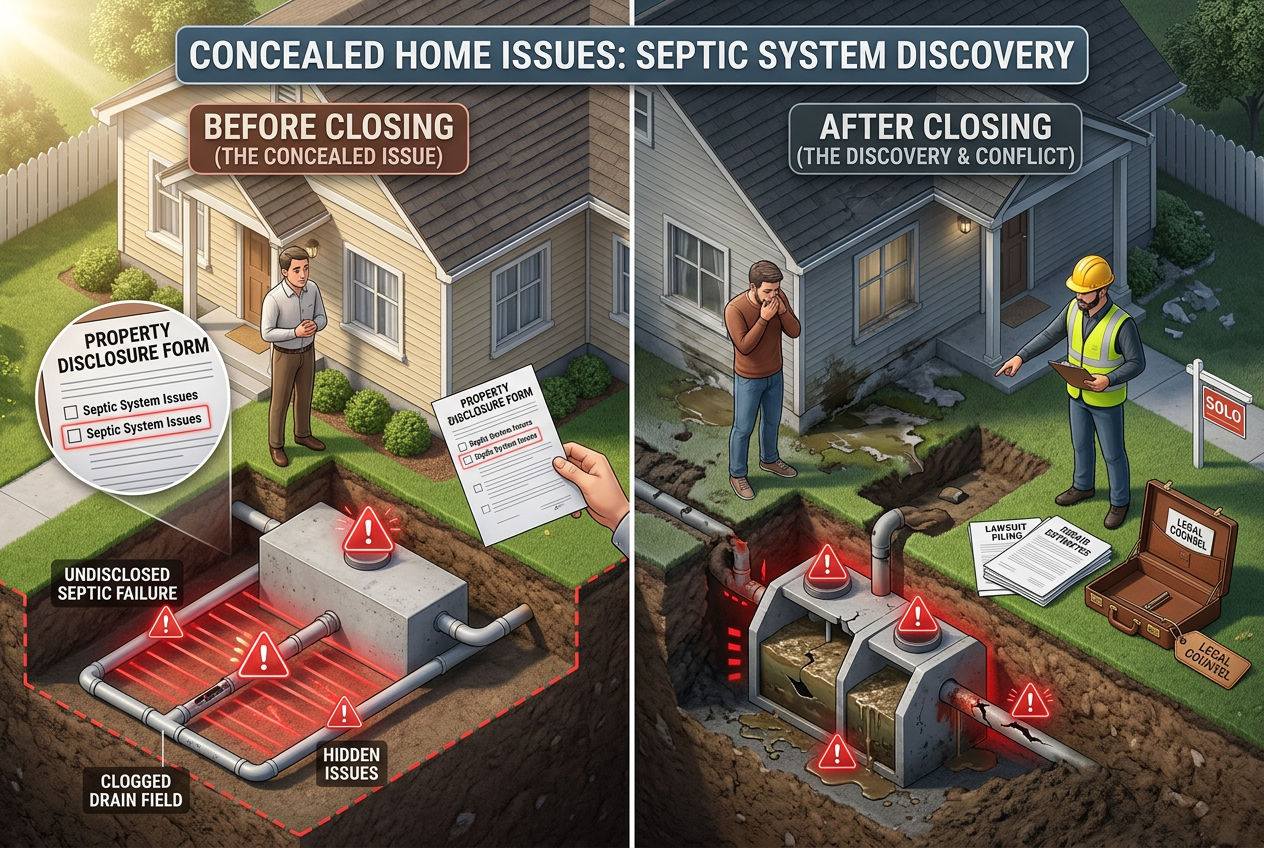
The practical fallout hits fast. Septic failures can render a home uninhabitable within days of discovery. Raw sewage backing up into a basement or surfacing in a yard isn't just a health hazard — it's a code violation that can trigger county enforcement action and prevent you from occupying the property. That urgency is exactly why courts treat undisclosed septic defects seriously, and why buyers who find themselves in this situation need to act on multiple fronts simultaneously: document the failure, get a professional assessment, and consult a real estate attorney before the statute of limitations clock runs down.
The legal theories available to you when a seller didn't disclose septic problems — negligent misrepresentation, fraudulent misrepresentation, and fraudulent concealment — each carry different burdens of proof and different potential recoveries. Understanding which one fits your facts is the first conversation to have with your attorney.
💡 Key Takeaway: Don't wait to consult a real estate attorney. Many offer free initial consultations for non-disclosure cases, and early legal guidance shapes every decision that follows — from how you document the failure to whether you repair before filing suit.
This is the question that trips up the most buyers. The short answer: no, not automatically.
An "as-is" clause means you agreed to buy the property in its current condition. It does not mean the seller can lie on the disclosure form or hide a known problem. Courts in most states have consistently held that fraudulent concealment voids the protection of an as-is sale.
If a seller had their 1,000-gallon concrete tank pumped six months before listing, received a report saying the drain field was saturated, and then checked "no known issues" on the disclosure form — that's not a buyer-beware situation. That's fraud.
Think of it this way: as-is protects sellers from buyers who discover normal wear and tear. It doesn't protect sellers from buyers who discover they were lied to.
⚠️ Important: Even in states with strong caveat emptor traditions, deliberately hiding a known septic defect from a buyer crosses the line from "buyer beware" into actionable fraud. An as-is clause is not a license to lie.
The distinction between a latent defect and a patent defect matters here. A patent defect is something a reasonable buyer could have spotted during a normal inspection — a cracked tank lid, for example. A latent defect is hidden and not discoverable through ordinary observation — like a drain field that looks fine from the surface but has been failing for two years underground. Sellers have a stronger legal duty to disclose latent defects precisely because buyers can't discover them on their own.
This is where most cases get won or lost. You need to show the seller had actual or constructive knowledge of the defect. Here's what to look for:
Pump-out records. Septic companies log service visits. If the seller had the system pumped every year instead of the EPA-recommended every 3–5 years, that's a red flag suggesting they knew something was wrong. Request these records through discovery if you file suit.
County health department complaints. Many counties maintain records of sewage complaints, code violations, and failed inspections. A prior complaint from a neighbor about sewage surfacing on the property is powerful evidence.
Permit history. Check with your county for any permits pulled for septic repairs or drain field work. An unpermitted repair — a seller quietly rerouting a distribution box, for example — is both evidence of prior knowledge and a separate code violation.
Prior inspection reports. If the seller had a pre-listing inspection done, that report is typically discoverable. Massachusetts requires a Title 5 inspection before any property transfer — those reports become public record and directly document system condition at time of sale.
Neighbor testimony. Longtime neighbors sometimes know things about a property that no document will show. A neighbor who watched a septic repair crew work on the drain field two summers ago is a credible witness.
Real estate agent communications. Emails, texts, or MLS notes can sometimes reveal what the seller told their agent about the system.
Your own inspector's findings. If you had a pre-purchase septic inspection and the inspector flagged concerns that the seller then dismissed or misrepresented, document that exchange immediately.
✅ Pro Tip: Request septic pump-out records through your county health department and directly from local septic companies. These records are often the single strongest piece of evidence — they show the seller interacted with the system and received professional assessments of its condition.
You have four main paths, roughly in order of escalation:
Before anything else, send a formal demand letter to the seller — ideally through a real estate attorney. This letter outlines the defect, the evidence that the seller knew, the cost to repair, and a demand for compensation. Many cases resolve here, especially when the evidence is strong. A demand letter costs far less than litigation.
Many real estate contracts include a mediation clause requiring both parties to attempt mediation before filing suit. Mediation is confidential, faster than court, and often produces a settlement. A mediator who specializes in real estate disputes will understand both the legal and technical dimensions of a septic failure.
If the seller didn't disclose septic problems and concealed what they knew, you can sue for:
These are separate legal theories, and which one applies depends on what you can prove. Cases involving a failed septic inspection discovered post-closing often hinge on the timeline — when did the seller first know, and what did they disclose?
According to data from the National Association of Realtors, disclosure disputes are consistently among the top three post-closing legal claims against home sellers. A properly documented septic failure with a $20,000–$40,000 repair bill gives you enough at stake to make litigation economically rational.
📊 Quick Fact: Septic system replacement costs $15,000–$30,000 nationally, with engineered systems on difficult sites exceeding $50,000. These figures make non-disclosure lawsuits economically viable — and give sellers a strong incentive to settle before trial.
In egregious fraud cases, courts can order rescission — essentially unwinding the entire transaction. You return the house; the seller returns your money. Rescission is a high bar and is usually reserved for cases involving deliberate, provable fraud. But it does happen, and it's worth asking your attorney whether the facts of your case support it.
The most common recovery is the cost to repair or replace the system. A conventional septic system replacement runs $15,000–$30,000 in most markets. A mound system or an engineered system for a difficult site can exceed $50,000. Drain field replacement alone typically costs $5,000–$20,000, depending on soil conditions and system size.
Beyond repair costs, courts sometimes award:
✅ Pro Tip: Keep every receipt related to the septic failure — temporary housing, hotel stays, portable toilet rentals, water damage cleanup, and emergency pumping. Courts can award these incidental costs on top of the repair bill, but only if you can document them.
Disclosure requirements vary significantly. Here's a quick reference:
| State | Disclosure Strength | Key Notes |
|---|---|---|
| Massachusetts | Very Strong | Title 5 inspection required before sale; report becomes public record |
| California | Strong | TDS form covers all known defects; broad seller liability |
| Ohio | Strong | ORC § 5302.30 requires detailed sewage system disclosure |
| Texas | Strong | TAR Seller's Disclosure Notice; specific septic checkbox |
| Florida | Moderate–Strong | Johnson v. Davis standard; known latent defects must be disclosed |
| Alabama | Weak | Strong caveat emptor tradition; fraud still actionable |
| Wyoming | Weak | Limited mandatory disclosure; buyer investigation expected |
Sources: State statutes and real estate commission disclosure forms; Florida Supreme Court, Johnson v. Davis (1985)
Time is not your friend here. Miss the deadline, and even the strongest case is dead.
Statutes of limitations for real estate non-disclosure claims typically range from 1 year (Louisiana) to 6 years (Maine and several other states), with most states landing at 2–4 years. But the clock doesn't always start at closing — in many states, it starts when you discovered or reasonably should have discovered the defect. This is called the discovery rule, and it's critically important for septic cases where the failure may not become apparent until months or years after purchase.
Here's a practical state-by-state breakdown for the most common scenarios:
| State | Limitations Period | Clock Starts |
|---|---|---|
| California | 3 years (fraud) | Discovery |
| Florida | 4 years | Discovery |
| Texas | 4 years | Discovery or closing |
| Ohio | 4 years | Discovery |
| Massachusetts | 3 years | Discovery |
| New York | 6 years (contract) / 3 years (fraud) | Closing or discovery |
| Louisiana | 1 year | Discovery |
| Maine | 6 years | Closing |
Even if you believe you're within the window, consult an attorney immediately. Some states have absolute bars — called statutes of repose — that cut off claims regardless of when you discovered the problem. In a handful of states, if more than 10 years have passed since construction or sale, no claim can proceed even if fraud is proven.
⚠️ Warning: Statutes of limitations are strict deadlines — miss yours by even one day and your case is permanently barred, no matter how strong the evidence. If you suspect undisclosed septic problems, consult an attorney now rather than waiting to see if the issue gets worse.
If you've just discovered a septic failure that you believe should have been disclosed, your first 72 hours matter enormously. Here's the sequence:
Step 1: Document everything with photos and video. Photograph sewage surfacing, wet spots over the drain field, backup in fixtures, and any visible system components. Timestamped video is even better. Do this before any cleanup or repair work disturbs the evidence.
Step 2: Get a professional septic inspection. A licensed septic inspector or engineer can assess the system condition and provide a written report. Expect to pay $300–$600 for a standard inspection, more for a full engineered assessment. This report is your primary technical evidence.
Step 3: Request historical records. Contact your county health department for complaint records, inspection history, and permit records associated with the property address. Many counties allow public records requests online.
Step 4: Get repair estimates. Obtain written estimates from at least two or three licensed septic contractors. These estimates establish your damages concretely and are essential for any demand letter or litigation.
Step 5: Preserve all communications. Save every email, text, and document related to your purchase — the disclosure form, your inspector's report, any communications with the seller or their agent about the septic system. Print and back up digital records.
Step 6: Consult a real estate attorney. Do this before you contact the seller, before you repair the system if at all possible, and certainly before the statute of limitations runs. Many real estate attorneys offer free initial consultations for non-disclosure cases.
📋 Pro Tip: Your first 72 hours after discovering a septic failure are critical for building a strong case. Prioritize photographic and video evidence before any cleanup or repair work disturbs the scene — this documentation becomes your strongest asset in any legal proceeding.
Compare top-rated companies in your area. Get free, no-obligation quotes from verified providers.
Was this article helpful?
Connect with licensed, verified septic companies in your area.
Get estimates from licensed, verified companies in your area. No obligation.
⚡ Average response time: under 2 hours